
Lab-Grown Diamonds: The Complete Guide
A lab-grown diamond is a diamond, formed by people rather than by geological processes. It is grown from a diamond seed inside controlled laboratory equipment, then cut and polished into the same shapes sold for natural diamonds. Its chemical composition, crystal structure, and optical and physical behavior are essentially identical to those of a natural diamond, which is why laboratory-grown stones are graded, set, and worn in the same way. This pillar guide is the hub of Belaroq's diamond education library. It defines the lab-grown diamond, explains how it is made, compares it with natural diamonds, and walks through the 4Cs, shapes, settings, prices, and certification before you buy, with links to the deeper guides.
A laboratory-grown diamond is a diamond, not a look-alike.
It is carbon crystallized into the diamond structure using controlled laboratory equipment, which gives it the same essential chemistry, crystal structure, and optical and physical properties as a natural diamond, an origin that must be disclosed, and a place in the same grading and setting tradition as any other diamond.
Lab-grown diamonds at a glance
- A diamond is a crystal of carbon atoms arranged in a repeating diamond structure; laboratory-grown and natural stones share that structure and are both graded and set in the same way.
- Natural diamonds formed deep in the Earth over hundreds of millions to billions of years, while laboratory-grown diamonds are produced in controlled chambers over days to weeks.
- Laboratory-grown and natural diamonds share essentially the same chemical, optical, and physical properties, including hardness, brilliance, fire, and resistance to scratching.
- A laboratory-grown diamond is not a simulant; cubic zirconia and moissanite are different materials chosen to resemble diamond in appearance.
- In the United States and many other markets, sellers must disclose laboratory origin clearly enough for ordinary consumers, and laboratory-grown stones may not be described as natural or mined.
- IGI is a widely used issuer of laboratory-grown diamond grading reports, applying familiar 4C-based color and clarity grades to laboratory-grown stones.
- GIA grades eligible D-to-Z laboratory-grown diamonds and has issued Premium and Standard reports for them since October 1, 2025.
- A grading report may cover a loose stone or a mounted piece, and smaller accent diamonds may be documented at jewelry level, so buyers should check the report's stated scope.
What is a lab-grown diamond?
A lab-grown diamond is a diamond that was grown by people in specialized equipment instead of forming deep inside the Earth, and like any diamond its quality is described through independent diamond certification. It starts as a tiny diamond seed, and carbon is added under controlled laboratory conditions until a larger crystal forms. The finished stone is chemically the same material as a natural diamond: carbon atoms locked into the diamond crystal structure. That shared chemistry and structure are what give a laboratory-grown diamond the hardness, brilliance, and sparkle buyers associate with diamond, and why it is never correct to call these stones 'fake' or compare them with glass.
An important distinction follows. A simulant such as cubic zirconia or moissanite is a different material that only resembles diamond; a laboratory-grown diamond is diamond. Because the two origins look alike to the unaided eye, sellers must state laboratory origin clearly, and buyers should look for disclosure in the product name and support it with a grading report where one is issued. In markets that follow the United States Federal Trade Commission's guidance, laboratory-grown stones must not be described as natural, mined, or genuine, and clear retail disclosure is expected. Grading then follows the same 4C vocabulary used for natural diamonds, applied to the laboratory-grown stone by the issuing laboratory.
- It is carbon crystallized in the diamond structure, not a substitute material.
- It is grown from a diamond seed in a laboratory, then cut and polished like any diamond.
- Its laboratory origin is disclosed in the product name and supported by a report where one is issued.
- It is graded on the same 4C scales as natural diamonds, using the issuing laboratory's terms.
- It is not moissanite or cubic zirconia; those simulants are different materials.
- Its origin is confirmed by gemological testing and documentation, not by appearance alone.
- Its quality still varies stone by stone, exactly as it does among natural diamonds.
How are lab-grown diamonds made?
All laboratory-grown diamonds start with a seed: a small piece of diamond. Around that seed, technicians recreate the conditions under which carbon crystallizes into diamond, and the crystal grows atom by atom. There are two established methods. High pressure, high temperature growth, called HPHT, places the seed in a press where intense heat and pressure dissolve carbon in a metallic flux so it crystallizes onto the seed. Chemical vapor deposition, called CVD, holds seed plates in a heated chamber and feeds in carbon-rich gas; energy from a plasma breaks the gas apart and carbon deposits on the seeds layer by layer.
Either process can take days to weeks and produces a rough crystal, not a finished gem. The rough is then planned, cleaved or laser cut, and polished by a diamond cutter into one of the familiar shapes, such as a round brilliant. Because both HPHT and CVD grow genuine diamond material, neither method is automatically better; the quality of the finished stone depends on the rough, the cutting decisions, and the polish, which is why buyers compare the cut, color, clarity, and dimensions of the polished diamond rather than choosing a method by name.
- Both methods start from a diamond seed and add carbon to grow the crystal.
- Growth produces rough, which a cutter then plans, cuts, and polishes into a finished stone.
- A grading report may state the growth method and any post-growth treatment separately.
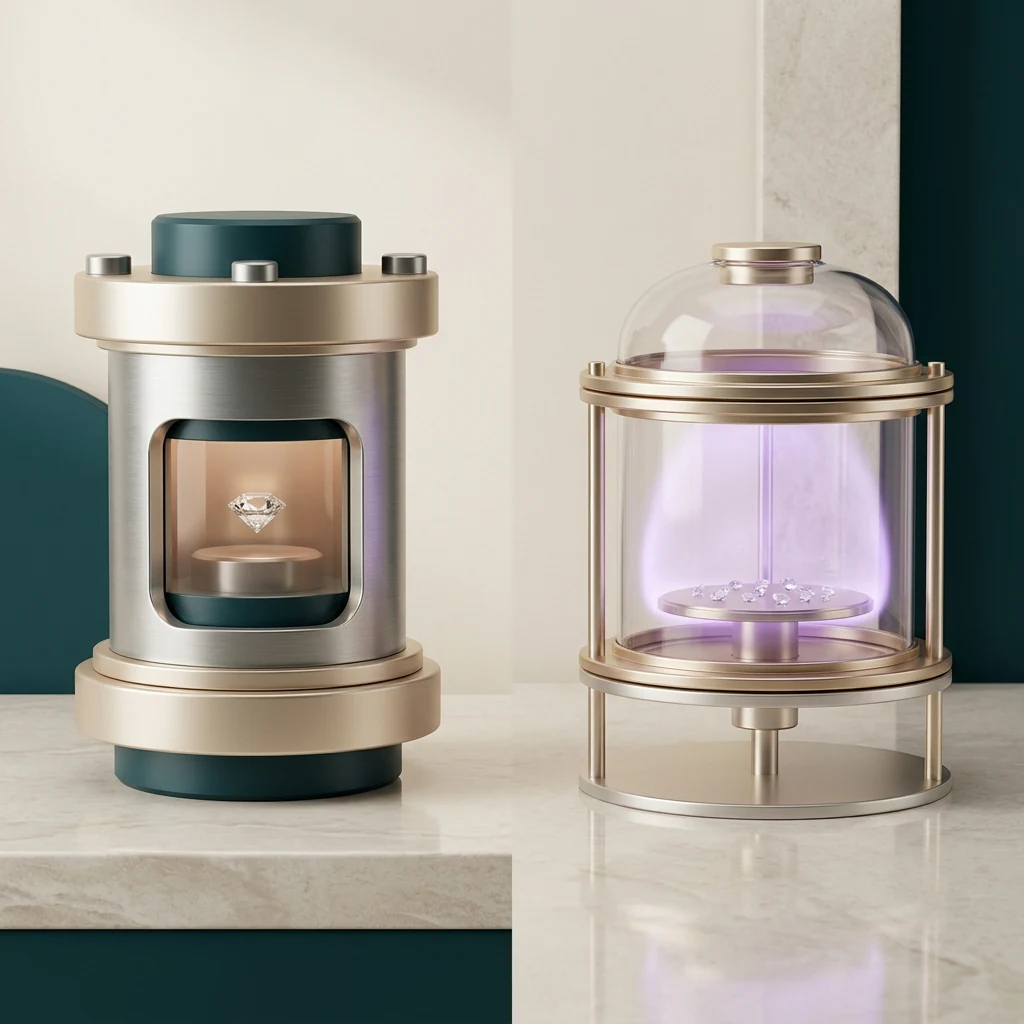
| HPHT | CVD | |
|---|---|---|
| Full name | High pressure, high temperature | Chemical vapor deposition |
| Growth environment | A press with very high heat and pressure | A heated chamber containing energy-activated carbon-rich gas |
| How carbon reaches the seed | Carbon dissolves in a metallic flux and crystallizes on the seed | Carbon deposits on the seed plates layer by layer from the activated gas |
| Typical growth time | Days to weeks | Days to weeks |
| Does the method guarantee quality? | No; the cut, color, clarity, and finish of the polished stone matter | No; the cut, color, clarity, and finish of the polished stone matter |
Growth method and post-growth treatment are separate facts, and a grading report may disclose either or both.
Lab-grown vs natural diamonds
Laboratory-grown and natural diamonds are the same material with different histories, the heart of any lab-grown vs natural diamonds comparison. A natural diamond formed in the Earth's mantle under geological heat and pressure, and most natural diamonds took hundreds of millions to billions of years to form before being carried toward the surface. A laboratory-grown diamond formed in a machine over days to weeks. After growth, both are cut, polished, graded, and set in jewelry, and both are worn and cared for in the same way. The difference is origin and the facts that follow from it: supply, documentation, and how each is described.
Price is where buyers notice the difference most. Laboratory-grown diamonds are typically sold at lower retail prices than natural diamonds with comparable stated characteristics, because laboratory production is a repeatable manufacturing process rather than a geological find. The comparison is not fixed or universal; it changes with quality, size, market conditions, and the seller. Rarity also differs. Natural diamonds are limited by what the Earth produced, while laboratory capacity can expand, which is why resale markets treat the two differently and why buyers should not treat either as an investment promise.
- Same material: crystallized carbon in the diamond structure.
- Different origin: geological formation versus controlled laboratory manufacture.
- Different typical retail price position, without any fixed percentage or guarantee.
- Different rarity and resale context, with no guaranteed resale value for either stone type.
- Same 4Cs: cut, color, clarity, and carat apply to both, on the issuing laboratory's terms.
- Same care: both are durable diamond and follow the same cleaning and setting advice.
| Dimension | Natural diamond | Laboratory-grown diamond |
|---|---|---|
| Origin | Formed in the Earth and brought to the surface through geological processes | Grown from a diamond seed in controlled laboratory equipment |
| Typical formation time | Hundreds of millions to billions of years | Days to weeks in a growth chamber |
| Retail price position | Generally higher for comparable stated characteristics, varying with quality and market | Generally lower for comparable stated characteristics, varying with quality and market |
| Rarity | Limited by geological supply | Repeatable manufacturing with expandable capacity |
| Disclosure expectation | Sold and described as natural diamond | Must be disclosed as laboratory-grown and never described as natural |
This table summarizes origin facts, not resale guarantees. Neither stone type carries a guaranteed resale value.
The 4Cs for lab-grown diamonds
Carat, cut, color, and clarity are the four standard dimensions used to describe any diamond, natural or laboratory-grown. Carat is a unit of weight, not visual size, so two one-carat diamonds can face up differently depending on dimensions and proportions. Cut describes how well the stone's proportions and finish return light; it is the factor most under human control. Color grades on the D-to-Z color scale describe the presence or absence of noticeable body color, and clarity describes internal and external characteristics viewed under magnification by trained graders. Laboratory-grown stones span the same ranges as natural ones, from colorless to warm and from clean to included, so the 4Cs are just as useful here.
Grading terminology matters because laboratory-grown stones are graded by gemological laboratories, not by the seller's own adjectives. IGI reports apply the familiar 4C grades, including the clarity scale and color scale, to laboratory-grown diamonds, and IGI is the standard documentation path for many sellers, including Belaroq. GIA also grades eligible D-to-Z laboratory-grown diamonds, issuing Premium and Standard reports since October 1, 2025. Because each issuer defines its own grades and report scope, buyers should check which laboratory issued the report and read that issuer's definitions rather than assuming grades translate across laboratories or between one report type and another. When a piece holds several stones, note whether grades describe the center stone or the jewelry as a whole.
| C | What it measures | Practical note |
|---|---|---|
| Carat weight | The stone's weight; one carat equals 0.2 grams | Compare carat with millimeter measurements, and check whether a piece's weight is center-stone or total carat weight |
| Cut | Proportions, symmetry, and polish, and how the stone returns light | Cut drives brilliance; a well-cut stone can appear livelier and larger than a poorly cut stone of the same weight |
| Color | Presence of noticeable body color on the issuing laboratory's scale | Near-colorless and colorless grades are popular; compare stones on the same laboratory's scale |
| Clarity | Internal and external characteristics viewed under magnification | Many stones are eye-clean even when magnification reveals inclusions; view the stone or photos when possible |
The issuing laboratory defines each grade. Read the report to see which scale and terms apply to the stone you are considering.
Popular shapes and settings
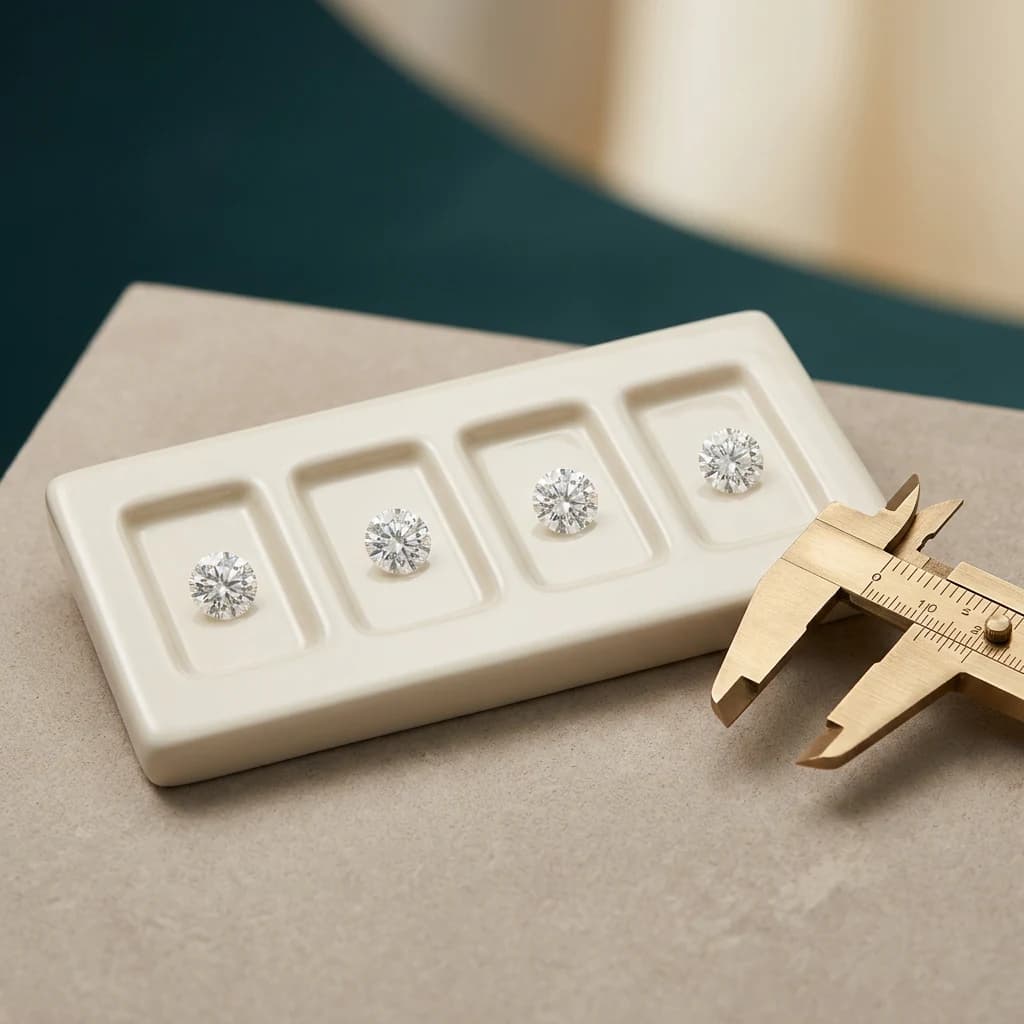
Shape describes the face-up outline of a polished diamond. The round brilliant is the most popular because its facet pattern is engineered for brightness, but fancy shapes offer distinct looks. Princess cut is a square shape with sharp corners and strong brilliance. Cushion cut has rounded corners and a soft, vintage feel. Emerald cut uses long, step-like facets that emphasize clarity and an elegant hall-of-mirrors look rather than heavy sparkle. Oval combines an elongated outline with brilliant-style faceting and can make a center stone appear larger for its weight, while pear and marquise offer pointed, dramatic alternatives; see the shape-by-shape rundown for a side-by-side comparison.
The setting is the metal framework that holds the stone. A solitaire places a single center diamond on a plain band, keeping attention on the stone. A halo surrounds the center with small accent diamonds, adding visual presence. Pavé lines the band with tiny stones for continuous sparkle, while a bezel encircles the diamond in a metal rim, offering protection and a modern, low-profile look. Shape and setting interact, as the setting guide shows: an emerald cut suits a clean solitaire or bezel, while a cushion reads well in a halo. Belaroq's made-to-order pieces pair a chosen shape with the matching setting. Choose the style that matches how the ring will be worn every day.
- Round brilliant: the most popular cut, engineered for brightness and versatility.
- Princess: a square, sharp-cornered outline with strong brilliance.
- Cushion: rounded corners and a soft, vintage-leaning profile.
- Emerald: long step facets and an elegant mirror effect instead of heavy sparkle.
- Oval: an elongated brilliant cut that reads larger for its carat weight.
- Pear and marquise: elongated, pointed outlines with a dramatic, flattering line.
Lab-grown diamond prices
Understanding how lab-grown prices work starts with several visible factors. The stone contributes through carat weight, cut, color, clarity, shape, and the issuing laboratory's report. The design contributes through the setting style, accent stones, total carat weight, and metal. A solitaire with a smaller, well-cut center stone can cost less than a halo piece with a larger center plus accents, even when both are described as 'one carat,' because the first measures the center stone and the second may total all stones. Reading the specification, not the headline, is the buyer's first pricing tool.
Belaroq keeps entry into laboratory-grown diamond jewelry deliberate and documented. Pieces in the jewelry under $500 collection start at or below $500; a real laboratory-grown diamond piece is accessible without undisclosed quality claims. Custom pieces follow the made-to-order path and typically take about 30 days from confirmed specification to completion, with ready inventory shipping faster, within about 14 days. Prices on the site reflect the configured stone, metal, and setting at the time of order; buyers should compare the total configured price, not a headline figure, and should not rely on invented market statistics. The production path and included documentation are part of total value, so compare them with the price.
- The stone: carat weight, cut, color, clarity, shape, and the issuing laboratory's report.
- The design: setting style, accent stones, total carat weight, metal, and workmanship.
- The production path: ready inventory ships faster, while made-to-order pieces take about 30 days.
- The documentation: report type and issuer are part of what the price includes.
- The comparison basis: compare the total configured price, never a loose-stone headline.
- The honest limit: Belaroq states its own anchors and does not repeat invented market statistics.
Certification and reports
At Belaroq, the standard documentation path for laboratory-grown diamond jewelry is an IGI grading report, a widely used issuer for laboratory-grown stones. The report describes the submitted stone or piece, typically including shape, measurements, carat weight, color, clarity, cut information, and growth method where applicable, along with a report number. GIA documentation is available on request, subject to service review, for buyers who prefer it. Every Belaroq order should state exactly which documentation is included before ordering. For pieces with small accent stones, documentation may be issued at jewelry level rather than as a separate report for every stone.
A report is a record, not an appraisal. It records what the laboratory observed about the item examined under its procedures; it does not set a price, promise resale value, or serve as a warranty. Buyers can verify a report by entering its number on the issuing laboratory's official website and matching the stone's inscribed number, measurements, and description to the piece in hand. For mounted jewelry, note whether the report covers the mounted item or the loose center stone, because the scope of grading differs between the two. That scope note is part of the record, not a defect.
- Confirm which laboratory issued the report and whether it covers a loose stone or mounted jewelry.
- Enter the report number on the issuer's official website to verify it.
- Match the inscribed number, measurements, and description to the piece in hand.
- Keep the report with the order record; it documents findings, not a price promise.
- Read the scope note: some mounted-jewelry reports describe the center stone only.
Editorial illustration created for Belaroq with Gemini 3.1 Flash Image via APIYi.
Lab-grown diamond questions, answered
Concise answers to the questions buyers ask most about laboratory-grown diamonds.
Are lab-grown diamonds real?
Yes, in the material sense. A laboratory-grown diamond is crystallized carbon with the same essential chemical, optical, and physical properties as a natural diamond. Because most shoppers hear the word real as meaning natural, the United States Federal Trade Commission expects sellers not to describe laboratory-grown stones as real, genuine, or natural without clear qualification. Check the product name and the grading report for clear laboratory-grown wording.
Do lab-grown diamonds test as real diamonds?
Basic handheld testers respond to diamond's thermal or electrical behavior, so a laboratory-grown diamond can register as diamond on many instruments. That result confirms diamond material, not origin. Identifying laboratory growth can require spectroscopy, fluorescence imaging, and other advanced methods used by qualified gemological laboratories, which is why the grading report matters more than any single tester result. If origin matters, ask which laboratory documentation accompanies the stone.
How are lab-grown diamonds made?
Growth starts with a small diamond seed. In HPHT growth, intense heat and pressure dissolve carbon in a metallic flux so it crystallizes on the seed. In CVD growth, energy-activated carbon-rich gas deposits carbon onto seed plates layer by layer. Whichever method is used, the rough crystal is then planned, cut, and polished into a finished diamond.
What is the difference between CVD and HPHT?
Both grow diamond from a seed; the difference is the environment. HPHT uses very high pressure and temperature inside a press, while CVD uses a heated chamber with energy-activated carbon-rich gas. Post-growth treatment is a separate consideration on either path. Neither method is automatically better; judge the polished stone's cut, color, clarity, and documented specification instead. Read the report for treatment disclosure, which is recorded separately from the method.
Are lab-grown diamonds cheaper than natural diamonds?
Typically yes at retail, when comparing stones with broadly similar stated characteristics, because laboratory growth is a repeatable manufacturing process rather than a geological find. The gap is not fixed; it varies with quality, size, market conditions, and the seller. Compare the total configured price of the finished piece, never a loose-stone headline or a historical percentage. At Belaroq, entry pieces in the jewelry-under-500 collection start at or below $500.
Is a lab-grown diamond a real diamond?
It is genuine diamond material: carbon crystallized in the diamond structure. The word real is the problem, because consumers commonly understand it to mean natural. For that reason, United States Federal Trade Commission guidance expects sellers to say laboratory-grown diamond and to avoid describing the stone as real, genuine, or natural.
How long do lab-grown diamonds last?
Diamond is exceptionally hard and chemically stable, and laboratory-grown stones are no different from natural ones in that respect. A properly set and cared-for laboratory-grown diamond should last indefinitely as a gem. Durability depends on the whole piece: setting security, prong condition, metal choice, and avoiding hard impacts on vulnerable points such as corners.
Do lab-grown diamonds hold their value?
There is no guaranteed resale value for any diamond purchase, and laboratory-grown stones are no exception. Secondary-market prices are shaped by supply, condition, design, metal value, and buyer policies rather than by a grading report. A report records characteristics; it is not an appraisal or an investment promise. Buy for the design and the documented specification. Resale is a market question, not a certificate question.
Are lab-grown diamonds good for engagement rings?
Yes. The material is diamond, with diamond's hardness and sparkle, so it performs the same role in an engagement ring as a natural stone. What matters is the same as with any ring: the documented stone, a secure setting matched to everyday wear, and clear disclosure and documentation. Belaroq's made-to-order engagement rings pair laboratory-grown centers with the selected setting and report.
What does lab-grown diamond certification include?
It depends on the issuing laboratory and whether the stone is loose or mounted. A typical IGI laboratory-grown diamond report covers shape, measurements, carat weight, color, clarity, cut information, growth method, and an inscription with a verifiable report number. Check the report's stated scope, and verify the number on the issuer's official website. The same verification applies to any issuer.
The practical takeaway
The practical takeaway: laboratory-grown diamonds are diamond material with a disclosed, manufactured origin. They are grown by HPHT or CVD, cut like any diamond, graded on the same 4Cs by gemological laboratories, and documented with IGI as Belaroq's standard path and GIA on request. Buyers make the best decisions when they compare documented stones and configured prices, verify report numbers with the issuing laboratory, and measure every claim against the written specification. That written record is the buyer's protection, and it costs nothing to ask for it before ordering.