
Lab-Grown Diamond Prices: What to Expect in 2026
Lab-grown diamond prices vary widely because a diamond is never bought by carat alone. Color, clarity, cut and carat — the 4Cs — plus shape, grading report, metal and setting all move the number on the page. This guide explains how the pricing works, how price per carat behaves, how lab-grown pricing compares with natural diamonds, and how to compare listings fairly. The goal is not a single market price, but a reliable way to read one.
Lab-grown diamond prices vary widely with the 4Cs, shape, report and setting — compare complete like-for-like specifications.
A finished piece's price reflects its full specification, so the only fair comparison matches carat, cut, color, clarity, shape, report and setting side by side on current listings.
Pricing at a glance
- Price is driven by the 4Cs plus the complete piece: shape, report, metal and setting.
- Price per carat rises as carat weight rises, because larger lab-grown stones are rarer to produce.
- Total carat weight (TCW) of a piece is not the same as center-stone carat weight.
- Lab-grown diamonds are typically positioned well below comparable natural diamonds.
- At Belaroq, the displayed VVS price is 30% above the same product's VS price (July 2026 snapshot).
- Belaroq's jewelry-under-500 collection offers complete starter pieces at or below US$500.
- Prices change; the product page is the final reference for any current price.
What drives lab-grown diamond prices?
A lab-grown diamond's price is the price of a specification, not a loose-stone commodity quote. Carat weight sets the scale, while cut, clarity and a stone's position on the color chart refine it. Shape changes the rough material and cutting choices, and the grading report documents what was produced. Because Belaroq sells finished, made-to-order jewelry, metal, setting style and the work of assembling the piece are also part of the displayed price. Two identical carat weights can therefore sit at very different price points.
The practical effect is that budgeting has to be done on the complete piece, not on the stone alone. A buyer who fixes only carat may overpay for grades they cannot see, or miss a setting difference that changes comfort and durability. Reading every specification line — carat, cut, color, diamond clarity, report and mounting — is what turns a headline number into a comparison that holds on a product page.
- Carat — the stone's weight, the largest single driver at equal grades
- Color — grade position on the D-to-Z scale moves the price
- Clarity — VS, VVS and neighboring categories price differently
- Cut and shape — proportions and shape affect yield and light return
- Report — an IGI or GIA report documents the stone's grades
- Setting and metal — the mounting and its metal are part of the piece price
Price per carat: how the math works
Carat is a unit of weight — 0.2 grams — not a measure of face-up size. Price per carat is simply the total price divided by carat weight, and it is not a flat rate: the per-carat figure rises as carat weight rises, because larger lab-grown stones are harder to produce and far fewer come out of each growth run. A stone double the weight is not double the per-carat price.
A related trap is confusing total carat weight (TCW) with center-stone carat. A tennis bracelet's TCW may spread across dozens of small stones, while a solitaire's carat refers to one center stone — the same number can mean very different value. Comparing lab-grown diamond prices per carat across different specifications, or across TCW and center carat, produces a number with no meaning. The only number worth quoting is one built from identical specifications.
Typical price picture (as of September 2026)
There is no single market price for lab-grown diamonds, and any fixed number quoted today can be stale tomorrow. What a buyer can rely on is structure: complete starter pieces exist at entry prices, and as center-stone carat and grades rise, the total rises too — with the specific 4Cs, shape, report and setting doing the work. The table below describes the shape of the market in careful, qualitative terms rather than fabricated ranges.
For concrete numbers, stay with what can be verified. The most reliable published anchor is Belaroq's own catalog. The jewelry-under-500 collection offers complete starter pieces at or below US$500, and every product page displays the price of the exact specification shown. For any other piece, the honest answer is the same: check the current listing, because that is where the real price lives, updated for the piece you are actually considering.
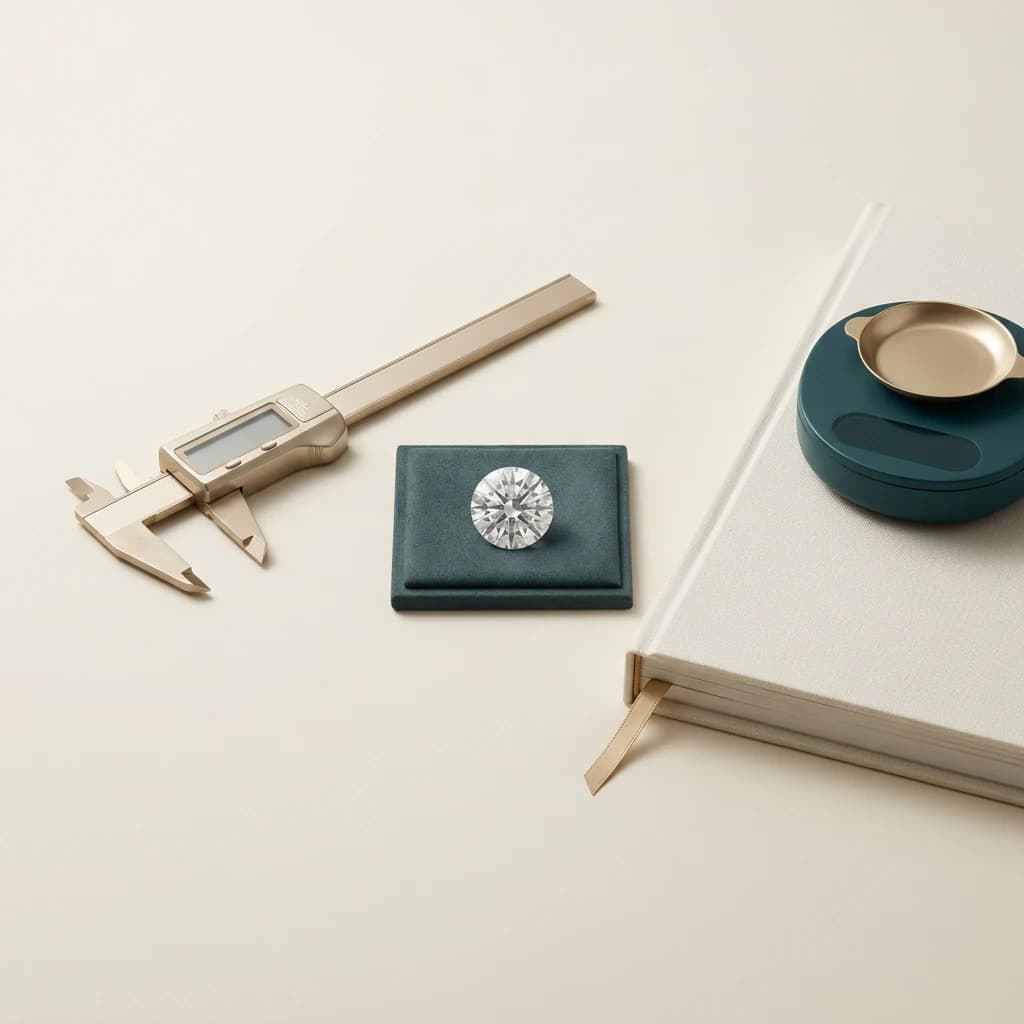
| Category | What the price reflects | What to expect |
|---|---|---|
| Budget starter pieces | Complete finished jewelry at entry-level specifications | Belaroq's jewelry-under-500 collection offers complete starter pieces at or below US$500 |
| Classic 1-carat-range solitaires | Center-stone carat, plus the chosen color, clarity, cut, metal and setting | Substantially higher — the price is driven by the specific 4Cs; check current product pages |
| 2-carat-range pieces | A larger center stone with matching metal and mounting work | Higher again — compare exact carat, grades and report; check current product pages |
| Larger statement pieces | Multiple carats across the design, with more metal and setting labor | Highest — price depends almost entirely on the chosen specification; check current product pages |
Prices change. The product page is the final reference for any current price, and no single number applies across retailers.
Lab-grown vs natural diamond prices
Lab-grown diamonds are typically positioned well below comparable natural diamonds, but the difference varies by carat, quality and retailer — so anyone comparing lab-grown diamond prices vs natural should compare actual listings rather than fixed percentages. The gap exists for structural reasons: lab-grown stones come from growth facilities where output can be planned, while natural stones depend on what mines yield, and mined supply of high-grade, larger stones is genuinely scarce. Production economics drive the divergence; the lab-grown vs natural comparison goes deeper.
The difference also widens as carat rises, because rarity behaves differently in the two supply chains. Natural diamonds become far rarer at higher carat weights, while lab-grown capacity scales more evenly — so a large stone's price gap can be much bigger than a small stone's. That makes a like-for-like comparison of actual pieces — full specifications, matching grades, current prices — the only sound way to judge value.
How to compare prices like for like
Price comparisons fail for one reason more often than any other: the two pieces are not actually the same. A fair comparison holds the specification constant and varies only the retailer. Any change to carat, color, clarity, cut or shape breaks the comparison, because each of those lines carries its own cost, as VS vs VVS pricing shows even within a single product. The checklist below is the discipline Belaroq's product team applies when pricing: nothing gets compared until the specification fields match exactly.
One Belaroq example makes the discipline concrete. In the current catalog (July 2026 snapshot), the displayed VVS price is 30% above the same product's VS price — for example, a piece displayed at $1,000 in VS displays at $1,300 in VVS. That 30% is not a market rule; it is the fixed relationship between two variants of the same product, and it shows why comparisons must stay inside one design — a rule that applies just as much to pieces in the under-$500 catalog.
- Same carat weight, with center stone and any side stones listed separately
- Same color grade
- Same clarity grade — at Belaroq, compare the VS and VVS variants of one product
- Same shape and measurements
- Same metal and setting
- Same report type (IGI or GIA), issued for that specific stone
- Total price including any customization, engraving or resizing
Price trends and what they mean
Lab-grown retail prices have generally declined over recent years as production scaled up and more producers entered the market. This guide deliberately avoids quoting percentage claims, because reported rates differ by date, quality band and source — and a number that was accurate last year may mislead this year. The trend is real; the precise slope is not worth memorizing. What matters for a buyer is direction, not a precise curve — the grades documented on a diamond report stay fixed while prices move.
Timing matters more than forecasting. Prices can also shift between research and purchase, especially on larger stones or fast-moving designs. The practical response is to time detailed research near the purchase decision and to evaluate the finished piece on its own terms: the specification, the report, the setting and the displayed price. Buying the piece you want, at a price verified against current listings, beats guessing the market bottom.
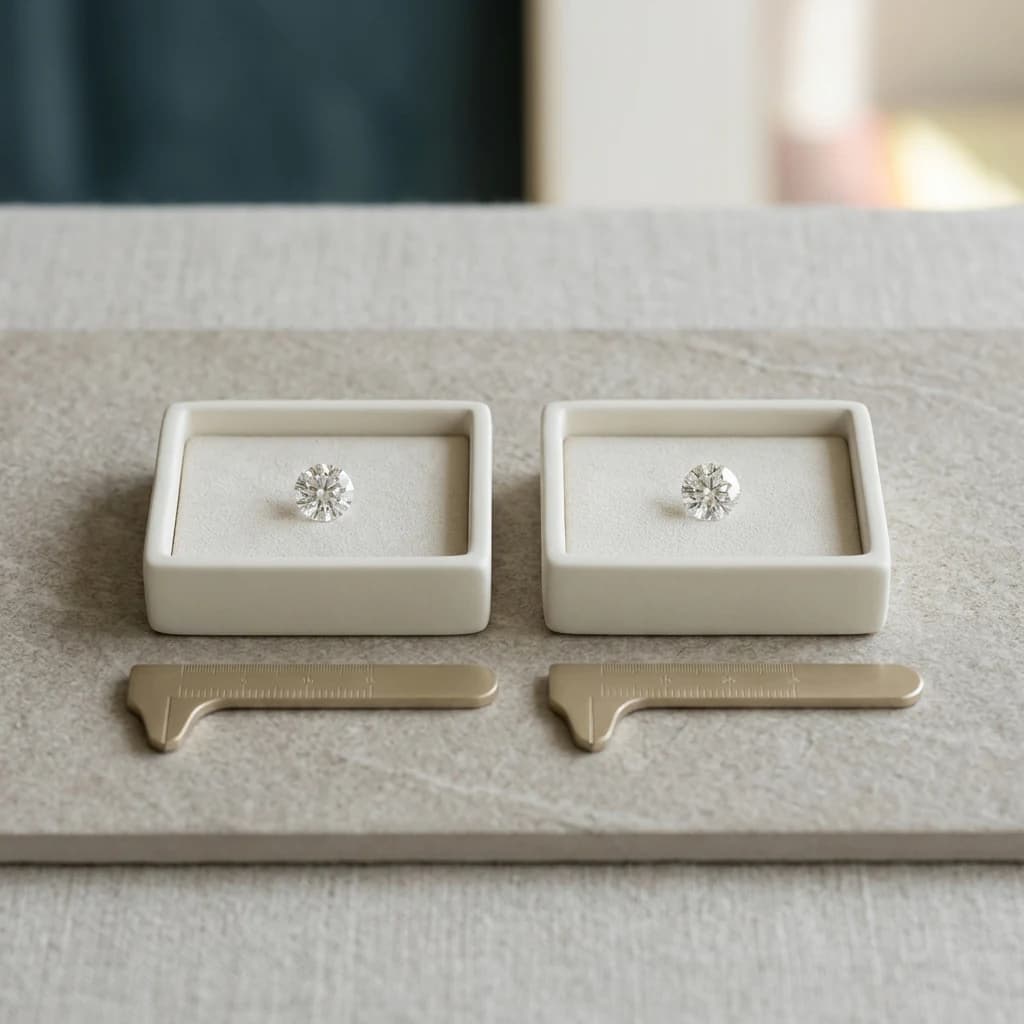
Ilustración editorial creada para Belaroq con Gemini 3.1 Flash Image mediante APIYi.
Lab-grown diamond price questions, answered
Direct answers to the pricing questions buyers search for.
How much does a 1 carat lab-grown diamond cost?
No single price exists for a 1 carat lab-grown diamond. The figure depends on color, clarity, cut, shape, grading report and whether the stone is loose or set in finished jewelry, and it varies by retailer. Compare actual listings that show the full specification, and treat the product page as the final reference.
How much does a lab-grown diamond cost per carat?
Price per carat is the total price divided by carat weight, and it rises as carat rises because larger lab-grown stones are rarer to produce. It is only meaningful within identical specifications. Comparing per-carat rates across different grades, shapes or settings is misleading.
Are lab-grown diamonds cheaper than natural?
Lab-grown diamonds are typically positioned well below comparable natural diamonds, but the difference varies by carat, quality and retailer. The gap tends to widen at larger carat weights, where natural rarity increases sharply. Compare actual listings rather than relying on a general percentage.
Why are lab-grown diamond prices falling?
Retail prices have generally declined over recent years as production capacity scaled up and more producers entered the market. This guide avoids quoting percentage figures because reported rates differ by date, quality band and source. The practical takeaway is the direction of change, not a specific curve.
What is the cheapest lab-grown diamond jewelry?
The most affordable route is a complete finished piece at entry-level specifications: a smaller carat weight, a modest setting and standard grades. Belaroq's jewelry-under-500 collection offers complete starter pieces at or below US$500. Check current listings, since inventory and prices change.
Does a 2 carat lab-grown diamond cost twice a 1 carat?
Not necessarily. Because price per carat rises with carat weight, a 2 carat stone typically costs more than double a 1 carat stone of matching grades, and often substantially more. The only reliable comparison matches color, clarity, cut, shape and report exactly.
Do certification and grading affect price?
Yes. An IGI or GIA report documents the stone's carat, color, clarity and cut, and higher grades command higher prices because they are rarer outcomes. A report also makes grades verifiable. Always compare prices at the same grade and report type.
Is VVS worth 30% more than VS?
At Belaroq, the displayed VVS price is 30% above the same product's VS price — a $1,000 VS piece displays at $1,300 in VVS (July 2026 snapshot). Whether that is worth it depends on whether the higher clarity category itself matters; a well-selected VS leaves more budget elsewhere.
Where can I compare current lab-grown diamond prices?
Use product pages that display the full specification alongside the price, including carat, color, clarity, cut, report and setting. Belaroq product pages show each variant's price and grades, including VS and VVS options, so like-for-like comparisons can be made directly on current listings.
The practical takeaway
Lab-grown diamond prices reward specification-level thinking. The 4Cs set the stone's cost, shape and report complete it, and metal, setting and labor finish the price of the piece. Price per carat rises with carat, TCW is not center carat, and lab-grown pricing is generally positioned well below natural — without a single fixed market number to memorize. Compare complete, like-for-like specifications on current product pages, remember that Belaroq's VVS variants display 30% above VS (July 2026 snapshot), and treat the jewelry-under-500 collection as the verified entry point. The listing you are looking at is the price that exists.