
Diamond Clarity Scale: Chart and Grades Explained
Diamond clarity describes the relative absence of inclusions and blemishes, and the diamond clarity scale is the graded vocabulary that records what a trained grader sees at 10× magnification. This guide reads the diamond clarity chart from Flawless to Included, explains how grades are determined, how clarity affects price and appearance, and how the same scale applies to laboratory-grown diamonds. A dedicated VS versus VVS comparison covers the choice most buyers actually face. It closes with a practical checklist for choosing a grade, written for jewelry buyers in plain terms, so the decision rests on the actual stone in front of you rather than a letter on paper.
For most everyday jewelry, VS or VVS offers the practical balance — judge the actual stone.
Most everyday jewelry decisions settle between VS and VVS, because both categories can be eye-clean even though the grade describes what a trained grader sees at 10× magnification, so the final call belongs to the actual stone, its position in the setting, and the price attached to the finished piece, not to the grade label alone.
Diamond clarity at a glance
- Clarity is graded at 10× magnification by trained graders under standardized lighting, with the stone clean, examined face-up, and turned through several positions before a grade is recorded.
- Graders weigh five factors for every characteristic: size, number, position, nature, and relief, rather than judging what a casual glance reveals or what a photograph suggests about the stone.
- The clarity scale holds eleven grades across six categories, ordered from Flawless at the top to Included at the bottom when the chart is read best to worst.
- Flawless and Internally Flawless stones are rare, because nearly every diamond carries at least one internal or external characteristic under 10× magnification, and most finished jewelry never needs the top grades.
- VVS, meaning Very Very Slightly Included, describes minute inclusions that are difficult for a skilled grader to see even at 10×, and that remain invisible to the unaided eye.
- VS, meaning Very Slightly Included, describes minor inclusions that a skilled grader can see more readily at 10×, but that usually stay invisible in normal wear.
- SI, meaning Slightly Included, describes inclusions that are noticeable at 10× and may be visible without magnification in some stones, which is why SI stones are inspected one by one.
- 'Eye-clean' is a shopping term rather than an official grade, and no universal definition fixes the viewing distance, lighting, or observer behind the claim, so it should always be confirmed by inspection.
What is diamond clarity?
Diamond clarity describes how free a diamond is of inclusions and blemishes, the internal and external characteristics that nearly every diamond has. Inclusions are characteristics enclosed in the stone or extending into it from the surface, such as tiny crystals, feathers, and clouds; blemishes sit on the surface and include naturals, polish lines, and minor chips. Because no growth process is perfectly clean, whether in nature or in a diamond growth laboratory, almost every stone carries some combination of these characteristics. Clarity grading is the discipline of finding them, describing them, and recording how visible they are, so that two people describing the same stone would give a buyer the same picture.
Grading always happens at 10× magnification, with the stone clean and examined in several positions, because the scale describes what a trained grader can see under that magnification, not what a buyer notices in normal wear. The grader weighs five factors for every characteristic: size, number, position, nature, and relief. Position matters because a characteristic under the table is more visible than one hidden near a prong, while nature and relief describe how a characteristic reads against the stone around it. Clarity is therefore a visibility scale, not a sparkle scale; brilliance and fire come mainly from cut, proportions, and polish.
The diamond clarity scale (chart)
The diamond clarity scale orders what a grader sees at 10× into six categories holding eleven grades. Read the diamond clarity chart best to worst from Flawless through Included: Flawless (FL), Internally Flawless (IF), Very Very Slightly Included (VVS1 and VVS2), Very Slightly Included (VS1 and VS2), Slightly Included (SI1 and SI2), and Included (I1, I2, and I3). That best to worst order ranks rarity and grading difficulty, not wearability; most diamonds sold in fine jewelry sit in the middle of the chart, and most of those stones look clean in normal wear. The chart below pairs each category with its meaning at 10×.
The chart below summarizes the GIA diamond clarity chart as the reference point, since GIA defined the modern eleven-grade scale that most of the industry follows. A diamond clarity and color chart is often printed alongside it, with clarity grades running down one axis and color grades across the other, and the two scales stay separate because clarity measures characteristics while color measures body tint. A colorless stone can carry visible inclusions, and a slightly tinted stone can be internally clean, so the scales should be read independently. This table is a summary for orientation, not a substitute for the issuing laboratory's wording, which always controls.
| Grade category | Meaning at 10× | Practical interpretation |
|---|---|---|
| FL — Flawless | No inclusions and no blemishes are visible to a skilled grader at 10× magnification | Extremely rare in any origin; usually reserved for collectors or buyers who explicitly request the very top grade of the chart |
| IF — Internally Flawless | No inclusions are visible; only minor surface blemishes appear to a skilled grader at 10× | Effectively identical in appearance to Flawless once set, since the surface blemishes are often removed in finishing or hidden by the setting |
| VVS1–VVS2 — Very Very Slightly Included | Inclusions are minute and difficult for a skilled grader to see at 10×, even with careful effort | The most demanding realistic choice for everyday jewelry; such stones are virtually always eye-clean in any setting |
| VS1–VS2 — Very Slightly Included | Inclusions are minor and easier for a skilled grader to see at 10× | The most popular balance of clarity, appearance, and price in fine jewelry; usually eye-clean at normal viewing distance |
| SI1–SI2 — Slightly Included | Inclusions are noticeable at 10× and may be visible without magnification | Budget-sensitive choice; some stones are eye-clean while others are not, so the individual stone must be inspected |
| I1–I3 — Included | Inclusions are obvious at 10× and often visible without magnification | Seldom used in fine jewelry; I2 and I3 stones can show reduced transparency and, in extreme cases, durability concerns |
This table summarizes the GIA clarity scale for orientation, ordered from best to worst. Each issuing laboratory defines and applies its own grades, so read the wording on the report for the stone you are considering.


How clarity grades are determined
Clarity grades are assigned by trained graders, not by machines, sellers, or cameras. A grader works with the stone clean and unmounted where possible, under controlled magnification and standardized lighting, and compares what the stone shows against master comparison stones that anchor each boundary on the scale. The grade records how visible the characteristics are at 10×, judged against the five factors of size, number, position, nature, and relief. The result is written into the stone's grading report along with carat, color, and cut, so the grade travels with the stone and can be checked by an independent laboratory at any time.
A photograph cannot assign a clarity grade. Camera focus, lighting, and post-processing change how characteristics appear, and many inclusions are too small for a photograph to resolve reliably. Report plot diagrams sketch the main characteristics and their positions, but they are identification guidance, not a complete picture of the stone. The same discipline applies to laboratory-grown diamonds. IGI reports apply the familiar 4C clarity grades to laboratory-grown stones, while GIA has issued Premium and Standard reports for eligible D-to-Z laboratory-grown diamonds since October 1, 2025, so buyers should note which format the report for a given stone uses. The grade lives in the grading report, not in the photograph.
How clarity affects price and appearance
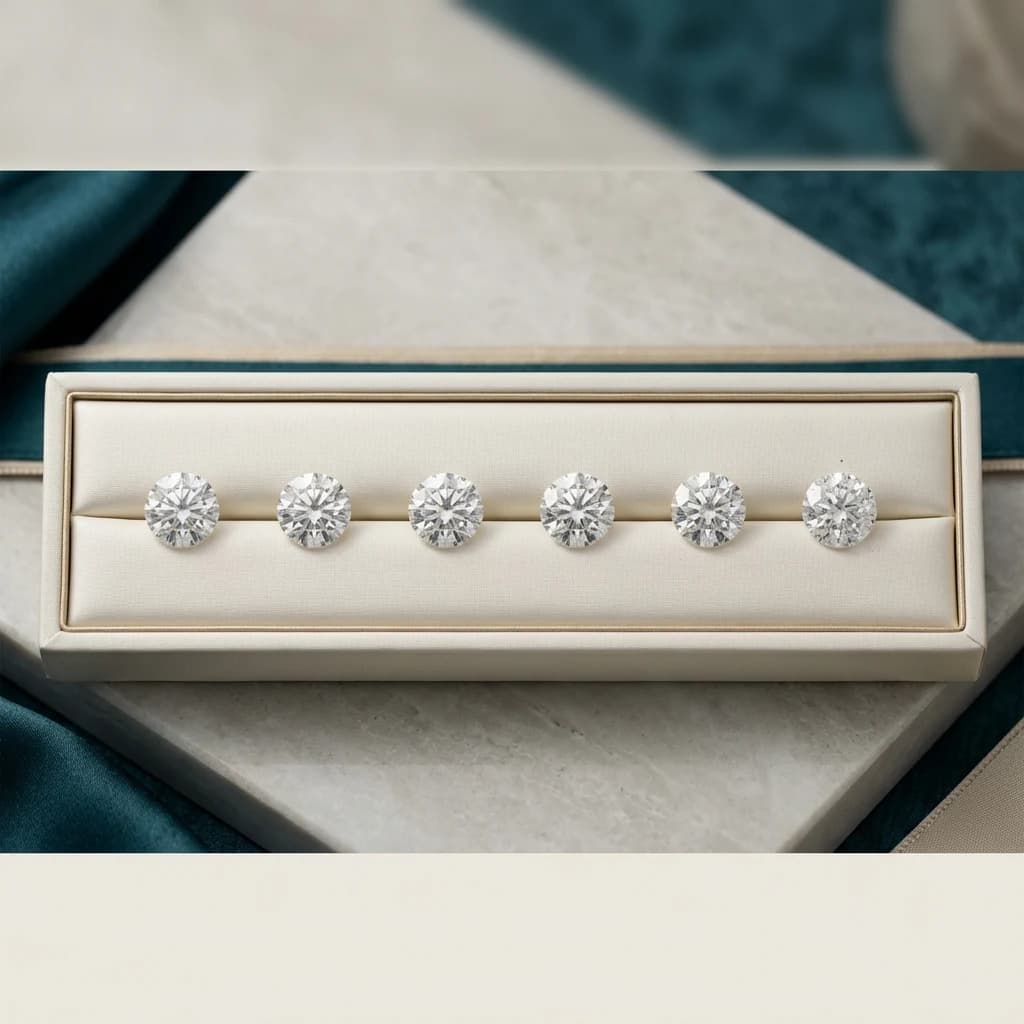
Each step up the clarity scale represents a rarer stone, and rarity shows up in price, as seen in published lab-grown pricing, but the steps are not equal in the showroom. The boundary between VS and VVS describes what a trained grader can resolve at 10×, and for many stones nothing about that boundary is visible to the unaided eye in normal wear. Whether the higher grade is worth paying for depends on the stone itself: larger stones present more area for characteristics to appear, step-cut shapes such as emerald and Asscher cuts expose the interior through long facets, and a characteristic under the table is more visible than the same characteristic hidden near a prong.
Price differences are decided stone by stone and change over time, so fixed percentages quoted from outside sources are not reliable. One verified anchor is available: as of July 24, 2026, Belaroq's catalog prices VVS clarity at 30% above the same product's VS price, a snapshot of how the two grades compare on identical designs, settings, and documentation. The snapshot is offered for orientation, not as a promise the difference stays fixed. Buyers who want a deeper look at that specific decision can read the dedicated VS versus VVS comparison, which examines visibility, report wording, and when each grade is worth choosing over the other.
How to choose a clarity grade
Choosing a clarity grade is a sequence of small decisions, and the grade on the report is only the first filter. Budget leads, because clarity is one of the 4Cs and money moved away from an invisible grade can be spent on carat, cut, metal, or a more elaborate setting. After budget comes appearance: the question is whether the characteristics are visible in the finished piece, in normal light, at the distance other people actually stand. That question cannot be answered from a grade letter alone, which is why the checklist below runs from budget through verification. The list is ordered deliberately, and each step guards a different failure mode.
The checklist works for engagement ring purchases, earrings, necklaces, and bracelets alike. It is deliberately conservative: when a decision is hard to reverse, such as a custom order, it asks for more verification rather than less. It also reflects that subgrades matter when a report or an invoice names one, and that the report must describe the piece actually delivered. Run through the list for any stone above the entry end of the scale, and the grade choice usually settles itself. For stones at the top of the scale, the same list protects against paying for rarity that will never be seen.
- Set the budget before comparing grades; money not spent on an invisible clarity step can go to carat, cut, metal, or a more visible setting.
- Inspect the actual stone or its certified high-magnification media instead of deciding from a grade letter alone, because visibility depends on the individual stone.
- Give step-cut shapes such as emerald and Asscher cuts extra care, because their open facets expose the interior to the eye.
- Give larger stones extra care, because more surface area and a bigger table make characteristics easier to notice at normal distance.
- Treat multi-stone pieces as an ensemble: what matters is how the whole piece looks, including every accent stone, not any single stone's letter.
- Remember that 'eye-clean' has no universal standard; two sellers can use the word differently, so confirm the appearance of the actual stone yourself.
- When a subgrade such as VS1 or VS2 is named, specify it in the order so the delivered piece matches what was agreed.
- Match the report to the delivered piece: confirm the report number, the stone it describes, and that its grade refers to what is in your hands.
Clarity for lab-grown diamonds
Laboratory-grown diamonds are graded for clarity in the same way as natural diamonds, on the same magnification standard and the same visibility logic. The characteristics are the same kinds of features, because laboratory-grown and natural diamonds are the same material. IGI, the laboratory most often used for laboratory-grown reports, applies the familiar 4C clarity grades to laboratory-grown stones, so an IGI clarity grade reads the same way for either origin, as does the diamond color scale. Reports also state their scope: a report may cover a loose stone or a mounted piece, and jewelry-level reports may describe the center stone plus accent diamonds, so the buyer should check what the report actually covers.
GIA reports deserve a careful read. For eligible D-to-Z laboratory-grown diamonds, GIA has issued Premium and Standard reports since October 1, 2025: Premium carries the traditional 4C detail buyers expect, while Standard carries an overall quality assessment rather than the full grade set. When comparing reports, compare like with like by checking which laboratory issued each report, what scope it covers, and whether the grades are 4C grades or overall assessments. The issuing laboratory's definitions control, and different laboratories may describe the same stone differently, so a report is best read as a verified record of one stone on its own terms.
Editorial illustration created for Belaroq with Gemini 3.1 Flash Image via APIYi.
Diamond clarity questions, answered
Concise answers to the most common diamond clarity questions.
What is the best diamond clarity grade?
The best grade on paper is Flawless, the top of the diamond clarity scale, but it is rarely the best choice in practice. FL and IF stones are rare and carry premium prices for characteristics that almost no one can see once the stone is set, and often not even then. For most jewelry, VS or VVS offers the practical balance of a clean look and a sensible price.
Does the clarity chart work for lab-grown diamonds?
Yes. Laboratory-grown diamonds are the same material as natural diamonds and are graded on the same clarity scale with the same 10× standard. IGI applies the familiar 4C clarity grades to laboratory-grown stones, so the chart reads the same way. GIA uses Premium and Standard reports for eligible D-to-Z laboratory-grown diamonds, so buyers should confirm which report format applies to the stone they are considering before comparing grades.
Who defines the diamond clarity scale?
GIA defined the modern scale of six categories and eleven grades, and its wording is the industry reference point. However, each issuing laboratory defines and applies its own grades, and the report for a given stone carries the issuer's terms. Buyers should read the wording from the laboratory that issued the report in hand rather than assuming every laboratory uses identical definitions or boundaries.
What are the levels of clarity in diamonds?
From best to worst, the eleven grades run Flawless (FL), Internally Flawless (IF), Very Very Slightly Included (VVS1 and VVS2), Very Slightly Included (VS1 and VS2), Slightly Included (SI1 and SI2), and Included (I1, I2, and I3). The grades describe what a skilled grader can see at 10× magnification, and each step marks characteristics that are progressively easier to find under that magnification.
Is IGI clarity grading different from GIA?
Both laboratories grade clarity professionally, and their scales are broadly compatible, but the wording and definitions belong to each issuer. IGI commonly issues full 4C clarity grades for laboratory-grown diamonds. Since October 1, 2025, GIA has issued Premium and Standard reports for eligible D-to-Z laboratory-grown stones, so the report formats differ and each should be read on its own terms, and the same stone can carry reports from both.
What does eye-clean mean?
'Eye-clean' means a stone shows no characteristics visible to the unaided eye, generally viewed face-up at a normal distance by someone with normal vision. It is a shopping term, not an official grade, and no universal definition fixes the viewing distance, lighting, or observer. Buyers should confirm eye-clean claims by inspecting the actual stone or its high-magnification media rather than trusting the phrase alone.
Is SI clarity bad?
Not necessarily. SI stones carry inclusions that are noticeable at 10×, and some SI stones are still eye-clean, particularly smaller stones or stones whose characteristics hide near the setting. The risk is that visibility varies stone by stone, so an SI purchase calls for inspecting the individual stone and its position in the setting rather than relying on the grade letter alone; SI works best when the stone verifies clean.
Can you see inclusions with the naked eye?
Sometimes, and it depends on the stone. Inclusions in FL through VS stones are rarely visible without magnification, which is why those grades are popular. Some SI stones and most I-grade stones show characteristics to the unaided eye. Size, position, cut, and viewing conditions all matter, so the only reliable check is to look at the individual stone in the finished piece, in the lighting you will actually wear it.
Does clarity affect sparkle?
Only in extreme cases. Brilliance and fire come primarily from cut, proportions, and polish, and a well-cut stone with minor inclusions sparkles normally. Clarity becomes visible when inclusions are dense or dark enough to scatter or absorb light, which is typically an I-range situation. Above that, clarity mostly affects how clean the stone looks under close inspection, not how it performs in motion. So choose cut first and clarity second.
Which clarity grade gives the best value?
For most buyers, VS offers the best value because it is usually eye-clean while costing less than VVS and far less than FL and IF. VVS is worth considering when the higher clarity category matters for its own sake or when comparing specific stones. The real value decision is stone by stone: inspect the individual stone, its setting, and the actual price difference between the options offered.
The practical takeaway
Clarity is a visibility scale, graded at 10× magnification and recorded on the diamond clarity chart from Flawless to Included. Most of the practical range for fine jewelry sits between VS and VVS, where stones are usually eye-clean and the differences live at the grader's magnifier rather than at normal viewing distance. Laboratory-grown diamonds are graded on the same scale by IGI, with GIA Premium and Standard reports for eligible D-to-Z stones. Decide by budget first, then inspect the actual stone, give extra care to step cuts and larger stones, and confirm that the report matches the delivered piece, because the grade only matters when it describes what you are actually buying. When the grade on paper and the piece in hand match, clarity has done its job.