
What Are Lab-Grown Diamonds?
Lab-grown diamonds are diamonds created in controlled manufacturing environments rather than formed underground. Their origin is different, but their material is diamond: they have essentially the same chemical composition, crystal structure, and optical and physical properties as natural diamonds. This guide explains what that statement does—and does not—mean for identification, quality, durability, price, disclosure, and your buying decision.
A lab-grown diamond is diamond material with a clearly disclosed laboratory origin.
It is carbon crystallized in the diamond structure using a controlled HPHT or CVD process. It can match a natural diamond in appearance and essential material properties, but it has a different growth history that a qualified gemological laboratory can identify. It is not the same as a diamond simulant such as cubic zirconia or moissanite.
Lab-grown diamonds at a glance
- They are made of diamond material, not glass, cubic zirconia, or moissanite.
- The two primary growth methods are HPHT and CVD.
- A polished lab-grown diamond may look the same as a natural diamond to the unaided eye.
- Advanced testing can identify laboratory origin and, in many cases, the growth method.
- Quality still varies: cut, color, clarity, carat, proportions, and setting all matter.
- A grading report describes the submitted item; it is not a resale-value promise or appraisal.
What makes a lab-grown diamond a diamond?
The word diamond describes a material: carbon atoms arranged in a diamond crystal structure. Laboratory-grown and natural diamonds both meet that material description. Their essential chemical, optical, and physical properties are closely comparable, which is why a well-cut laboratory-grown diamond can display the brilliance, fire, transparency, and scratch resistance associated with diamond.
Origin is the crucial distinction. Natural diamonds formed through geological processes within the Earth. Laboratory-grown diamonds are manufactured from a diamond seed under controlled conditions. Different growth environments leave microscopic and atomic-scale features that specialist laboratories can detect, so saying the two origins are indistinguishable in every respect would be inaccurate.
A simulant is a different material selected because it resembles diamond. Cubic zirconia and moissanite may look diamond-like, but they do not have diamond's chemical composition and full set of physical properties. Clear product naming should keep natural diamonds, laboratory-grown diamonds, and simulants separate.
| Question | Lab-grown diamond | Natural diamond | Diamond simulant |
|---|---|---|---|
| What is it? | Diamond material grown by a manufacturing process | Diamond material formed by a geological process | A different material that resembles diamond |
| Typical origin | HPHT or CVD growth facility | Formed within the Earth and later mined | Manufactured as CZ, moissanite, glass, or another material |
| Can appearance alone prove origin? | No | No | Not reliably in every case |
| How is identity confirmed? | Disclosure plus appropriate gemological testing or report | Appropriate gemological testing or report | Material-specific testing |
| Can quality vary? | Yes—widely | Yes—widely | Yes, but diamond grades do not automatically apply |
This comparison addresses identity and origin. It does not rank one option as universally better for every buyer.
How are lab-grown diamonds made? HPHT and CVD explained
Both leading methods begin with a diamond seed and add carbon to grow a larger crystal. High-pressure, high-temperature growth—HPHT—uses a press, intense heat, and intense pressure. Carbon dissolves in a metallic flux and crystallizes on the cooler seed. The resulting rough crystal is then cut and polished.
Chemical vapor deposition—CVD—places diamond seed plates in a lower-pressure chamber containing carbon-rich gas. Energy activates the gas, and carbon deposits on the seeds in thin layers. A CVD-grown crystal may later receive a treatment, including HPHT treatment, to modify color. Growth method and post-growth treatment are separate facts, and a suitable laboratory report may disclose both.
| HPHT | CVD | |
|---|---|---|
| Full name | High pressure, high temperature | Chemical vapor deposition |
| Growth environment | Very high heat and pressure in a press | Activated carbon-containing gas in a chamber |
| How carbon reaches the seed | Through a molten metallic flux | Layer by layer from activated gas |
| Possible later treatment | Treatment may occur depending on the stone | HPHT or other post-growth treatment may be used to adjust color |
| Is one automatically better? | No—judge the finished stone and documented specification | No—judge the finished stone and documented specification |
What is the same—and what is different—from a natural diamond?
For a buyer, the similarities are substantial: both are diamond, both can be cut into the same shapes, both can range in color and clarity, and both require thoughtful setting and care. A lab-grown diamond is not automatically flawless, colorless, or well cut simply because it was made in a controlled environment.
The differences center on origin, growth structure, rarity story, market pricing, and disclosure. Natural and laboratory-grown diamonds can contain different growth features, fluorescence patterns, inclusions, strain patterns, or inscriptions. These are useful to trained laboratories, but they are not a home identification checklist and not every stone displays every feature.
- Same decision factors: cut, color, clarity, carat weight, dimensions, proportions, and the finished setting.
- Different origin: geological formation versus controlled manufacture.
- Different identifying features: advanced instruments can read growth-related markers.
- Different market context: supply, retail pricing, and resale behavior should not be assumed to match.
- Same need for disclosure: the seller should state clearly what type of stone is being offered.
Can you tell a lab-grown diamond by looking at it?
Usually not with the unaided eye. Because laboratory-grown diamonds closely match natural diamonds in essential material and optical properties, appearance alone is not a reliable origin test. A traditional handheld diamond tester may confirm diamond-like thermal or electrical behavior without establishing whether the diamond formed in the Earth or in a growth chamber.
Definitive identification can require spectroscopy, fluorescence imaging, magnification, and other advanced methods used by qualified gemological laboratories. A girdle inscription and report number can support traceability, but the inscription should be matched to the issuer's report database rather than accepted on appearance alone.
How are lab-grown diamonds graded and certified?
Independent gemological laboratories can identify a diamond as laboratory-grown and describe characteristics of the submitted stone. Depending on the laboratory, report type, stone size, and whether the stone is loose or mounted, a report may include shape, measurements, carat weight, color, clarity, cut information, growth method, post-growth treatment, and inscription details.
Read the actual report rather than assuming every certificate has the same scope. Match the report number, measurements, inscription, and description to the stone or finished piece. Smaller accent diamonds may be screened as a parcel or documented at jewelry level rather than receiving an individual report for every stone.
A grading report is not an appraisal, warranty, proof of investment value, or guarantee of future resale. It records findings about the item examined under the issuing laboratory's procedures and terms. The sales page and order confirmation should separately state what documentation is included with the product.
- Confirm that the report explicitly identifies laboratory-grown origin.
- Verify the report number on the issuing laboratory's official website.
- Check whether the report covers a loose stone or a mounted jewelry item.
- Compare carat weight with millimeter measurements and the product's total-carat wording.
- Look for disclosed growth method or post-growth treatment when the report provides it.
- Do not treat a report as a monetary valuation.

Are lab-grown diamonds durable for everyday jewelry?
Yes, when the design and setting suit the intended use. Because the material is diamond, a lab-grown diamond has diamond's high resistance to scratching. That does not make any diamond indestructible: a hard impact at a vulnerable edge, an exposed point, a damaged prong, or abrupt extreme temperature change can still create risk.
Durability belongs to the whole piece, not only the stone. Setting height, prong or bezel coverage, metal, band thickness, stone shape, and maintenance all matter. Remove fine jewelry for high-impact work, inspect the setting periodically, and follow the care and warranty terms for the finished product.
Are lab-grown diamonds automatically sustainable or ethical?
Laboratory origin removes mining from the diamond-growth step, but that fact alone does not prove that every lab-grown diamond has a lower total environmental impact or an ethical supply chain. Production uses energy and equipment; the result depends on the energy source, facility efficiency, materials, cutting, metals, logistics, labor practices, and the boundary used for comparison.
Treat broad claims such as ‘eco-friendly,’ ‘carbon neutral,’ or ‘100% ethical’ as evidence questions. A responsible claim should identify the specific benefit, measurement boundary, period, method, and independent support. Belaroq should only make product-level environmental claims when supporting evidence applies to that exact supply chain.
What about price, resale, and long-term value?
Lab-grown diamonds are often sold at lower retail prices than natural diamonds with broadly comparable stated characteristics, but the difference is not fixed. Prices change with technology, supply, size, quality, brand, setting, and market conditions. Compare the current finished-piece price, not a historical percentage or a loose-stone headline.
Neither a laboratory report nor a retail price guarantees resale value. Secondary-market demand, buyer policies, condition, design, metal value, and future supply can all affect an offer. If resale is important, seek an independent current appraisal or written buyback terms. For most buyers, the soundest basis is the design, documented specification, budget, and enjoyment of the jewelry—not an investment promise.
A practical checklist before buying lab-grown diamond jewelry
Start by confirming identity, then compare the finished piece. Product photography and a generic sample report can help explain a design, but the product page and confirmed order record should define what you are purchasing.
Belaroq offers made-to-order lab-grown diamond jewelry. The selected clarity option, material, size, price, total-carat wording, customization, and included documentation should remain attached to the cart and order. A guide, concept image, or AI preview does not replace the confirmed production specification.
- The words ‘lab-grown’ or ‘laboratory-grown’ appear clearly next to ‘diamond.’
- The product distinguishes center-stone carat from total carat weight.
- Shape, dimensions, color, clarity, cut information, metal, and setting are clear where applicable.
- The page states exactly what report or documentation is included, if any.
- The report number can be verified with the issuing laboratory when a report is supplied.
- The final price updates with clarity, metal, size, or customization choices.
- Production time is separated from shipping transit time.
- Return, resizing, warranty, and custom-order restrictions are reviewed before payment.
- Any environmental, ethical, or value claim is specific and supported rather than absolute.
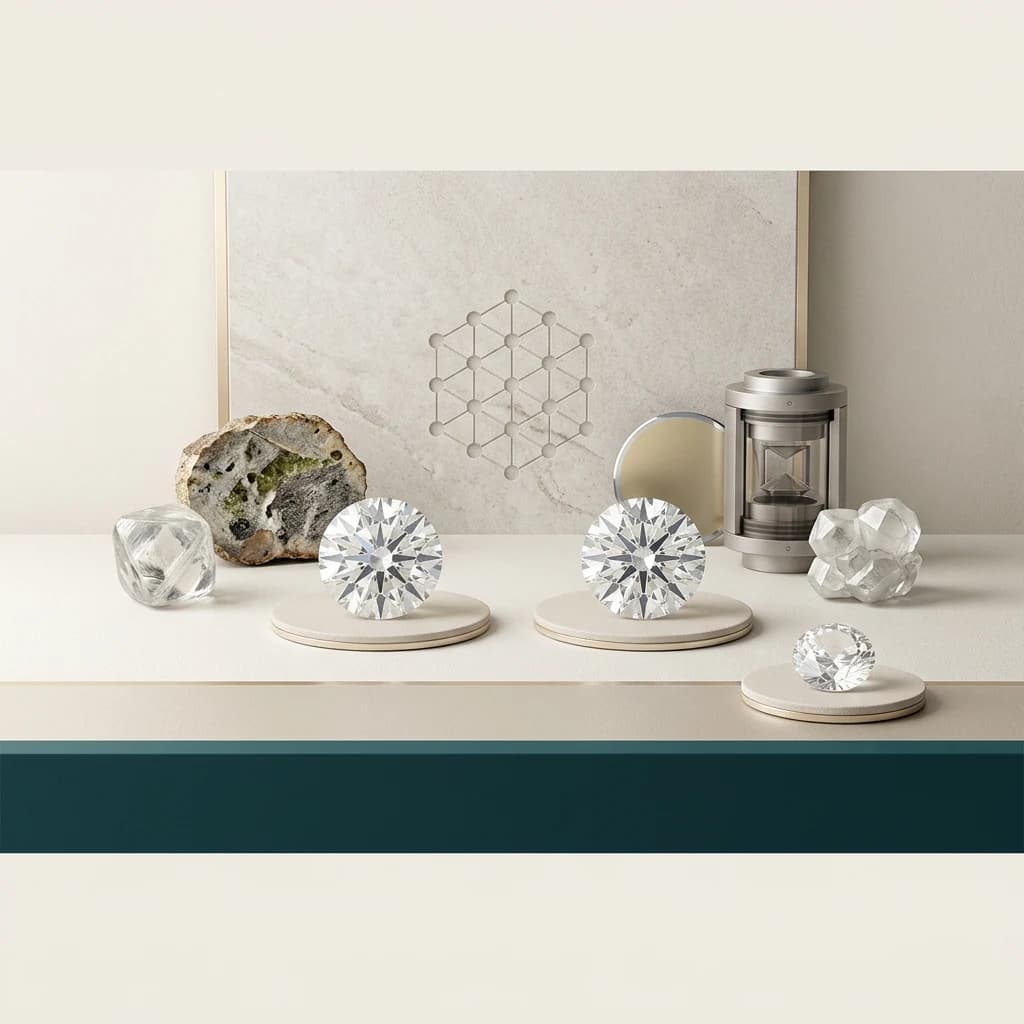
Editorial illustration created for Belaroq with Gemini 3.1 Flash Image via APIYi.
Lab-grown diamond questions, answered
These short answers address the questions buyers most often ask before comparing an actual stone or finished piece.
Are lab-grown diamonds real diamonds?
They meet the material definition of diamond: essentially pure carbon crystallized in the diamond structure. Their manufactured, non-mined origin must still be disclosed clearly, and they should not be described as natural, mined, real, or genuine stones.
Are lab-grown diamonds the same as cubic zirconia or moissanite?
No. Cubic zirconia and moissanite are different materials used as diamond simulants. A lab-grown diamond is crystallized carbon in the diamond structure.
Can a jeweler tell a lab-grown diamond by looking at it?
Not reliably by unaided appearance alone. Growth features, spectroscopy, fluorescence imaging, inscriptions, and other laboratory methods may be needed to determine origin.
Is CVD or HPHT better?
Neither method is automatically better. CVD and HPHT describe how the crystal grew; evaluate the individual diamond's cut, color, clarity, carat, measurements, treatment disclosure, report, and price.
Will a lab-grown diamond pass a diamond tester?
Many basic testers respond to diamond's material properties and may indicate diamond, but that does not establish natural or laboratory origin. Origin identification can require advanced testing.
Do lab-grown diamonds get cloudy or lose their sparkle?
The diamond material does not normally become cloudy simply because it was lab-grown. Oil, lotion, soap, dust, surface damage, or a loose setting can reduce apparent sparkle, so cleaning and inspection still matter.
Do all lab-grown diamonds come with a certificate?
No. Documentation depends on the seller, stone size, report type, and whether stones are loose, mounted, or small accents. Confirm exactly what the product and order include.
Are lab-grown diamonds more ethical or environmentally friendly?
Not automatically. Laboratory origin avoids diamond mining, but a complete claim must also consider energy, materials, cutting, metals, logistics, labor, and the evidence boundary.
Do lab-grown diamonds hold their value?
There is no guaranteed resale value. Market supply, condition, design, metal, buyer policies, and future prices all matter; a grading report is not an appraisal or investment promise.
Is a lab-grown diamond better than a natural diamond?
There is no universal answer. Lab-grown may suit a buyer prioritizing current size or design within a budget; natural may suit someone who values geological origin and rarity. Compare verified facts and choose according to your priorities.
The practical takeaway
A lab-grown diamond is diamond, but its origin must remain explicit. Verify identity and documentation, judge the individual stone and finished setting, separate evidence from broad marketing claims, and record the exact specification you are buying.