
Lab-Grown vs Natural Diamonds: The Real Differences
Lab-grown and natural diamonds look alike, wear alike, and are graded with the same vocabulary, yet shoppers searching for lab grown vs natural diamonds still meet confusion and conflicting claims. The comparison does not have to be emotional. Both are real diamond material; the honest differences sit in origin, price position, rarity context, and resale behavior. This guide starts with what lab-grown diamonds are, walks through each difference side by side, and ends with a practical framework for choosing. No invented statistics, just the documented facts.
Both are real diamonds; the difference is origin, price position and rarity context, not chemistry.
Lab-grown and natural diamonds are the same material, crystallized carbon, with the same essential chemical, physical and optical properties; what differs is origin, formation time, typical price position, rarity and resale context.
The comparison at a glance
- Both are diamond material: crystallized carbon in the diamond crystal structure.
- The difference is origin: geological formation versus controlled laboratory growth.
- Lab-grown diamonds grow from a seed in weeks; natural diamonds formed over geological time.
- Both sit at 10 on the Mohs hardness scale and wear the same way.
- The same laboratory grading standards and 4C vocabulary apply to both origins.
- Disclosure of laboratory origin is required in major markets such as the United States.
- Lab-grown diamonds typically occupy a lower price position than comparable natural diamonds.
- Resale markets differ: neither origin carries a guaranteed resale value.
What is the actual difference?
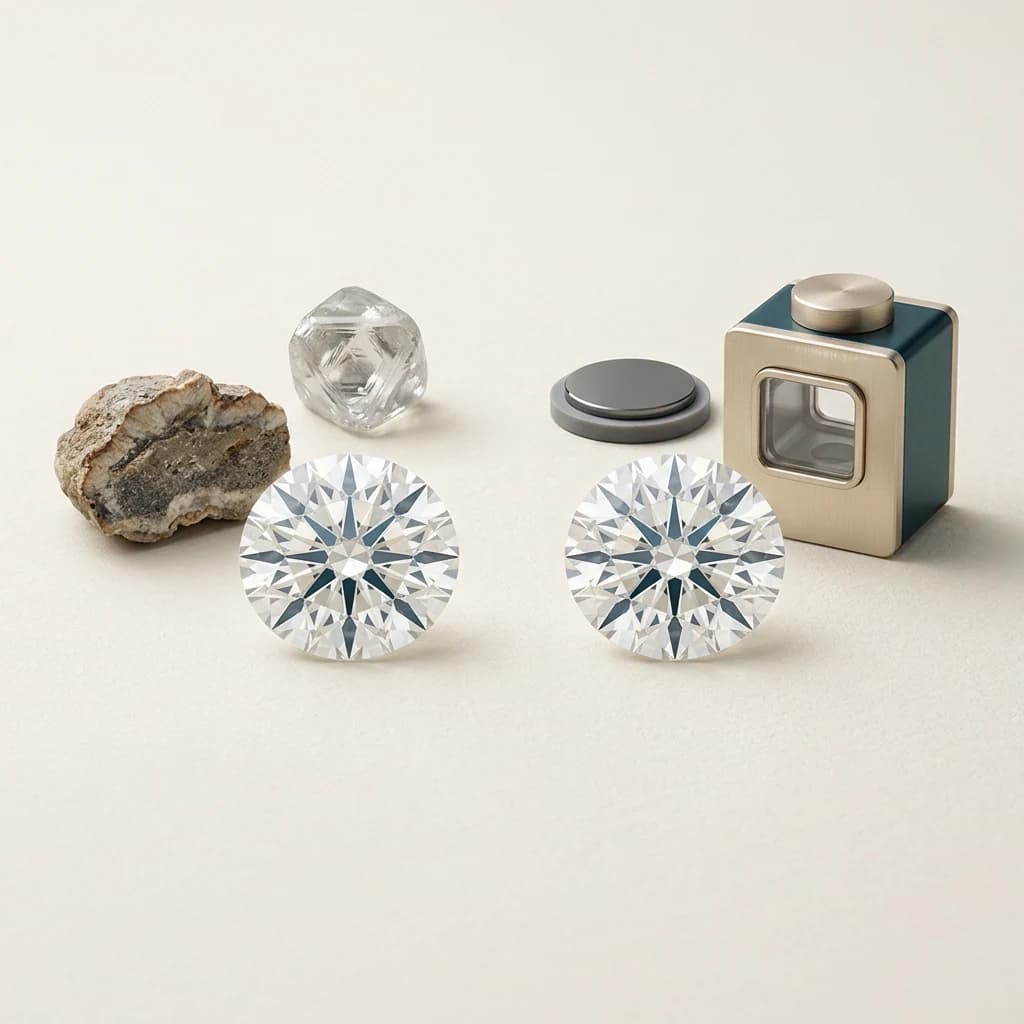
When buyers compare lab grown vs natural diamonds side by side, the visible answer is anticlimactic: in a finished setting, the two can be indistinguishable to the unaided eye. Both sparkle the same way because both are the same material. The difference is not in the stone itself but in its history.
A natural diamond crystallized deep inside the Earth under geological heat and pressure, and reached the surface through volcanic activity long before the stone was mined. A lab-grown diamond began as a small diamond seed, and carbon was added under controlled laboratory conditions until a larger crystal formed over weeks.
The two established growth methods are HPHT, which applies intense heat and pressure in a press, and CVD, which deposits carbon from energy-activated gas onto seed plates.
Both methods produce genuine diamond crystal, which is then cut and polished exactly like natural rough. Neither process produces a simulant: cubic zirconia and moissanite are different materials that only resemble diamond, and they sit outside this comparison entirely.
- Natural: formed in the Earth's mantle over geological time, then mined.
- Lab-grown: grown from a diamond seed in weeks using HPHT or CVD.
- Both: the same crystallized carbon, cut and polished the same way.
- Neither is a simulant; cubic zirconia and moissanite are separate materials.
Are lab-grown diamonds real?
Yes. The question behind the long-tail search is lab grown diamonds real or fake deserves an answer in three parts. First, material reality: a lab-grown diamond is crystallized carbon in the diamond crystal structure, with essentially the same chemical composition, crystal structure, and physical properties as a natural diamond, which is exactly what an independent report exists to verify.
Second, grading reality: the same gemological laboratories that grade natural diamonds grade lab-grown ones, applying the same 4C scales to color, clarity, cut, and carat. Third, disclosure reality: lab-grown diamonds are real diamonds with a different origin, and sellers in major markets must say so.
The United States Federal Trade Commission expects clear, understandable disclosure of laboratory origin, and laboratory-grown stones may not be marketed as natural or mined. The fake confusion almost always comes from simulants, which imitate diamond's appearance but are chemically different materials; a dishonest seller passing one off as diamond is where fake correctly applies.
A properly disclosed lab-grown diamond is not a fake diamond; it is a diamond grown in a laboratory.
- Real in material: crystallized carbon with diamond's chemistry and crystal structure.
- Real in grading: graded by the same laboratories on the same 4C scales.
- Real in law: treated as diamond with a different origin, and disclosed as laboratory-grown.
- Fake means simulant: cubic zirconia and moissanite are different materials, not lab-grown diamonds.
- Disclosure matters: laboratory origin must be stated clearly in every market Belaroq serves.
Side-by-side comparison
A side-by-side table is useful because it flattens a complicated subject into rows, and a little dangerous for the same reason. Every row below states origin and market facts, not promises about any individual stone. Read the rows as a comparison of categories, then verify any specific stone against its own grading report.
| Comparison point | Natural diamonds | Lab-grown diamonds |
|---|---|---|
| Origin | Formed in the Earth's mantle and brought to the surface through geological processes, then mined | Grown from a diamond seed in laboratory equipment, then cut and polished |
| Formation time | Most natural diamonds formed over hundreds of millions to billions of years | Weeks of growth in an HPHT press or CVD chamber |
| Chemical composition | Carbon atoms arranged in the diamond crystal structure | Carbon atoms arranged in the diamond crystal structure |
| Appearance and durability | Diamond brilliance and fire, 10 on the Mohs hardness scale | Diamond brilliance and fire, 10 on the Mohs hardness scale |
| Grading | Graded by gemological laboratories on the 4Cs | Graded by the same laboratories on the same 4Cs, with origin disclosed |
| Price position | Typically positioned at a significant premium | Typically positioned lower; compare actual listings |
| Rarity and resale context | Rare in geological terms, with an established resale market and no guaranteed resale value | Repeatable manufacturing, with a limited resale market and no guaranteed resale value |
| Common purchase occasions | Engagement, bridal, and heirloom gifting | Engagement, everyday fine jewelry, and larger stones at a lower price position |
This table summarizes public gemological positions and broad market patterns. Laboratories are the reference for grading claims, and no row promises resale value for either origin.
Price: lab-grown vs natural
The price difference is real, which is why lab grown vs natural diamonds price and 1 carat lab grown diamond vs natural price are among the most searched phrases in this category. On a like-for-like basis, lab-grown diamond pricing sits below those of a natural diamond with comparable documented color, clarity, cut, and carat weight. The gap is not a fixed percentage: it shifts with carat weight, quality level, market conditions, and retailer.
A one-carat lab-grown diamond does not have one fixed price, and neither does a one-carat natural diamond; both range with their 4Cs and their documentation. The drivers of the difference are structural. Natural diamonds are constrained by geological supply: the Earth made what it made, and mining delivers a limited flow. Lab-grown diamonds are manufactured, so production capacity can expand and costs settle lower. The accessible end of that range is easy to see in the under-$500 collection. Rarity perception compounds the effect: markets price natural diamonds as rare finds and lab-grown diamonds as manufactured goods.
Compare presentations honestly too. A headline can pair a certified natural stone with an uncertified lab-grown one, or a one-carat center stone with a piece whose one carat is total weight; the total configured price, with equivalent documentation, is the honest number.
Belaroq anchors the comparison with its own catalog rather than invented market statistics. Lab-grown diamond jewelry starts under $500 in the jewelry-under-500 collection, without undisclosed quality claims. For larger stones, the price follows the stone, metal, and setting selected at order time, so buyers should compare actual listings for the specification they want, not a fixed multiplier heard in a video.
- The gap is real but not fixed: it varies with carat, quality, market conditions, and retailer.
- Supply explains the direction: geological rarity versus repeatable manufacturing.
- Documentation is part of the comparison: compare certified to certified.
- Belaroq anchor: lab-grown diamond jewelry starts under $500 in its catalog.
Advantages and disadvantages
Every search for disadvantages of lab grown diamonds deserves an answer that is complete, not apologetic. Both origins have real advantages and real trade-offs, and the lists below state both sides plainly. Clarity grading is not one of the differences: the clarity grading system applies identically to both origins.
- Lab-grown advantage: a typically lower price position for comparable documented size and quality.
- Lab-grown advantage: the growth method is usually stated on the grading report, making production transparent.
- Lab-grown advantage: the same material properties as natural diamond, including hardness and wear behavior.
- Lab-grown advantage: wide availability in larger carat weights and popular shapes.
- Lab-grown advantage: a repeatable supply that supports consistent availability across collections.
- Lab-grown disadvantage: a limited resale market, with few established buyers for pre-owned stones.
- Lab-grown disadvantage: resale value is typically a small fraction of the purchase price.
- Lab-grown disadvantage: rarity and heirloom context differ, since supply can expand with demand.
- Lab-grown disadvantage: market prices can shift as production scales, so past prices predict little.
- Lab-grown disadvantage: disclosure and report quality vary by seller, so documentation must be checked.
- Natural advantage: a long-established resale and trade-in market, though no resale value is guaranteed.
- Natural advantage: geological rarity that anchors the heirloom, one-of-a-kind context.
- Natural advantage: an origin story tied to the Earth that many buyers want for milestone gifting.
- Natural advantage: a widely established grading-report ecosystem with long histories at major laboratories.
- Natural disadvantage: a typically higher price position for comparable documented characteristics.
- Natural disadvantage: geological supply limits choice at larger carat weights within a given budget.
- Natural disadvantage: origin claims require documentation, since appearance alone cannot prove natural origin.
- Natural disadvantage: resale value is uncertain and never guaranteed, despite the established market.
How to choose between them
The choice between lab-grown and natural is a budget-and-meaning decision, not a chemistry exam. Start with budget: if the goal is the largest, best-cut stone a fixed amount can document, lab-grown stretches it further, a pattern that shows up most clearly in finished lab-grown engagement rings. Second, size ambition: a larger carat weight is more reachable in lab-grown, and for many wearers size and cut shape the daily experience more than origin does.
Third, meaning. Natural diamonds carry geological rarity and an heirloom narrative; lab-grown diamonds carry a modern, documented manufacturing story. Neither meaning is fake, but they are different. Fourth, resale expectations: buyers who plan to resell should be honest that neither origin guarantees recovery, though natural diamonds have the more established secondary market. Fifth, documentation: compare report issuers, report scope, and disclosure wording before comparing prices.
Whichever side of the decision a buyer lands on, the verification checklist is identical. Confirm that the stone is what it claims to be, that its grading report matches the jewelry in hand, and that its origin is disclosed in plain language. A well-chosen diamond of either origin ends in the same place: a durable, documented, clearly described stone the wearer will enjoy for decades.
- Budget: lab-grown typically buys more carat and cut quality for the same spend.
- Size ambition: larger lab-grown stones are more widely available at lower price positions.
- Meaning: geological rarity versus documented modern manufacture; choose the story, not the hype.
- Resale: assume neither origin resells for close to purchase price, then compare secondary markets.
- Documentation: verify identity, grading, and disclosure before comparing prices.
- Either way: a great cut in a great setting matters more to daily wear than origin alone.
Editorial illustration created for Belaroq with Gemini 3.1 Flash Image via APIYi.
Lab-grown vs natural diamond questions, answered
Direct answers to the questions buyers actually search for.
Are lab-grown diamonds real or fake?
Real. A lab-grown diamond is crystallized carbon with the same essential chemical, physical, and optical properties as a natural diamond, grown in weeks instead of formed over geological time. The word fake correctly applies to simulants such as cubic zirconia and moissanite, which are different materials that only resemble diamond. A disclosed, properly graded lab-grown diamond is a real diamond with a different origin.
Can a jeweler tell a lab-grown diamond from a natural one?
Not by looking at it. With standard tools, a finished lab-grown diamond can be indistinguishable from a natural one, even to a trained eye. Laboratories identify origin with advanced instruments, including spectroscopy and fluorescence imaging, and often laser-inscribe the girdle. Origin verification therefore belongs to a grading report, not to a counter-top inspection.
Do lab-grown diamonds test as real?
Yes, on diamond testers. Thermal and electrical conductivity testers respond to diamond material, so a lab-grown diamond registers as diamond on many standard instruments. That result confirms the material is diamond, not the origin. Determining laboratory growth requires laboratory-level analysis, so a tester pass and a grading report answer two different questions, and both are worth having.
How much cheaper are lab-grown diamonds?
There is no fixed percentage. Lab-grown diamonds typically occupy a lower price position than natural diamonds with comparable documented color, clarity, cut, and carat, and the gap varies with size, quality, market conditions, and retailer. Rather than quoting a multiplier, compare actual listings for the exact specification you want, and make sure both sides of the comparison carry equivalent documentation.
Is a 1 carat lab-grown diamond cheaper than natural?
Typically, yes, when the comparison matches documented color, clarity, and cut. A one-carat lab-grown diamond usually sits at a lower price point than a comparable one-carat natural diamond, but neither has a single fixed price: both range with quality and documentation. Compare the total configured price of real listings, not a headline, to see the gap for the exact stone you want.
What are the disadvantages of lab-grown diamonds?
The honest list is short but real. Resale markets are limited, and resale value is typically a small fraction of the purchase price. The rarity and heirloom context differs from natural diamonds because supply can expand with demand. Market prices can shift as production scales, and documentation quality varies by seller, so the buyer must verify the grading report and disclosure rather than assume them.
Do lab-grown diamonds hold their value?
Generally, no, not in resale terms. Like natural diamonds, lab-grown diamonds should not be treated as investments, and they do not yet have an established secondary market: resale offers are typically a small fraction of the original price. Buyers who care about retention should weigh that honestly before spending, and buy a stone they want to keep and wear.
Are natural diamonds better?
Not in any absolute sense. Natural diamonds are better at what they uniquely offer: geological rarity, an established secondary market, and an heirloom narrative. Lab-grown diamonds are better at price position, larger carat weights for a given budget, and documented modern manufacture. Better depends on which of those the buyer values, not on any difference in hardness, sparkle, or chemistry.
Can you see a difference side by side?
No, not reliably. A well-cut lab-grown diamond and a well-cut natural diamond of similar grades can look the same to the unaided eye, and even to many trained jewelers. Origin leaves microscopic and atomic-scale traces that laboratories detect with advanced instruments, not features visible in a showcase. Side by side, the differences you see come from cut, color, clarity, and carat, not origin.
Should I buy a lab-grown or natural engagement ring?
Match the ring to the couple, not to a camp. Choose lab-grown if budget favors a larger, better-cut center stone, or if documented modern manufacture fits the story. Choose natural if geological rarity and heirloom context matter more than carat weight. Whichever is chosen, verify the grading report and check the disclosure wording.
The practical takeaway
Lab-grown and natural diamonds are the same material with different origins, and most of the confusion around lab grown vs natural diamonds dissolves once origin, price position, rarity, and resale are separated. Both are real diamonds, both are graded by the same laboratories, and neither is a guaranteed store of value. The right choice follows the buyer's priorities: budget and size point toward lab-grown, rarity and heirloom meaning toward natural, and verification of identity, grading, and disclosure is non-negotiable either way.