
CVD vs HPHT: The Two Ways Lab Diamonds Grow
Every lab-grown diamond starts as a diamond seed, but the industry grows those seeds two ways: CVD and HPHT. One route uses a low-pressure gas chamber, the other a high-pressure press. This guide explains how each method works, how the two compare, and what the growth method does and does not say about a finished stone, so you can shop with the method in its proper place. New to the category? Start with what a lab-grown diamond is.
CVD and HPHT both grow genuine diamond; they differ in equipment and conditions, not in the material produced.
CVD grows diamond layer by layer from an activated carbon-rich gas in a vacuum chamber, while HPHT crystallizes diamond from carbon in molten metal under extreme pressure and temperature; either route produces real diamond, and the finished stone is judged by the same grading standards as any diamond, whatever its origin; the equipment differs, the material does not.
CVD and HPHT at a glance
- Both methods grow genuine diamond, carbon crystallized in the diamond crystal structure.
- CVD grows in a plasma chamber, adding carbon layer by layer from an activated gas.
- HPHT grows in a press under extreme conditions that mimic the Earth's interior.
- The growth method is a production detail, not a quality grade.
- A grading report may state the growth method and any post-growth treatment.
- Identifying the growth method requires laboratory equipment, not the unaided eye.
- Both methods can produce colorless stones, and both span the full quality range.
Two ways to grow a lab diamond
Both commercial methods begin the same way: a small diamond seed is placed in a controlled environment, and carbon is added until a larger crystal forms. What differs is how the carbon arrives. One route applies extreme pressure and heat inside a press; the other feeds an activated carbon-rich gas across the seed inside a low-pressure chamber. For a fuller walkthrough of seeds, chambers and what makes the result diamond, see our lab-grown diamonds explained guide, which also covers how each route is controlled and what happens after growth.
What the two methods share matters more than what separates them. Both grow genuine diamond, carbon atoms arranged in the diamond crystal structure, and both feed the same market of cut and polished stones set into finished jewelry. The growth method is a production detail: it records how a crystal was made, not a grade of how well it was made, the way a factory line does not score the product it ships. Origin documentation and quality grading are separate exercises, and keeping them separate is the point of the comparison.
- Both methods start from a single diamond seed.
- CVD delivers carbon from an activated gas inside a chamber.
- HPHT delivers carbon through molten metal inside a press.
- Both results are genuine diamond, cut and polished the same way.
What are CVD lab diamonds?
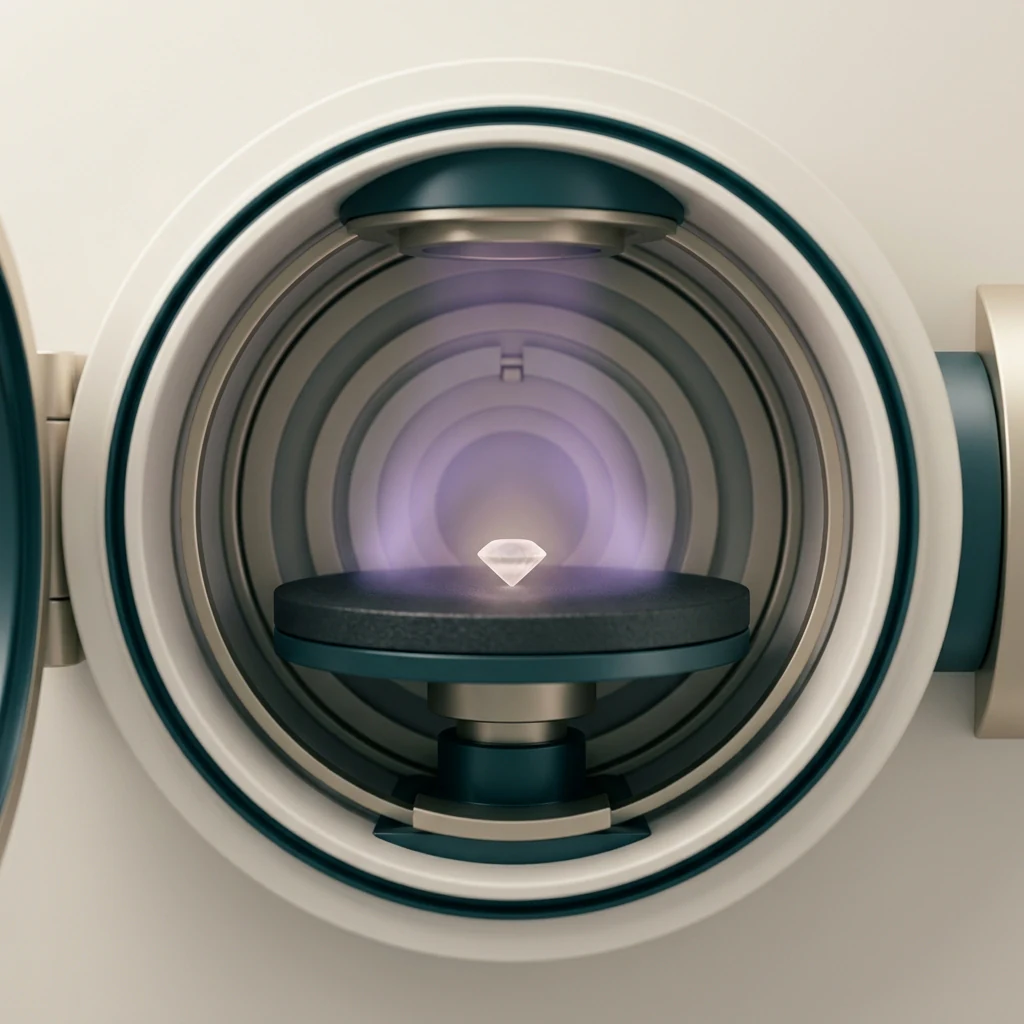
CVD stands for chemical vapor deposition. A thin diamond seed plate sits inside a sealed vacuum chamber while a carbon-rich gas, methane mixed with hydrogen in many processes, flows over it. An energy source, usually a microwave plasma, breaks the gas molecules apart so carbon settles onto the seed and bonds into diamond, building the crystal upward in thin layers of new material over a growth run measured in days or weeks. Because growth happens one layer at a time, the process rewards patience and precise control over speed.
Compared with the press, the CVD chamber runs at moderate pressure and more moderate temperatures, and growth is deliberately slow and finely controlled. Many CVD-grown crystals receive a post-growth treatment, HPHT treatment among them, to improve color, though not every stone needs it. Color and clarity still vary by run, treatment and cutting, so the method label never substitutes for a grading report that records the stone as it actually is. The label answers how the stone grew; the report answers what it is.
- Grows on a flat seed plate inside a sealed vacuum chamber.
- Carbon comes from an activated, carbon-rich gas.
- Deposits diamond layer by layer, atom by atom.
- Some stones receive post-growth treatment to adjust color.
What are HPHT lab diamonds?
HPHT stands for high pressure, high temperature, and the method works like a fast-forward version of the Earth's own diamond kitchen. A diamond seed is packed with a carbon source and a metal catalyst inside a growth cell, which a press squeezes and heats until the metal melts. Carbon dissolves into the molten flux and crystallizes onto the seed as diamond, growth that continues until the crystal reaches its intended size and the press is slowly brought back to room conditions.
HPHT is the older of the two routes. Diamond growth under high pressure was demonstrated in the 1950s, decades before CVD matured into a commercial jewelry method, and modern presses now grow gem-quality crystals of meaningful size. As with CVD, some stones receive treatment to adjust color before cutting, and the crystals that emerge enter the same cutting, grading and setting pipeline as any diamond. The only asterisk is documentation: the origin is disclosed, the diamond is not, and the wearer notices neither.
- A press delivers very high pressure and very high temperature.
- A molten metal catalyst carries carbon to the seed.
- Conditions echo those in which natural diamonds formed.
- The older of the two commercial growth methods.

CVD vs HPHT: key differences
The differences between the two methods are real, but they are production fingerprints rather than quality verdicts. HPHT grows inside a press at extreme pressure and temperature, while CVD grows inside a vacuum chamber from an activated gas. Each route leaves its own signature in the crystal: HPHT material can carry metal-related growth features, and CVD material can show fine growth layering under magnification, details gemologists read in a laboratory setting but wearers never notice. The table below therefore stays with typical traits, not guarantees.
Neither signature makes a stone better. Color, clarity and usable crystal size depend on the individual run, on any post-growth treatment and on the cutter's decisions, not on the method label. Both routes ship stones across the full quality range, which is exactly why the method cannot act as a shortcut. Read the table as background, then judge each stone on its own documented specification, the way you would compare any two diamonds of different origins and different paperwork, and the method will quietly stop mattering.
| Aspect | CVD lab diamonds | HPHT lab diamonds |
|---|---|---|
| Growth conditions | A vacuum chamber at moderate pressure and moderate temperatures; carbon comes from an activated carbon-rich gas flowing across the seed | A press at very high pressure and very high temperature; carbon crystallizes onto the seed from a molten metal flux |
| Equipment | A sealed chamber with gas delivery and a plasma or another energy source that activates the gas | A large press holding a heated growth cell built around the seed and its carbon source |
| Growth speed and style | Builds upward from a seed plate in thin layers, a slower and finely controlled process | Grows around the seed within molten metal, often in fewer and larger crystals per run |
| Typical inclusions and growth marks | Layered growth features and occasional inclusions tied to the gas chemistry | Metal-flux inclusions and growth patterns tied to the press environment |
| Color as grown | Can range widely; brown or gray tones are common before any post-growth treatment | Can range widely; tints may appear that treatment can later reduce |
| Common post-growth treatment | HPHT or another treatment may be used to adjust color | Treatment may be used, depending on the individual stone |
These traits describe patterns commonly reported across production, not universal rules. Individual stones vary, and the grading report, not the growth method, is the record that defines a specific stone. When in doubt, trust the report over the method label.
Can you tell if a diamond is CVD or HPHT?
Not by eye. A polished CVD stone and a polished HPHT stone of similar color, clarity and cut look essentially the same, and the difference usually escapes even a well-equipped jewelry counter. Gemological laboratories read growth history through growth marks, inclusion patterns, spectroscopy and fluorescence imaging, instruments that examine the crystal at levels no loupe can reach, and often with several methods working together on one stone. The verdict lands on paper, not at the counter.
That is why the method usually reaches the buyer on paper rather than by sight. A grading report may name the growth method and any post-growth treatment alongside the 4Cs, and how the report records growth explains what the report's fields typically show. Buyers do not need to prefer one method over the other; the stone's documented qualities carry the decision, and the method stays origin information, not a buying signal. That is all the method needs to be.
- Appearance cannot reliably identify the growth method.
- Growth marks, inclusions and spectroscopy are laboratory tools.
- The report may name the method and any post-growth treatment.
- No method preference is required for a sound purchase.
Does the growth method change quality or price?
No fixed quality or price rule is attached to either method. A CVD stone is not automatically better, worse, more durable or more expensive than an HPHT stone. The 4Cs, cut, color, clarity and carat weight, still govern quality, and retail pricing follows the finished stone's documented specification together with the design, metal and setting around it, so two identical stones can land at different prices for reasons unrelated to growth. The method is simply not part of that equation, and no reputable report uses it as one.
What the method does change is the paperwork. Disclosing the growth method and any treatment is a transparency standard in the lab-grown market, not a quality verdict, so two stones with identical 4Cs can grow in different equipment and deserve the same calm evaluation. Judge the stone, read the report, and let the method stay background information: it explains the stone's history, while the 4Cs and the setting describe the piece you will actually wear, the piece the price should be judged on.
- Compare finished stones on the same 4Cs, not on the method.
- Read the report for growth method and post-growth treatment.
- Check that the listing's wording matches the documentation.
- Treat method labels as origin information, not quality grades.
Editorial illustration created for Belaroq with Gemini 3.1 Flash Image via APIYi.
CVD vs HPHT questions, answered
Concise answers to the growth-method questions buyers search for.
What are CVD lab diamonds?
CVD lab diamonds are diamond crystals grown by chemical vapor deposition: a thin seed plate sits in a vacuum chamber while an energy source, usually a microwave plasma, breaks down a carbon-rich gas so carbon deposits onto the seed layer by layer. The resulting crystal is genuine diamond, cut and polished like any other stone.
What are HPHT lab diamonds?
HPHT lab diamonds are diamond crystals grown in a press under very high pressure and temperature, conditions that echo the Earth's interior where natural diamonds formed. Carbon carried through a molten metal catalyst crystallizes onto a diamond seed, and the result is genuine diamond ready to be cut, polished, set and worn exactly like any other diamond.
Can you tell if a lab grown diamond is CVD or HPHT?
Not by eye. A polished CVD stone and a polished HPHT stone can look essentially identical, and identifying the method requires laboratory equipment: magnification for growth marks and inclusions, plus spectroscopy and fluorescence imaging. A grading report may state the method directly, which is the practical way to know without a laboratory.
What is the CVD lab diamond growing method?
Chemical vapor deposition places a thin diamond seed in a vacuum chamber and feeds it a carbon-rich gas. The gas is activated, usually by a plasma, which breaks the molecules apart so carbon bonds to the seed as diamond. Growth proceeds layer by layer, and the resulting crystal is later cut, polished and set into finished jewelry.
What is the HPHT lab diamond growing method?
High pressure, high temperature growth places a diamond seed with a carbon source and a metal catalyst inside a press. Intense pressure and heat melt the metal, carbon dissolves into it, and diamond crystallizes on the seed. The method is the older of the two commercial growth routes, demonstrated for diamond in the 1950s.
Is CVD better than HPHT?
Neither is inherently better. Both methods produce genuine diamond, and both can yield stones of excellent or mediocre quality depending on the individual run, treatment and cutting. The growth method is a production detail; compare stones on cut, color, clarity, carat weight and the grading report instead, and let the equipment stay background.
Which is more expensive, CVD or HPHT?
There is no consistent rule. Retail price follows the finished stone's carat, color, clarity, cut, shape and setting, not the chamber it grew in. Because either method can produce stones across the quality range, the growth method is not a reliable price signal. Compare documented specifications and finished-piece prices instead.
Do CVD diamonds test as real?
Yes. CVD-grown stones are diamond, crystallized carbon in the diamond structure, so they show diamond's material properties, including hardness and thermal behavior. Standard testers may identify them as diamond, but only a gemological laboratory can read the growth method and origin. They are real diamond with a laboratory growth history, not a simulant.
Why does the growth method matter?
The method matters mainly for transparency and documentation: it records how the stone was made, and clear disclosure lets buyers compare fairly. For the wearing experience, sparkle, hardness and durability, the method makes little difference, because both routes produce the same diamond material. Knowing the method is knowing the stone's history, not judging it.
The practical takeaway
HPHT and CVD are two routes to the same material, and neither method grades a stone. Judge the finished diamond on its cut, color, clarity, carat and grading report, and treat the stated growth method as origin documentation rather than quality. That specification-first habit serves every purchase, from a solitaire to the engagement ring you wear daily, and it is the same habit that makes any diamond comparison fair, on any budget.