
How to Choose an Engagement Ring Setting: Protection, Profile and Daily Wear
The setting is not only the look around a center stone. It determines how the stone is held, how much of its outline remains visible, how the ring sits above the finger and what kind of inspection and cleaning the design may need. Start with daily wear, then compare the stone shape, setting architecture, profile and wedding-band fit as one finished piece.
There is no universally best engagement ring setting.
Choose around the wearer’s routine, the diamond shape, the protection wanted, tolerance for maintenance and the way a wedding band should sit. Open prongs show more of the stone; bezels cover more of its edge; lower profiles may snag less. Construction quality and periodic inspection still matter with every design.
Engagement ring settings at a glance
- A setting describes how the gemstone is secured; a style describes the ring’s overall design.
- Prongs expose more of the stone, while a full bezel surrounds its girdle with metal.
- Six prongs can provide more retention redundancy than four if one prong is damaged, but workmanship still controls.
- V-prongs or protective metal can help cover vulnerable points on pear, marquise, heart and princess shapes.
- Low profile does not automatically mean a wedding band will sit flush; inspect the gallery and bridge as well.
- Halo and pavé details usually create more small-stone settings to clean and inspect than a simple solitaire.
- No setting makes a ring suitable for impact, heavy lifting, machinery or every glove-based task.
Setting and style are related, but they are not the same decision
A setting describes the metal structure that secures a gemstone: prong, bezel, channel, flush, tension or bar. A style describes the composition: solitaire, halo, three-stone, cathedral, pavé or cluster. A solitaire may use prongs or a bezel, while a halo can combine one center setting with many small-stone settings.
Choosing a halo for visual spread does not answer how the center edge is protected. Choosing a bezel does not determine the overall style. Before approval, ask what holds each stone and what composition surrounds it.
| Decision | Examples | What it changes |
|---|---|---|
| Stone-holding setting | Prong, bezel, channel, flush | Edge exposure, retention structure, cleaning access and visible metal |
| Overall style | Solitaire, halo, three-stone, cathedral, pavé | Silhouette, visual scale, number of stones, profile and maintenance complexity |
| Finished specification | Stone + setting + band + metal + size | How the complete ring fits, wears and can be serviced |
Use precise terms in a custom brief. The word setting is often used casually for the whole ring, so confirm what each person means.
Start with the wearer’s routine, not a trend
Start with where the ring will be worn. Equipment, weights, gardening, climbing or frequent gloves may favor smoother edges and a lower profile. That does not make a ring impact-proof; remove fine jewelry around force, abrasion, chemicals or machinery.
For an open diamond view and cleaning access, compare prongs. For more girdle coverage, compare full and partial bezels. If a halo or pavé adds sparkle, include every small-stone setting in the maintenance decision.
| Priority | Start by comparing | Verify before ordering |
|---|---|---|
| Active routine or frequent gloves | Smooth bezel-like edges, lower profiles, simple bands | Actual side view, snag points and when the ring should be removed |
| Maximum center-stone visibility | Open four- or six-prong heads | Prong placement, workmanship and inspection access |
| Pointed diamond shape | V-prongs, protective tips or a bezel | Coverage of every vulnerable point and final outline |
| Lower maintenance preference | Simple solitaire with fewer accent stones | Cleaning access and service expectations |
| Flush wedding-band look | Compatible bridge, gallery and head height | A side-by-side CAD or physical fit check with the intended band |
| More visual spread | Halo, cluster or wider metal framing | Center-versus-accent specification and repair complexity |
These are starting points, not guarantees. Construction quality, metal condition and the wearer’s habits affect every option.
Prong vs bezel: compare exposure, protection and upkeep
Prongs are narrow supports bent over the stone’s edge. They leave much of the outline visible, but expose more girdle and can catch fabric if raised or damaged. Movement, a new snag or a visible gap deserves inspection.
A full bezel surrounds the girdle with a continuous rim; a partial bezel leaves sections open. More perimeter coverage creates a smoother outline, but also shows more metal and can change the apparent outline. It does not make the ring immune to deformation or impact.
This is not simply sparkle versus safety. Cut drives diamond brightness; the setting changes visible edge, side access and surrounding metal. Compare finished rings under equal lighting and ask how each construction is serviced.
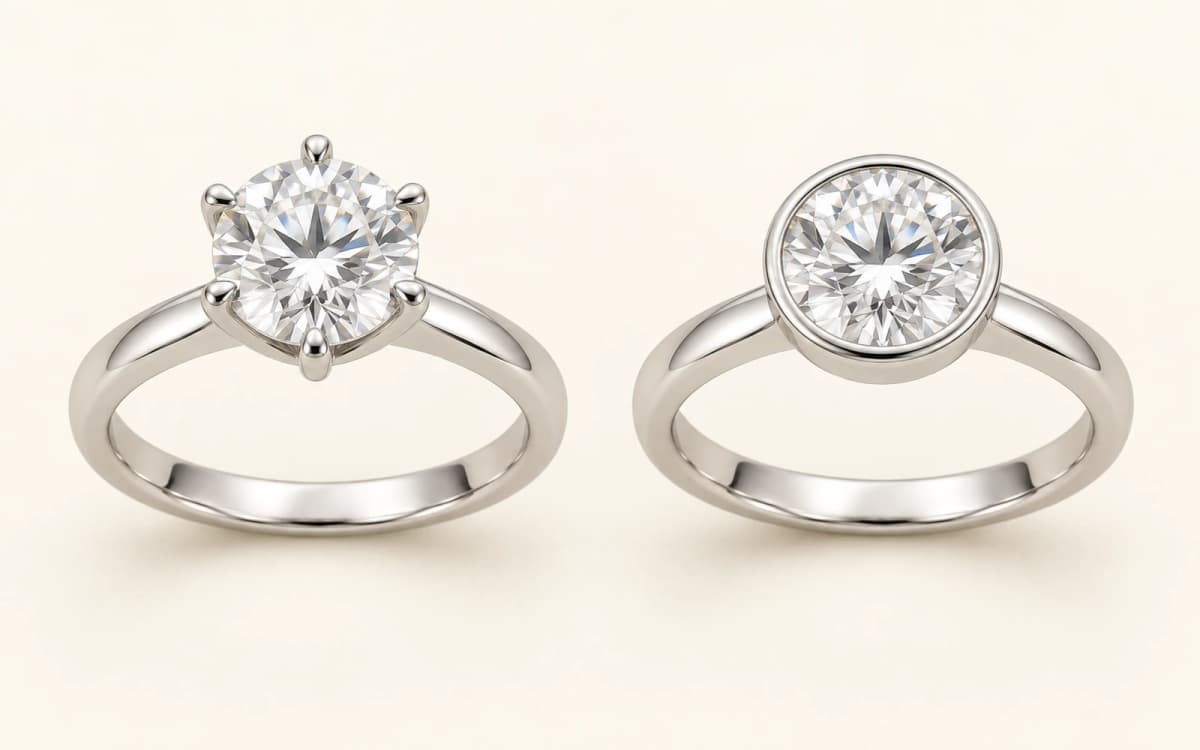
| Factor | Open prong | Full bezel |
|---|---|---|
| Visible outline | More of the diamond edge remains visible | A metal rim frames and covers the girdle |
| Edge exposure | More exposed between prongs | More perimeter coverage |
| Snag potential | Depends on prong height and finish | Usually a smoother outer edge |
| Inspection | Individual prongs can be viewed and checked | Check rim condition, stone movement and ring deformation |
| Appearance | Open, classic and stone-forward | Defined, streamlined and metal-framed |
A well-made prong setting can be secure and a bezel can still be damaged. The design name alone does not prove workmanship.
Four prongs, six prongs and V-prongs solve different problems
Four prongs show more of a round outline and may make it appear slightly squarer. Six distribute contact around more points and may add redundancy if one is damaged, but they add visible metal and still require precise alignment.
V-prongs wrap metal around vulnerable pear, marquise, heart or princess points. They must fit the individual stone and cover the point without creating a sharp snag.
Count is not a quality grade. Thickness, symmetry, seating, girdle contact, metal and bench work matter. Seek inspection if the stone clicks, shifts, catches more than before or shows a gap.
- Four prongs: less metal across the outline and a very open look.
- Six prongs: more contact points and potential redundancy, with more visible metal.
- V-prongs: targeted coverage for vulnerable points and corners.
- Shared prongs: a lighter look for adjacent stones, but one prong may affect more than one stone.
- Tiny pavé prongs or beads: many individual retention points that benefit from careful inspection.
Profile, basket, cathedral and wedding-band fit must be checked from the side
Profile describes how the ring rises from the finger; no universal millimeter line makes every design high or low. A lower head may reduce leverage, while a higher one may leave more room for a straight wedding band. Geometry matters more than the label.
A basket supports the stone below; a cathedral raises the shoulders toward the center. Either can use different heights. Bridge, gallery, bezel edge and accents determine whether another band sits flush or leaves a gap.
Check a true side view or CAD with the intended band. Review finger clearance, exposed edges, cleaning access and ring-to-ring contact. Record a required flush fit in the production specification.
| Area | Question to answer | Why it matters |
|---|---|---|
| Head height | How far does the center setting rise above the finger? | Affects leverage, snagging and visual presence |
| Basket and gallery | Is there cleaning access and enough structural support? | Affects care and the construction below the stone |
| Bridge | Can the intended band pass beside or beneath the head? | Determines flush fit or an intentional gap |
| Contact points | Where will another ring rub? | Helps prevent avoidable wear between the two rings |
The current catalog images are not dimensional drawings. Confirm profile claims with the final CAD or production record.
Halo, pavé and three-stone styles add separate setting decisions
A halo widens the field of sparkle, but its stones need their own settings and cleaning access. Pavé adds many beads or prongs to inspect. A three-stone design adds side-stone shape, height, spacing and protection.
Complexity is not automatic fragility, and a solitaire is not maintenance-free. Ask whether stones can be replaced, whether resizing affects the set area and where pavé should stop if future sizing is likely.
Visual size is not diamond weight. Record center carat, accent carat, stone count and measurements separately so the finished piece can be checked against the approved design.
Belaroq comparison: two 0.50 ct, 14K white-gold directions
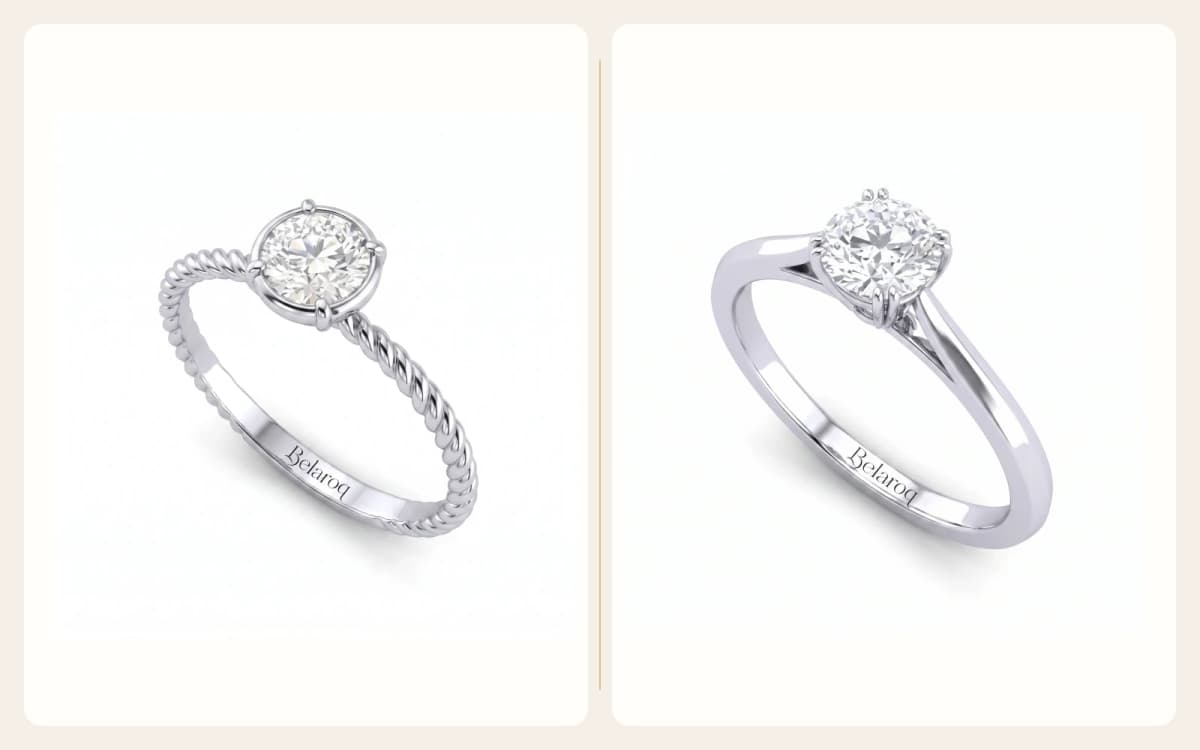
In the Belaroq catalog snapshot reviewed on September 20, 2026, BEL-ER-000033 and BEL-ER-000037 both record 0.50 ct and 14K white gold. Their stone origins differ, so this comparison covers visible architecture only—not value, optical performance or durability.
BEL-ER-000033 shows four primary contacts, a visible circular rim around much of the center outline and a twisted band. Because its catalog setting term is generic, confirm the final technical name and coverage from CAD.
BEL-ER-000037 shows an open six-prong solitaire architecture with split shoulders. Its visible edge is more open, but the images do not establish exact profile height or wedding-band fit.
| Record | Shared specification | Visible difference | Do not infer |
|---|---|---|---|
| BEL-ER-000033 | 0.50 ct; 14K white gold | Four contact points with a visible perimeter rim; twisted shank | Exact profile height, final construction name or performance |
| BEL-ER-000037 | 0.50 ct; 14K white gold | Open six-prong center; split shoulder | Exact profile height, wedding-band fit or guaranteed security |
Catalog specifications and imagery can change. Reconfirm the selected SKU, CAD, stone report and production record when ordering.
Use five checks before approving an engagement ring setting
A product image is a starting point, not a production specification. Before approval, connect the design to the selected stone, metal, size and service expectations. Keep approved images and written details together for the final check.
Resolve uncertainty before approval. The record should identify stone shape and measurements, holding metal, side profile, intended wedding-band relationship and areas that may be difficult to resize or repair.
- Protection: which edges, points and corners are exposed or covered?
- Profile: what is the actual side height, and where can the ring catch?
- Fit: will the intended wedding band sit flush, leave a gap or require a contour?
- Maintenance: which prongs, beads, rims and accent stones need inspection and cleaning?
- Specification: do the CAD, stone report, metal, ring size and written order record agree?
Care for the setting without relying on a fixed calendar
Inspection timing depends on wear, design, work and impacts. Watch for movement, clicking, a changed prong, new snag, bent band or rim gap. Stop wearing the ring and seek qualified inspection if anything changes.
Warm water, mild soap and a soft brush suit many diamond-and-gold rings, but other gemstones, treatments or delicate construction may require different care. An ultrasonic can worsen existing looseness and does not replace inspection.
Protect the ring from avoidable impact, keep it clean enough to inspect and respond promptly when its feel or appearance changes.
The hero and Belaroq comparison use catalog imagery. The prong-versus-bezel visual is an AI-assisted editorial illustration and is conceptual, not a scale drawing or production specification.
Engagement ring setting questions
Use these answers to narrow the design, then confirm the exact CAD and production specification.
What is the best engagement ring setting for an active lifestyle?
Compare smoother, lower-profile designs with fewer exposed edges. No setting is impact-proof; remove the ring for lifting, machinery, contact sports and unsafe work.
Is a bezel setting safer than a prong setting?
A full bezel covers more girdle and usually has a smoother perimeter. Well-made prongs can also be secure; neither name guarantees workmanship or prevents damage.
Are six prongs better than four?
Six add contact points and possible redundancy; four expose more outline. Correct seating, symmetry, metal condition and finish matter more than count alone.
Which setting protects a pear, marquise or princess diamond?
Compare V-prongs, protective tips or a bezel covering vulnerable points. The protection must fit the individual stone and be confirmed in the final design.
Does a low-profile engagement ring snag less?
It may reduce leverage, but snagging also depends on prong finish, exposed corners, decoration and activity. Review a true side view before deciding.
Will a low-profile ring sit flush with a wedding band?
Not necessarily. Basket, gallery, bridge, bezel edge or accents may block a straight band. Check both rings together in CAD or in person.
Can an engagement ring setting be changed later?
Sometimes. Stone dimensions, head, shank, accents, metal condition and the new design determine feasibility. Treat resetting as a new technical review.
Can Belaroq customize the setting and profile?
Custom Studio captures direction, stone shape, metal, size and notes. The approved CAD and written specification—not the preview alone—control production.
Choose the complete ring, not a setting name
A strong choice connects daily wear, stone shape, edge protection, profile, wedding-band fit and maintenance in one approved specification. Use setting labels to start the conversation, then verify the actual construction from multiple angles before production.