
Emerald Cut Diamond: The Complete Guide
The emerald cut is the defining step-cut diamond: a rectangular outline with cropped corners, long parallel facets, and a hall-of-mirrors flash that replaces the round brilliant's firework sparkle. Part of our complete shape library, this page covers what an emerald cut diamond is, why clarity and color deserve extra attention, the best ratios and settings, and how carat, size and price fit together — from an understated 1 carat to a statement 5 carat stone — so you can choose with confidence.
Emerald cut diamonds at a glance
- An emerald cut diamond is a rectangular step cut with long, parallel facets.
- Its corners are cropped for protection and a clean, elegant silhouette.
- Step facets create a hall-of-mirrors flash rather than brilliant sparkle.
- The shape has Art Deco heritage and a refined, classic look.
- The open table and step facets reveal inclusions and color more readily.
- Popular length-to-width ratios range from 1.3 to 1.5.
- The shape and grading standards are the same for lab-grown and natural stones.
What is an emerald cut diamond?
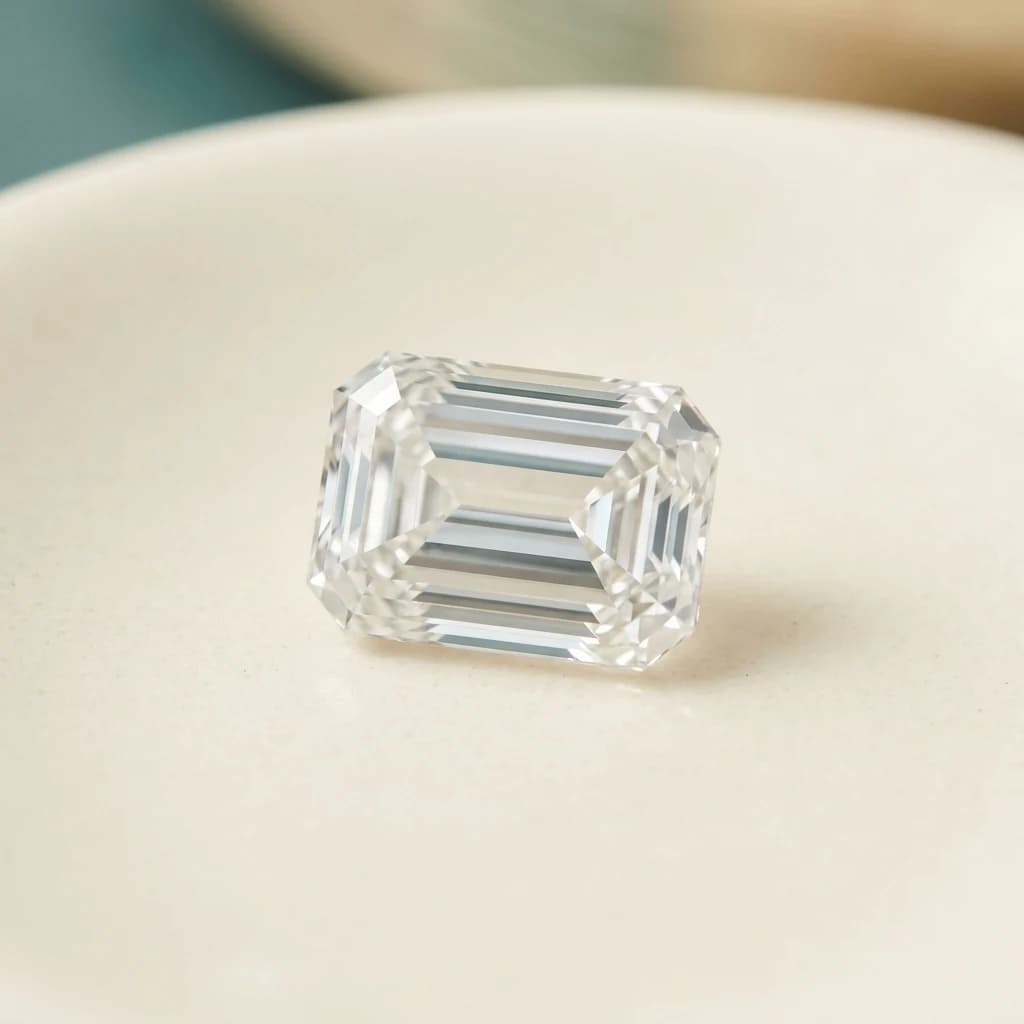
An emerald cut diamond is a rectangular step cut whose long, parallel facets form a series of broad planes running down the stone. Where a round brilliant uses dozens of small, angled facets to scatter light, the emerald cut's open pavilion returns light in clean, dramatic flashes — an effect often described as a hall of mirrors. Its corners are cropped at roughly 45 degrees, which protects those vulnerable points from chipping and gives the outline its distinctive, architectural character. Because the stone carries so few facets, each one matters: a slight tilt or a poorly positioned window can mute the hall-of-mirrors effect, which is why proportion and polish deserve close attention when comparing stones.
The cut takes its name from the emerald gemstone, for which the style was originally developed, and it has been a fixture of fine jewelry since the Art Deco era, when its geometric lines matched the period's design language exactly. Most emerald cut diamonds carry a length-to-width ratio between 1.3 and 1.5, producing an elongated, elegant profile that stretches across the finger. The shape reads as understated and deliberate, which is why it has stayed a favorite for engagement rings and heirloom-style pieces.
Emerald cut pros and cons
The emerald cut rewards the buyer who values elegance over intensity, and the same holds for emerald cuts grown in a lab. Its large, open facets and long silhouette create a sophisticated, understated flash of light rather than constant sparkle, and that restraint reads as deliberate rather than quiet. The elongated shape flatters long fingers and often makes a stone look larger than its carat weight suggests, because the broad table spreads across more of the finger. The straight lines carry a classic, luxury look that suits both minimalist solitaires and ornate Art Deco settings.
The trade-off is transparency. Because the emerald cut shows its interior so openly, inclusions and color are easier to see than in a brilliant, and cut quality is less standardized than for rounds, so two stones with similar reports can look quite different in person. Buyers who want maximum fire may prefer a round; buyers who want a clean, architectural flash will find the emerald cut worth the extra attention. None of this makes the shape fragile or flawed; it simply means the selection criteria shift, with clarity and proportion doing the work that sparkle does in a round.
- Sophisticated, understated flash of light instead of constant sparkle.
- Elongated shape flatters long fingers and elegant hand styles.
- Often appears larger than its carat weight because the table reads wide.
- Classic, luxury look with strong Art Deco heritage.
- Open facets reveal inclusions and body color more easily than a brilliant cut.
- No brilliant sparkle; the effect is calm flashes, not fire.
- Cut quality is less standardized, so comparing stones takes more care.
Why clarity and color matter more
A step cut is the most revealing diamond style. The broad, flat facets act like windows into the stone, so what sits inside — inclusions, graining, tint — shows more clearly than in a brilliant, whose many small facets break up and hide the interior. That means clarity deserves more attention on an emerald cut than on a round, and it is worth reviewing the actual stone or its grading report, with the clarity grades in hand, rather than relying on a grade label alone.
Color works the same way. The large, open table concentrates body color, so tint is easier to notice face-up than in a round brilliant — the the color grades runs from D to Z — and many buyers find that stepping up one clarity or color grade on an emerald cut has more visible impact than the same step on a round. Belaroq's catalog rule is a useful benchmark here: the same product in VVS clarity lists about 30% above its VS version, which makes the gap between adjacent grades a real budget decision rather than a technicality.
| Factor | Why it matters | Practical guidance |
|---|---|---|
| Clarity | The open table and step facets act like windows into the stone. | Start at VS2 or VS1 and confirm the stone is clean to the unaided eye at arm's length. |
| Color | The large table concentrates body color, making tint easier to notice face-up. | Near-colorless grades such as G or H sit near a practical balance for most buyers. |
| Cut | There is no single emerald cut grade, so proportions vary between stones. | Compare length-to-width ratio, table size and symmetry across the stones you like. |
| Price | Each step between grades carries a catalog price difference. | In Belaroq's catalog, the same design in VVS lists about 30% above its VS version. |
The 30% difference is Belaroq's catalog rule for identical designs, not a universal market figure; individual stones vary.
Best settings and ratios
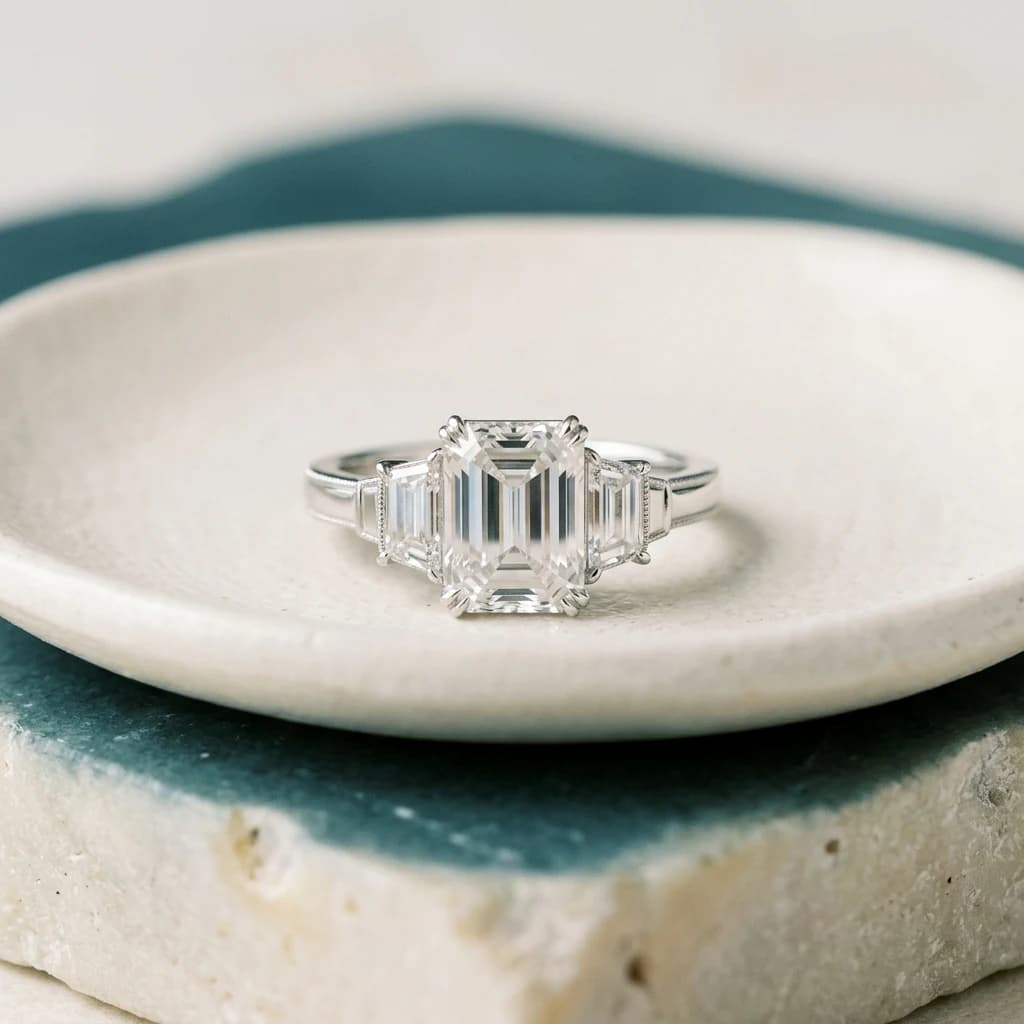
The emerald cut is a natural center stone, and the right choice among setting styles changes its character. A solitaire lets the elongated shape stand alone on a clean band; a three-stone ring pairs it with step-cut or tapered sides for extra presence; an east-west orientation turns the stone sideways across the finger for a modern look. A halo frames the open table with small brilliants and adds sparkle around the calm center, a pairing seen across many emerald cut diamond ring designs, while channel-set bands repeat the stone's straight lines. High-set prongs keep the table open and the corners visible, while a bezel frames the stone with metal for a more protected, modern look.
Ratio shapes character as much as setting does. A 1.3 length-to-width ratio reads more square and classic, while a 1.5 ratio reads longer and more contemporary, and ratios beyond that can look slender and dramatic. Most buyers find 1.3 to 1.5 the most versatile range, since it keeps the hall-of-mirrors effect even across the stone. If you like the geometry but prefer a square outline, the step-cut family's square sibling is the Asscher cut. Buyers shopping for emerald cut diamond engagement rings often match ratio to band style: slim bands suit longer ratios, while wider bands balance a squarer outline.
Carat, size and price
Carat is weight, not face-up size, and an emerald cut often looks larger than a round of the same weight because its length spreads across the finger. A well-proportioned 1 carat emerald cut diamond typically measures longer than a 1 carat round, so buyers who want visible presence often achieve it with less weight — a point worth checking against how lab-grown pricing works. When comparing stones, look at millimeter dimensions and ratio alongside carat, because two stones of equal weight can face up quite differently.
Price per carat rises with size, and the emerald cut's openness magnifies that decision. An emerald cut diamond 5 carat in weight carries a much larger table, so inclusions, tint and proportion choices become far more visible than in a 1 carat stone. Buyers scaling up should expect to spend more per carat and to compare stones more carefully, because small differences in clarity and ratio read strongly at that size.
| Carat context | What changes | Practical note |
|---|---|---|
| 1 carat | Face-up size depends on ratio and millimeter dimensions, not weight alone. | Compare length and width measurements across stones of the same carat weight. |
| 5 carat | A much larger table makes inclusions, tint and proportion choices more visible. | Expect to pay more per carat and to spend more time comparing individual stones. |
| Pricing | Belaroq anchors its catalog to lab-grown stones, with no fixed price per carat. | Some designs sit in the jewelry-under-500 collection; larger carat-plus pieces list higher. |
Prices are set per finished piece on Belaroq, not per carat, so comparisons should be made between specific designs.
Emerald cut vs round brilliant
These two shapes sit at opposite ends of the light spectrum. The round brilliant cut is engineered for maximum sparkle, with dozens of small facets scattering light in every direction. The emerald cut is engineered for architecture: a few broad, parallel facets return light in long, clean flashes. Neither is better; they are different personalities. The round reads lively and classic, while the emerald cut reads calm, graphic and deliberate.
On the finger, the differences extend beyond light. A round brilliant covers the finger with brightness, while an emerald cut stretches it with an elegant line that many buyers find flattering. Round brilliants also carry the most standardized cut grades, so comparisons are simpler; emerald cuts ask for a little more hands-on comparison. If you want fire and tradition, choose round. If you want understated flash and a longer look, choose emerald cut. For a middle path, some buyers pair a round center with step-cut side stones, or set an emerald center inside a brilliant halo, borrowing a little of each shape's character.
Illustration éditoriale créée pour Belaroq avec Gemini 3.1 Flash Image via APIYi.
Emerald cut diamond questions, answered
Concise answers to the questions buyers ask most about emerald cut diamonds.
What is an emerald cut diamond?
An emerald cut diamond is a rectangular step cut with long, parallel facets and cropped corners. The style was originally developed for emerald gemstones and later applied to diamonds, where it became a signature of Art Deco jewelry. Instead of brilliant sparkle, its broad facets return light in clean, mirror-like flashes, giving the stone a calm, architectural look with straight lines and an elongated profile.
Do emerald cut diamonds sparkle?
They flash rather than sparkle. The emerald cut's broad, parallel facets return light in wide, mirror-like flashes instead of the many small reflections of a round brilliant. The effect is dramatic but understated, and it is one of the main reasons buyers choose the shape. In low or scattered light, brilliants also tend to show more fire and movement than a step cut.
What clarity is best for an emerald cut?
There is no single best grade, but the open facets reward careful selection. Many buyers start at VS2 or VS1 and confirm the stone is clean to the unaided eye at arm's length. Because step cuts reveal inclusions more readily than brilliants, checking the actual stone or its grading report matters more than the grade label alone.
What ratio is best for an emerald cut?
Most emerald cut diamonds sit between 1.3 and 1.5 length-to-width. A 1.3 ratio reads more square and classic, while 1.5 reads longer and more contemporary, and ratios beyond that look slender and dramatic. The best ratio is the one that matches the silhouette you want, so compare stones with different proportions side by side before deciding.
Are emerald cut diamonds cheaper than round?
Per carat, emerald cut diamonds often list below round brilliants of comparable weight and quality, partly because rounds carry the highest demand and the most standardized cut grading. On Belaroq, prices are anchored to lab-grown stones, so the practical approach is to check current catalog pricing for both shapes rather than assume a fixed percentage gap between them.
What settings work best with emerald cut?
Solitaires and three-stone settings let the elongated shape stand out, east-west orientations modernize it, and halos add sparkle around the calm center. Channel-set bands repeat the stone's straight lines for a coordinated look, which is why they appear so often in emerald cut diamond engagement rings. Each works well; the choice comes down to how much presence and sparkle you want around the center.
How much is a 1 carat emerald cut diamond?
There is no single 1 carat emerald cut diamond price, because cut quality, color, clarity, setting and metal all move the total. Belaroq anchors its catalog to lab-grown stones, which list below comparable natural prices, with some designs in the jewelry-under-500 collection and carat-plus pieces priced higher. Compare specific stones rather than averages.
Do emerald cuts look bigger?
Often yes, for their carat weight. The elongated shape spreads the table lengthwise across the finger, so an emerald cut can look larger than a round brilliant of the same weight. Millimeter dimensions and ratio matter more than carat here, which is why comparing actual measurements is the reliable way to judge face-up size between stones.
Is emerald cut good for an engagement ring?
Yes. Emerald cut diamond engagement rings are among the most requested styles, prized for their clean lines, understated flash and Art Deco character. The shape flatters longer fingers and suits both minimalist and ornate settings. The main practical point is to choose clarity and color carefully, since the open facets show the stone's interior more than a brilliant cut would.
The practical takeaway
The emerald cut is a choice of character: calm flashes instead of firework sparkle, straight lines instead of circles. Its open facets reward attention to clarity and color, and its 1.3 to 1.5 ratios let you tune the silhouette from classic to modern. On Belaroq, lab-grown emerald cuts keep prices anchored and transparent, and a custom piece can reach any size you have in mind, usually within about 30 days. Pick the ratio, protect clarity, and the setting will follow naturally — browse our the engagement ring collection to see the shape in context.