
Cushion Cut Diamond: The Complete Guide
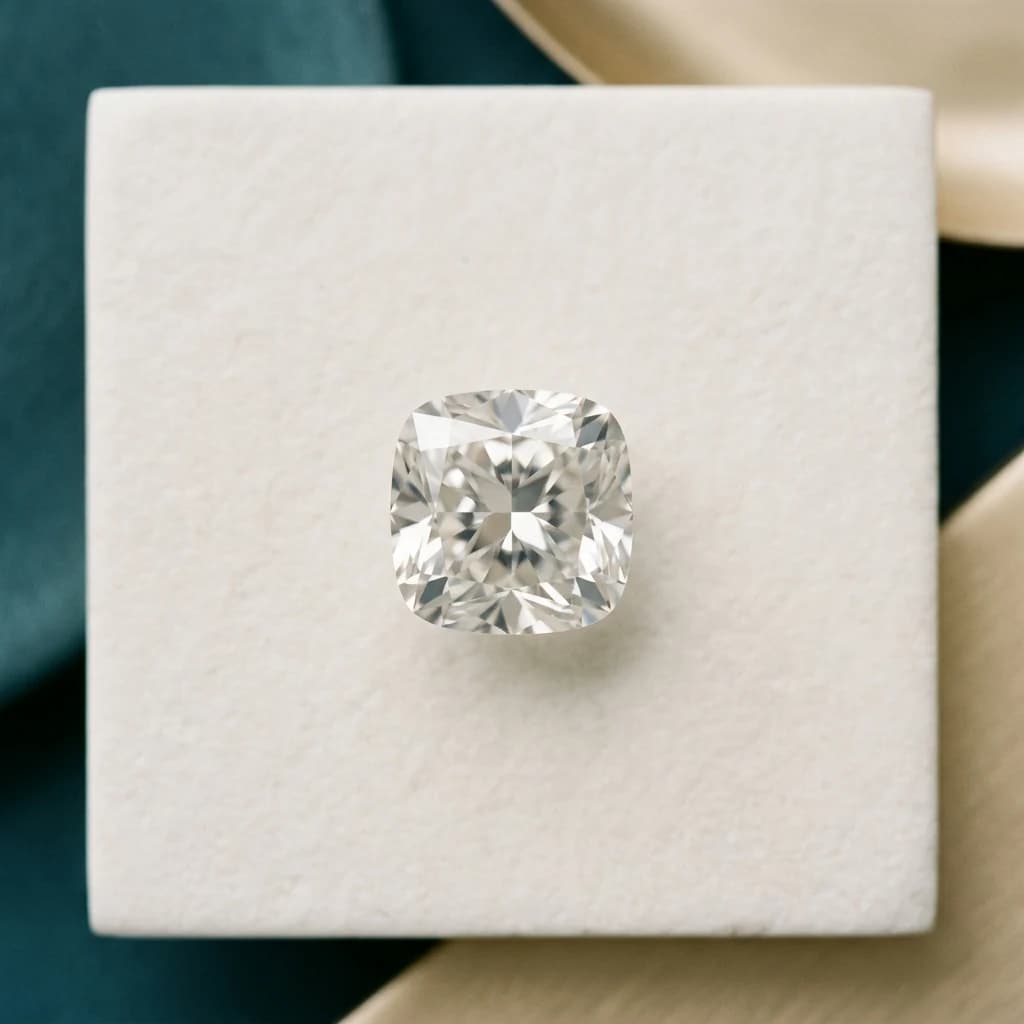
A cushion cut diamond is a square or gently rectangular diamond whose corners are rounded, creating the soft, pillow-like outline that gives the shape its name. Descended from the old mine cut, today's cushions span antique-style stones with chunky facets and modern brilliant cuts with fine, intricate light patterns. The name describes the outline; the facet pattern describes how the stone behaves in light. This guide explains what defines the shape, its strengths and trade-offs, the best settings and ring styles, and how cushion compares with radiant and princess cuts; the shape comparison covers the rest of the family.
Cushion cut diamonds at a glance
- A square or slightly rectangular outline with rounded corners, often called a pillow shape.
- Descended from the old mine cut, giving the shape an antique, romantic character.
- Two main facet families: antique-style chunky facets and modern brilliant patterns, including crushed ice.
- A favorite center stone for halo settings, which enlarge the perceived face-up size.
- Rounded corners are less exposed to knocks than the sharp corners of a princess cut.
- Typically priced below comparable round brilliants, making the shape a strong value.
- Available in the same outline and quality range whether lab-grown or natural.
What is a cushion cut diamond?
A cushion cut diamond is a diamond shaped as a square or slightly elongated rectangle with gently rounded corners, so the face-up outline resembles a pillow or cushion. Most cushions are drawn as squares, but rectangular versions with length-to-width ratios beyond roughly 1.10 or 1.15 are common, and the exact ratio changes how the stone reads on the hand, with square versions reading classic or contemporary depending on the facet pattern. Unlike a princess cut, whose corners meet at sharp ninety-degree angles, the cushion rounds every corner, which softens the silhouette and changes the way light travels near the edges. That rounded-corner outline, more than any facet detail, is what makes a cushion recognizable.
The shape is old. The cushion cut is the direct descendant of the old mine cut, a nineteenth-century cutting style with a high crown, a deep pavilion, a small table and large, chunky facets that return broad flashes of light. Old mine cuts were cut by hand to follow the rough crystal, which is why many antique cushions have slightly irregular outlines. Today the name covers a much wider family. Antique-style or chunky cushions recreate the old facet arrangement; modern brilliant cushions pack many smaller facets into the same outline, sometimes in the fine, scattered pattern known as crushed ice, and hybrid cuts blend the two. Because all of these are sold as cushion cut, the facet style matters more than the name when comparing stones.
Cushion cut pros and cons
The cushion's advantages are mostly about character and practicality. The rounded outline produces a soft, romantic quality of light; brilliant cushions sparkle, but with a broader, gentler flash pattern than the crisp pin-fire sparkle of a round brilliant, which many buyers find warmer and more personal. Rounded corners also make the stone more forgiving in daily wear, because corners are the parts of a diamond most exposed to knocks and chips, and a cushion has none that are sharp, which makes the shape practical for an active everyday life. The shape pairs naturally with halos and vintage styling, and because round brilliants command the highest demand, a cushion can often be had at a lower price for comparable documented characteristics; the same value logic applies to cushion cuts grown in a laboratory.
The trade-offs come from variety and perception. Cushion is less standardized than round: there is no single crown angle or facet count, and the range from chunky antique patterns to fine crushed-ice brilliants is wide. That variety makes like-for-like comparison harder, because two cushions of the same carat weight and color grade can look quite different in light and even in outline, so the buyer must judge the individual stone rather than the name. Cushions can also face up slightly smaller than their carat weight suggests, since some designs carry more depth below the girdle. None of this makes the shape worse; it makes the inspection step more important, which is manageable with photos, video and report measurements.
- Pros: soft, romantic light return with broader flashes than a round brilliant.
- Pros: rounded corners are far less likely to chip than the sharp corners of a princess cut.
- Pros: the vintage character suits halo, pavé and Art Deco styling.
- Pros: halo-friendly proportions that center beautifully inside a ring of accent diamonds.
- Pros: usually a strong value, often priced below comparable round brilliants.
- Cons: less standardized than round, with wide variation in proportions and facet patterns.
- Cons: chunky, crushed-ice and hybrid patterns all sell under one name, so comparing stones takes more work.
- Cons: some cushions face up slightly smaller than their carat weight suggests.
- Cons: the soft look is not for everyone; buyers wanting crisp geometry may prefer princess or radiant.
- Cons: no standardized cut grade from most laboratories, so light return must be judged by eye and measurements.
Best settings and ring styles
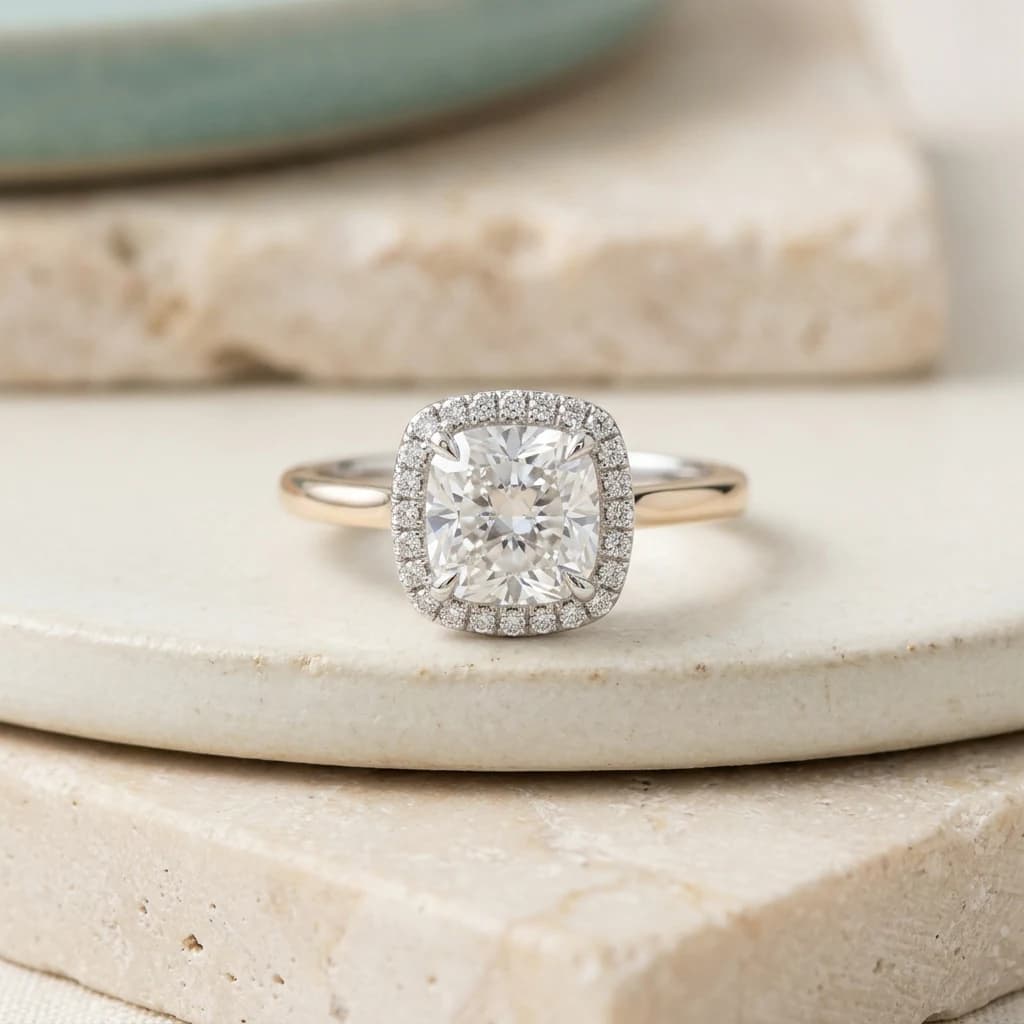
The halo is the most popular setting for cushion cut diamonds, and the pairing is not accidental. A ring of small accent diamonds around the center echoes the cushion's rounded outline, making the center stone read noticeably larger and reinforcing the vintage, romantic character that buyers choose the shape for. A cushion cut diamond with halo styling can be scaled to almost any budget because the halo, not a larger center stone, supplies the extra presence, while accent diamonds add total carat weight without adding depth. Because the halo is made of small stones, it also multiplies sparkle at normal viewing distance, which is why the combination has stayed popular since the Art Deco period. Belaroq builds halo engagement rings as made-to-order pieces, so the center cushion, metal and accent configuration are chosen together rather than settled for as a stock combination; the setting styles guide guide covers the wider range.
The other classic options each change the mood. A solitaire puts one cushion on a plain band, keeping all attention on the stone's outline and letting a chunky antique-style facet pattern speak for itself. A three-stone ring frames the cushion with matched side stones, which adds history and presence, often with a subtle Art Deco flavor. Pavé adds small stones along the band for continuous sparkle without touching the center. Bezel settings, while less common for cushions, wrap the stone in a protective metal rim for an active lifestyle. Across all of these, vintage and Art Deco styling suits the shape naturally, from milgrain edges to engraved galleries.
- Halo: the most popular cushion setting; a ring of accents enlarges the perceived center.
- Solitaire: one cushion on a plain band, keeping all attention on the stone.
- Three-stone: side stones frame the cushion with added history and presence.
- Pavé: small stones along the band add continuous sparkle without touching the center.
- Bezel: a metal rim protects the stone and suits an active lifestyle.
- Vintage detailing: milgrain edges, engraving and filigree suit the shape naturally.
Cushion cut vs radiant cut
Cushion and radiant cuts are easy to confuse because both can be square or rectangular and both typically use brilliant-style faceting. The difference is in the corners and the character of the light. A cushion rounds all four corners into soft curves, which gives the stone a gentle, romantic outline and a slightly antique feel even in a modern cut. A radiant cut trims its corners straight across into clean diagonal edges, so the outline stays geometric and modern. The radiant's facet pattern is also busier, with many small facets that return lively, broken flashes of light, while a cushion's look ranges from broad chunky flashes to fine crushed-ice shimmer depending on the facet style chosen.
How to choose between them is mostly a question of personality. Buyers who want softness, romance and a vintage or antique-leaning ring usually prefer the cushion; buyers who want crisp geometry and a more contemporary, architectural presence usually prefer the radiant. There is also a practical angle: the cushion's fully rounded corners present fewer exposed edges than the radiant's cut corners, although both are more protected than a princess cut's sharp points. Sparkle differs too, with the radiant's fine, busy pattern reading as more electric and the cushion's broad flashes reading as more relaxed. If the two look close in photos, compare the corners: curves mean cushion, straight trims mean radiant. Neither shape is better; the right choice is the outline and light character the wearer will still love in a decade.
Cushion cut vs princess cut
Princess and cushion are the two square diamond shapes buyers compare most often, and they sit at opposite ends of the style spectrum. A princess cut has straight sides, sharp ninety-degree corners and a precise, geometric modified-brilliant facet pattern that returns a crisp, almost futuristic sparkle. A cushion rounds the same basic square and softens its whole character, so the two read completely differently even in identical carat weights. The princess is exact and modern; the cushion is soft and vintage. Both are brilliant cuts, so both return plenty of light, but the princess concentrates it into fine, intense flashes while the cushion's broader facet arrangements, particularly the antique-style ones, return slower, larger flashes. The princess cut's corners also make it the more geometric statement, while the cushion's curves make it the more romantic one.
Value and wear put the comparison into practice. Princess cuts are efficient users of rough, so they can price attractively, and cushions are usually modestly priced as well; among laboratory-grown stones, both shapes are generally more affordable than a comparable round brilliant, with the final figure set by the documented stone and design. For daily wear, the cushion has the advantage: its rounded corners have no points to chip, while a princess cut's four corners need a protective setting, typically V-prongs or a bezel, to survive an active lifestyle. Buyers who want maximum protection and softness lean cushion; buyers who want maximum geometry and sparkle intensity lean princess. Both are excellent engagement ring choices.
Size, carat and price
Size is the first decision, and for a cushion it is about ratio as much as carat. A perfectly square cushion with a length-to-width ratio around 1.00 reads as classic and centered, while an elongated cushion with a ratio from about 1.10 to 1.20 or beyond reads as larger and slimmer, flattering longer fingers and giving the ring a more modern line. Because carat is a weight, not a visual size, the weight-versus-size distinction distinction matters: two one-carat cushions can face up differently depending on where their weight sits. A stone with more depth below the girdle hides part of its weight, so a well-chosen elongated cushion can look larger than a square cushion of identical carat weight. For most hands, either works; the choice is between a centered square presence and a longer, finger-flattering line.
Price then follows from the documented stone, the design and the production path. Belaroq does not quote invented market statistics, so the useful anchors are the company's own. Entry into laboratory-grown diamond jewelry is deliberate: complete pieces in the jewelry-under-500 collection start at or below $500, and real laboratory-grown diamond pieces are reachable without undisclosed quality claims. As the specification rises, so does the price; within Belaroq's catalog, a product's displayed VVS price sits 30% above the same product's VS price, a fixed relationship captured in a July 2026 snapshot of the catalog. Custom cushion pieces follow the made-to-order path and typically take about 30 days from confirmed specification to completion. The lab-grown pricing guide guide covers the wider pricing picture.
- Choose the ratio first: square near 1.00 reads classic; elongated around 1.15 reads larger and slimmer.
- Compare millimeter dimensions alongside carat weight, because carat measures weight, not face-up size.
- Entry anchor: complete lab-grown pieces in the jewelry-under-500 collection start at or below $500.
- Upgrade anchor: within Belaroq's catalog, VVS displays 30% above the same product's VS price (July 2026 snapshot).
- Lead-time anchor: custom cushion pieces typically take about 30 days from confirmed specification to completion.
- Verified numbers only: Belaroq states its own catalog anchors and points to product pages for current prices.
Editorial illustration created for Belaroq with Gemini 3.1 Flash Image via APIYi.
Cushion cut diamond questions, answered
Concise answers to the questions buyers ask most about cushion cut diamonds.
What is a cushion cut diamond?
A cushion cut is a diamond cut into a square or slightly rectangular outline with rounded corners, creating the soft pillow shape the name describes. The modern shape descends from the old mine cut and comes in two broad facet families: antique-style chunky facets and modern brilliant patterns, including the fine crushed-ice look. The outline defines the shape; the facet style defines how it sparkles.
Is a cushion cut more expensive than a round?
Usually not. Because round brilliants carry the highest demand, a cushion cut with comparable documented characteristics often prices lower, though the difference varies stone by stone and seller by seller. Compare the configured price of the actual finished piece rather than a headline figure. At Belaroq, entry pieces in the jewelry-under-500 collection start at or below $500.
What is the difference between cushion and radiant cut?
Both can be square or rectangular and both usually carry brilliant-style faceting. The cushion rounds all four corners into soft curves for a gentle, vintage-leaning outline, while the radiant trims its corners straight across into clean edges for a geometric, modern look. The radiant's finer, busier facets also return a more electric, broken sparkle than a typical cushion.
What is the difference between cushion and princess cut?
A princess cut is a square with straight sides, sharp ninety-degree corners and a precise geometric facet pattern, while a cushion rounds the same square into soft curves and a vintage character. Both are brilliant cuts with plenty of sparkle; the princess reads crisp and modern, the cushion soft and romantic. The princess corners also need a protective setting.
Do cushion cut diamonds look bigger?
Not automatically. Cushions can face up slightly smaller than some other shapes of the same carat weight because a share of the weight can sit in depth below the girdle. The practical levers are ratio and measurements: an elongated cushion around 1.15 reads larger than a square of the same weight, and comparing millimeter dimensions always beats comparing carat alone.
What setting is best for a cushion cut?
There is no single best setting, but the halo is the most popular: a ring of accent diamonds echoes the rounded outline and makes the center read noticeably larger. Solitaires keep attention on the stone, three-stone designs frame it with side stones, and pavé adds band sparkle. For everyday wear, choose whichever style the wearer finds most practical.
What is a crushed-ice cushion?
A crushed-ice cushion is a modern cushion whose many small, irregular facets scatter light into a fine, shimmering pattern rather than broad flashes. It is a facet style, not a different material. Some buyers love the lively texture; others prefer the larger flashes of antique-style chunky facets, and hybrid cuts sit between the two.
Do cushion cut diamonds need higher clarity?
Not necessarily. Rounded-corner brilliant faceting can conceal small inclusions well, so many cushions are eye-clean at mid clarity grades, and the same rule applies to laboratory-grown stones. Judge the individual stone in photos or video rather than assuming a grade. Larger cushions, like larger diamonds of any shape, deserve closer inspection because there is more stone to see.
Is cushion cut a good choice for an engagement ring?
Yes, and it is one of the most popular engagement shapes. The soft, romantic outline, rounded-corner durability and natural pairing with halo and vintage settings all suit a ring worn every day. What matters, as with any shape, is a documented stone, a secure setting and a design the wearer will love long term.
The practical takeaway
The cushion cut earns its popularity through contrast: a soft, rounded outline with a genuinely antique pedigree, offered in facet patterns that range from quiet, chunky antique styles to fine, modern crushed-ice brilliants. Choose the outline first, then the facet pattern you can actually see, because the name alone does not tell you how a stone behaves in light. Compare cushion against radiant when deciding between softness and geometry, and against princess when deciding between vintage warmth and crisp precision. Check millimeter dimensions alongside carat weight, and remember that an elongated ratio near 1.15 can buy visual size without extra weight. With halo, solitaire and three-stone settings all well proven, and laboratory-grown stones making the shape genuinely accessible, a documented cushion is a versatile, durable and romantic center stone for a finished engagement ring.