
Marquise Cut Diamond: The Complete Guide
The marquise cut is an elongated, boat-shaped diamond with two pointed ends and a long history. This guide explains what defines a marquise cut diamond, how its points should be protected, which ratios and settings look best, how a Dutch marquise differs, and what drives marquise cut diamond price. Use it when comparing a marquise cut diamond ring against other shapes, starting with the shape family.
Marquise cut diamonds at a glance
- Boat-shaped outline with two pointed ends, also called a navette.
- Among the largest-looking diamond shapes per carat of face-up spread.
- The two points need protective settings such as V-prongs or a bezel.
- Common ratios fall between roughly 1.75 and 2.25.
- Brilliant-style faceting returns bright, active sparkle along the lengthened body.
- The same shape and faceting are available in lab-grown and natural diamonds.
What is a marquise cut diamond?
A marquise cut diamond is a fancy shape with an elongated, boat-like outline that tapers to two pointed ends. The silhouette is also called a navette, from the French word for a small boat. The shape is usually traced to eighteenth-century France, often linked to the Marquise de Pompadour and the shape of a smile.
The faceting is brilliant-style, so light breaks into many bright flashes along the lengthened body of the stone. Because the outline stretches so far, a marquise shows a wide face-up area for its weight and is consistently described as one of the largest-looking per carat. That spread is a key reason the shape appears in marquise cut diamond engagement rings and bold solitaires.
Marquise cut pros and cons
The marquise wins buyers on spread and silhouette. It faces up larger than a round brilliant of the same carat, and its length draws the eye along the finger, flattering for many wearers. The shape also carries a distinctive vintage character that stands apart from round and cushion styles, and its efficient cutting from the rough often makes it good value. The same outline and faceting are available in laboratory-grown marquise stones.
The trade-offs are mostly practical. The two sharp points are the most exposed part of the stone and can chip if the setting does not protect them, so the mount matters more than with softer outlines; the same protective thinking applies to pear shaped diamonds, which taper to a single point at one end. Many marquise diamonds also show a bow-tie, a dark band across the center that shifts with cut proportions, and ratios vary widely, so stones of the same carat can look very different.
- Pro: one of the largest-looking shapes per carat, with a wide face-up spread.
- Pro: the elongated outline visually lengthens the finger.
- Pro: a distinctive, vintage character that stands out among modern cuts.
- Pro: efficient cutting from the rough often makes it good value.
- Con: two sharp points are vulnerable and need protective settings.
- Con: a bow-tie band of contrast can appear across the center of the stone.
- Con: proportions vary widely, so face-up outlines differ from stone to stone.
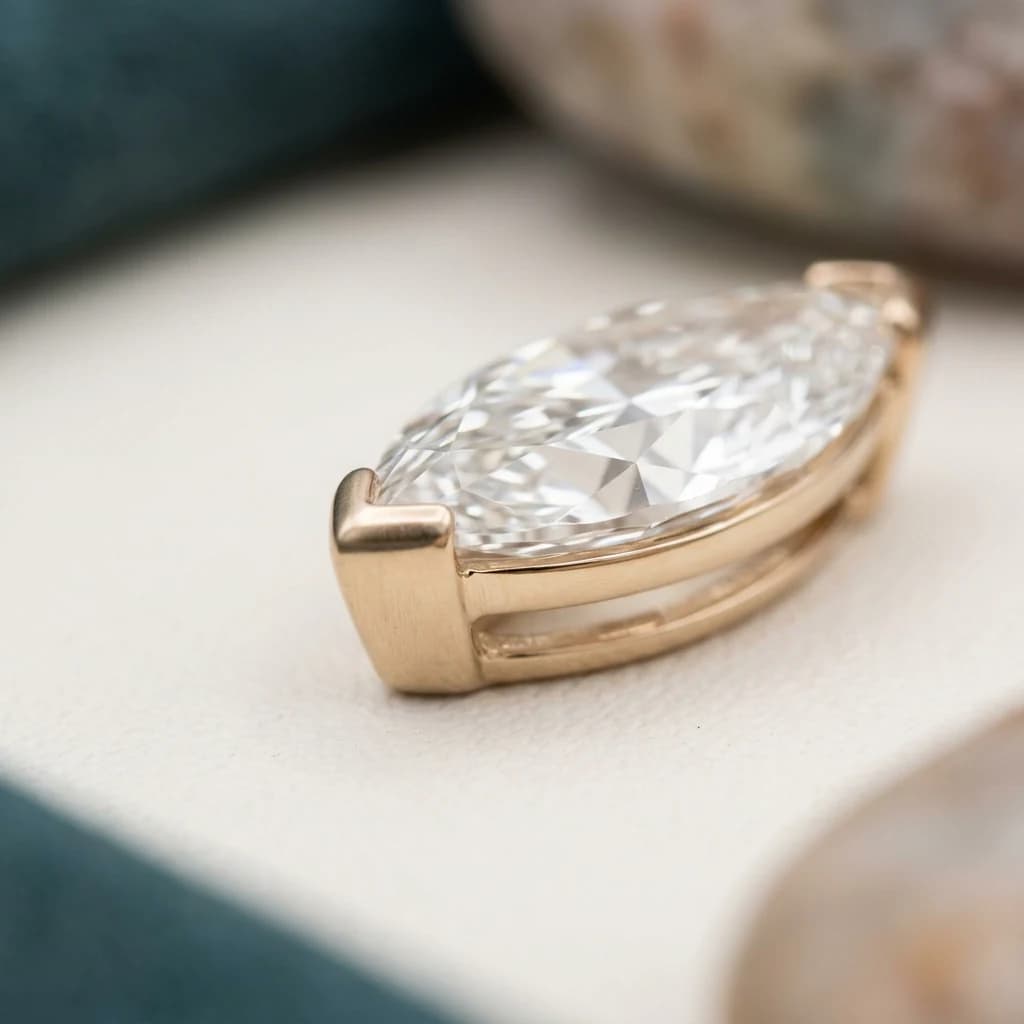
Ratios and settings
Ratio is the first thing to judge in a marquise: the length divided by the width. Most buyers prefer a ratio between roughly 1.75 and 2.25, which reads as a balanced boat, while slimmer stones look more extreme and wider stones more rounded. The mount has to suit that outline, so see our our setting guide guide; compare millimeter measurements and the face-up outline, not just carat, and view the stone before deciding.
Settings for a marquise cut diamond ring should do two jobs: present the elongated outline and shield the points. V-prongs are the classic answer because each metal tip cups a point, a bezel covers both ends, and a halo frames the stone and reduces point exposure. For a modern look, an east-west setting turns the marquise sideways across the finger, a style that works well in marquise cut diamond engagement rings and makes the stone's span across the hand the key number; see our carat-to-millimeter guide guide when comparing stones.
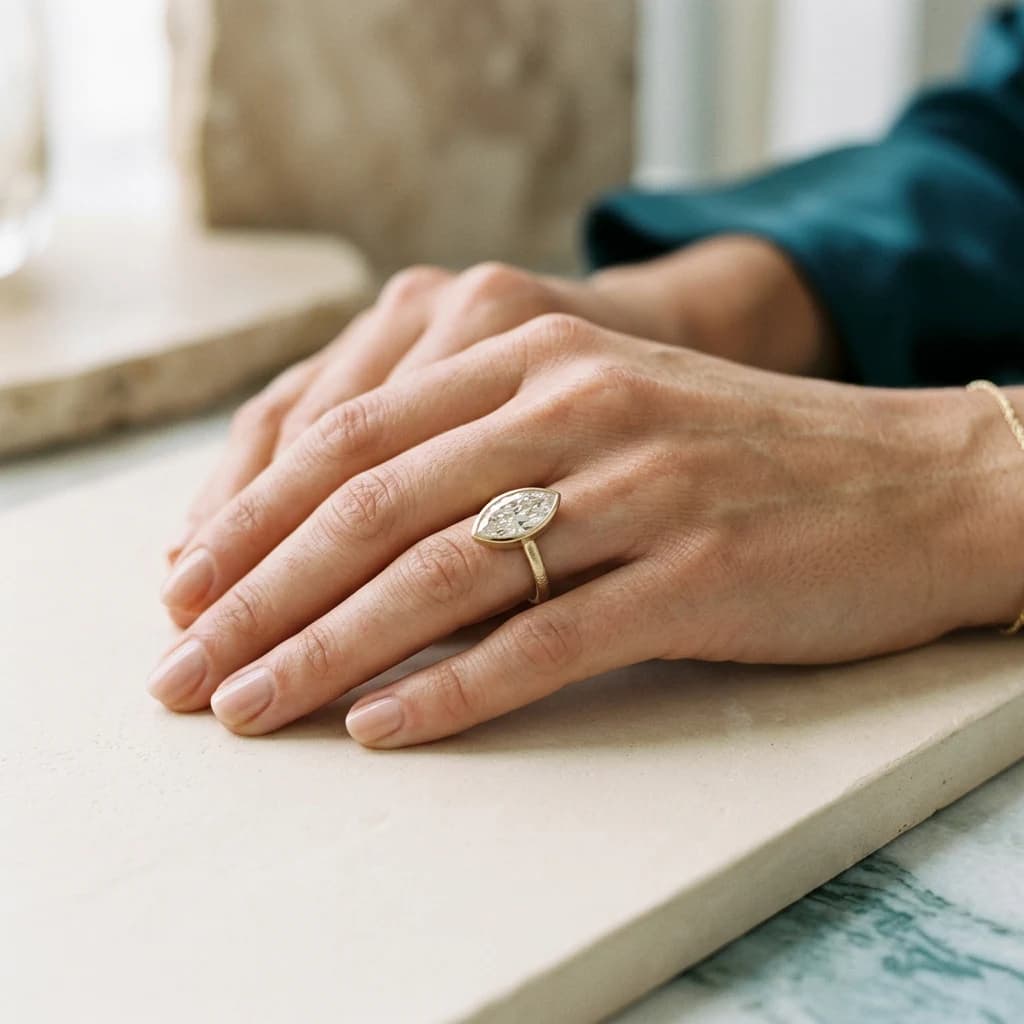
Dutch marquise and other varieties
The term Dutch marquise cut diamond describes a facet arrangement rather than a different outline. The pattern uses a slightly different pavilion layout than the most common marquise faceting, and buyers and cutters often describe the result as a softer, less linear look with broader flashes of light. The outline remains the classic elongated boat with two points.
Facet styles vary among marquise diamonds in general, and the Dutch marquise is one named variation among several that appear in the trade. None of these names is a formal grading term, so it is more useful to judge the individual stone's brightness, bow-tie and face-up outline than to shop by the facet name alone.
Price and value
Marquise cut diamond price per carat usually sits below the round brilliant because demand for rounds is stronger and marquise cutting uses the rough efficiently. The premium depends on carat, clarity, color and the individual stone, and within the Belaroq catalog the step from VS to VVS clarity carries a consistent premium of about 30 percent. The same factors drive how lab-grown diamonds are priced.
Value means comparing on the same basis. Two marquise diamonds of the same carat can differ visibly in outline, bow-tie and brightness, so compare grading reports and videos side by side. The Belaroq jewelry-under-500 collection includes completed lab-grown diamond pieces at or below US$500. If a standard design does not fit, a custom piece can fix the exact ratio and setting; Belaroq custom pieces are typically completed about 30 days after the specification is confirmed.
Ilustración editorial creada para Belaroq con Gemini 3.1 Flash Image mediante APIYi.
Marquise cut diamond questions, answered
Concise answers to the questions buyers ask most about marquise cut diamonds.
Why choose a marquise engagement ring?
A marquise cut diamond ring offers one of the largest face-up spreads per carat, and its elongated outline flatters the finger and reads as distinctive. Buyers choose it for a vintage-inspired silhouette with brilliant sparkle, or for a modern east-west design. It usually offers good value compared with a round brilliant of similar carat.
Which settings work well with marquise cut rings?
V-prong solitaires are the most common because each V-shaped prong cups a pointed end. Bezels and partial bezels cover both points completely, and halos frame the elongated outline while reducing exposure. For a modern line, an east-west setting turns the stone sideways across the band.
What metal should I choose for a marquise ring?
White metals such as platinum and white gold keep attention on the stone and suit the marquise's elongated line, while yellow and rose gold add contrast and a warmer vintage feel. In a marquise cut diamond ring, the choice is about color balance and daily wear, so match the metal to the wearer's style.
Which wedding bands pair with a marquise ring?
A curved or contoured band follows the center stone and sits close, while a straight band leaves a gap beside the pointed ends unless the marquise sits high or in an east-west setting. Chevron and gently curved bands mirror the point of the stone, and matching metal keeps the set cohesive.
Should my marquise ring be classic or modern?
Both work, and the setting decides the tone. A north-south solitaire with V-prongs or a halo reads classic and vintage, while an east-west orientation, a bezel or a mixed-metal band reads more contemporary. Choose based on how the ring will be worn every day, then have the setting protect the points either way.
How do you protect the points of a marquise diamond?
Choose a setting that covers both ends: V-prongs cup each point, a bezel wraps the full outline, and a halo frames the stone while reducing point exposure. Avoid designs that leave a tip uncovered against a hard surface. Check prongs regularly on a daily ring and have the setting inspected after any hard knock.
Do marquise diamonds look bigger?
Yes, and this is the shape's main appeal. Because the elongated outline spreads carat weight across a wide face-up area, a marquise cut diamond looks larger than a round brilliant of the same carat. Compare millimeter measurements rather than carat alone, since length, width and ratio change the perceived size from stone to stone.
The practical takeaway
The marquise is one of the largest-looking shapes per carat, with a vintage line and points that demand a protective setting. Judge the ratio, the bow-tie and the face-up outline together, and choose V-prongs, a bezel or a halo that covers both tips. For a marquise cut diamond ring, the setting is part of the design, not an afterthought, so browse the engagement collection with the mount in mind.