
Oval Cut Diamond: The Complete Guide
The oval cut diamond takes the round brilliant's light pattern and stretches it into an elongated, elegant outline that flatters the hand and often looks larger than its carat weight. This guide explains what an oval cut diamond is, how it compares with the other cuts covered in our the full shape rundown, how to judge the bow tie effect, the ratios and settings that suit it best, and what shapes 1 carat oval diamond prices, so you can compare stones with confidence.
What is an oval cut diamond?
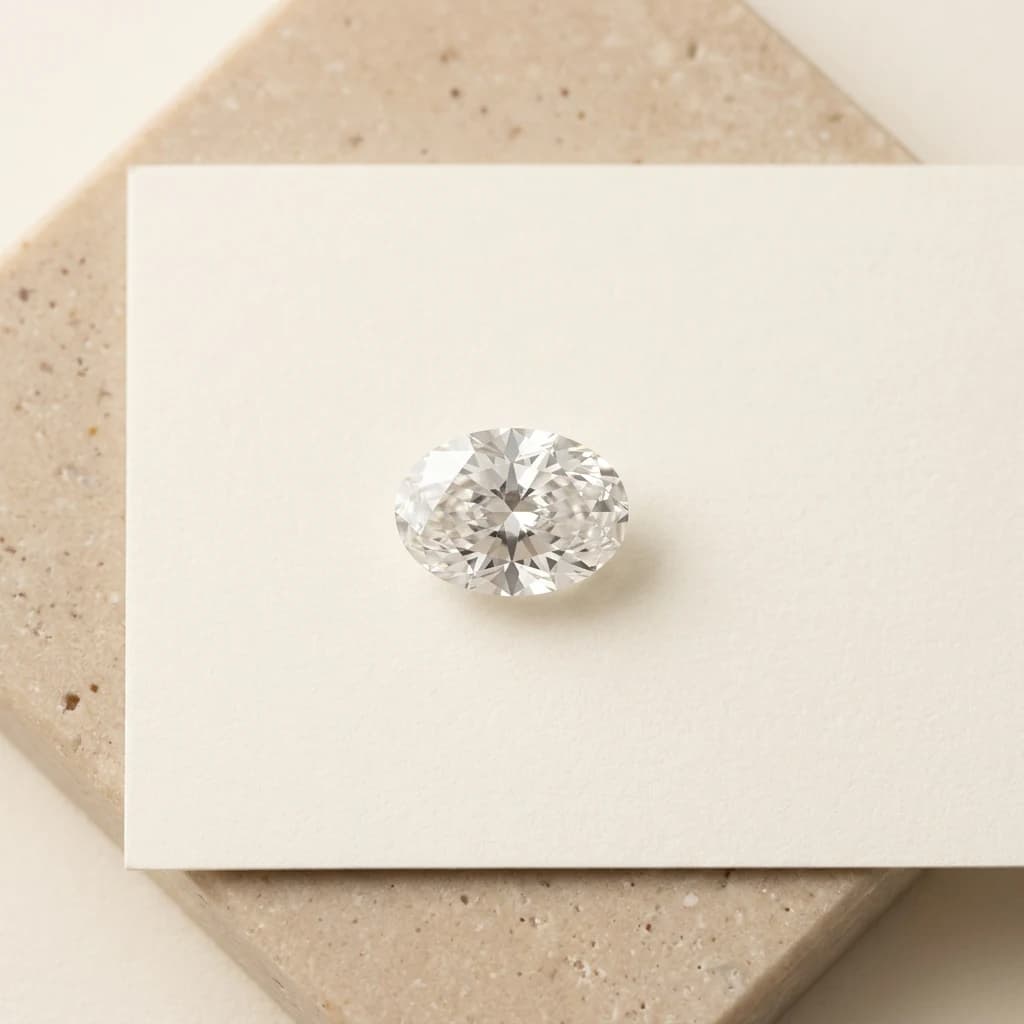
An oval cut diamond is a round brilliant elongated into an oval outline, and its formal name is the oval brilliant cut. It keeps the round's 58-facet sparkle but stretches it lengthwise, which makes fingers look longer and often makes the stone face up larger than a round brilliant of the same carat weight.
Oval cut diamonds at a glance
- An oval cut diamond is a round brilliant elongated into an oval outline.
- The formal name for the cut is the oval brilliant cut.
- Popular length-to-width ratios range from 1.35 to 1.50.
- Most ovals show some degree of bow tie contrast across the middle.
- The rounded outline has no sharp corners, so points are less exposed to chipping.
- An oval often faces up larger than a round brilliant of the same carat weight.
What is an oval cut diamond?
An oval cut diamond is a round brilliant elongated into an oval outline. The stone keeps the round's 58-facet brilliant pattern, with the same crown, girdle and pavilion structure, but every facet is stretched along the length of the stone, which changes the way light travels through it. Earlier oval shapes had existed for centuries, and the modern oval brilliant was refined in the 1960s before becoming a staple of engagement rings. The elongated outline flatters the hand, because its length draws the eye along the finger and makes fingers look longer, and that same length often makes an oval face up larger than a round brilliant of the same carat weight.
On grading reports and in jeweler terminology, the formal oval cut diamond name is the oval brilliant cut, sometimes written as oval modified brilliant. The word brilliant refers to the facet pattern the stone shares with the round brilliant, not to a measure of sparkle. Unlike rounds, which carry widely standardized cut grades, the oval brilliant has no single universally used cut grade, so proportions, symmetry and polish have to be compared directly between stones. This is why ratio and the bow tie effect do the work that a round's cut grade would otherwise have done for the buyer, and why two ovals with identical color and clarity reports can still look different in person.
Oval cut pros and cons
The oval's strengths are visible and practical. Its elongated, elegant outline flatters most hand shapes, and the absence of sharp corners softens the look while removing the delicate points that can chip or snag on other fancy shapes. The elongated table often makes an oval appear larger than a round brilliant of the same carat weight, stretching the budget's visual impact — a look that laboratory-grown ovals make even more attainable. The brilliant facet pattern also hides inclusions well: the many small facets break up what sits inside the stone, so clarity reads more forgivingly in an oval than in an open step cut such as an emerald.
The trade-offs are equally real. Most oval cut diamonds show some degree of bow tie effect, a darker hourglass pattern across the middle, and a dominant bow tie can mute the center of the stone. Cut quality is less standardized than for round brilliants, because no single cut grade applies to ovals, so two stones with similar reports can look quite different. Color can also concentrate slightly at the two ends of the oval, particularly in elongated stones, so a lower color grade may show a faint tint toward the tips before it shows in the center.
- Elongated, elegant outline that flatters most hand shapes.
- Often faces up larger than a round brilliant of the same carat weight.
- No sharp corners, so there are no delicate points to chip or snag.
- Brilliant facet pattern hides inclusions well for its size.
- Bow tie contrast can appear across the middle, from subtle to dominant.
- Cut quality is less standardized than for round brilliants.
- Color can concentrate slightly at the two ends of the stone.
- Proportions and symmetry deserve direct comparison between stones.
The bow tie effect, explained
The bow tie effect is the darker, bow-shaped or hourglass-shaped pattern that appears across the middle of many oval cut diamonds. It is not an inclusion or a flaw in the crystal; it is an optical result of how an elongated brilliant gathers and returns light. Toward the center of the stone, some light passes through instead of reflecting back, and some facets are blocked by the viewer's own head and shoulders, so the middle returns less brightness than the ends. The same effect appears in other elongated brilliants such as pear and marquise cuts, and to some degree it is a natural companion of the oval outline.
The practical question is not whether an oval has a bow tie, but how strong it is. A subtle bow tie can add depth and dimension to the face-up view; a dominant one reads as a dark patch that stays visible as the stone moves. To judge it, hold the stone face-up at a normal arm's length rather than under a jeweler's loupe, and rock it gently to see how the pattern changes. If the darker area is mild and breaks up as the stone tilts, most buyers find it acceptable; if it holds its darkness from every angle, the stone may look duller than a comparable oval with better proportions.
| Check | What to look for | Why it matters |
|---|---|---|
| Face-up view | Hold the stone at arm's length, not under magnification. | A bow tie invisible at normal distance will not affect the ring's look. |
| Movement | Rock the stone gently and watch the center. | A subtle bow tie breaks up as the stone moves; a dominant one holds its darkness. |
| Lighting | Compare the stone in daylight and in soft indoor light. | Some ovals look fine in one light and flat in another. |
Ratios, carat and settings
Ratio is the first number to check on an oval: length divided by width. Most buyers find a length-to-width ratio between 1.35 and 1.50 the most versatile range, with many preferring around 1.40 for a stone that reads clearly oval without looking stretched. A ratio below 1.35 starts to read roundish, while one above 1.50 reads long and slender, which suits some hands and settings better than others. Because ratio changes the silhouette and can influence how visible the bow tie is, it deserves the same attention as carat weight when comparing stones, much like the carat-to-millimeter distinction distinction between weight and face-up size.
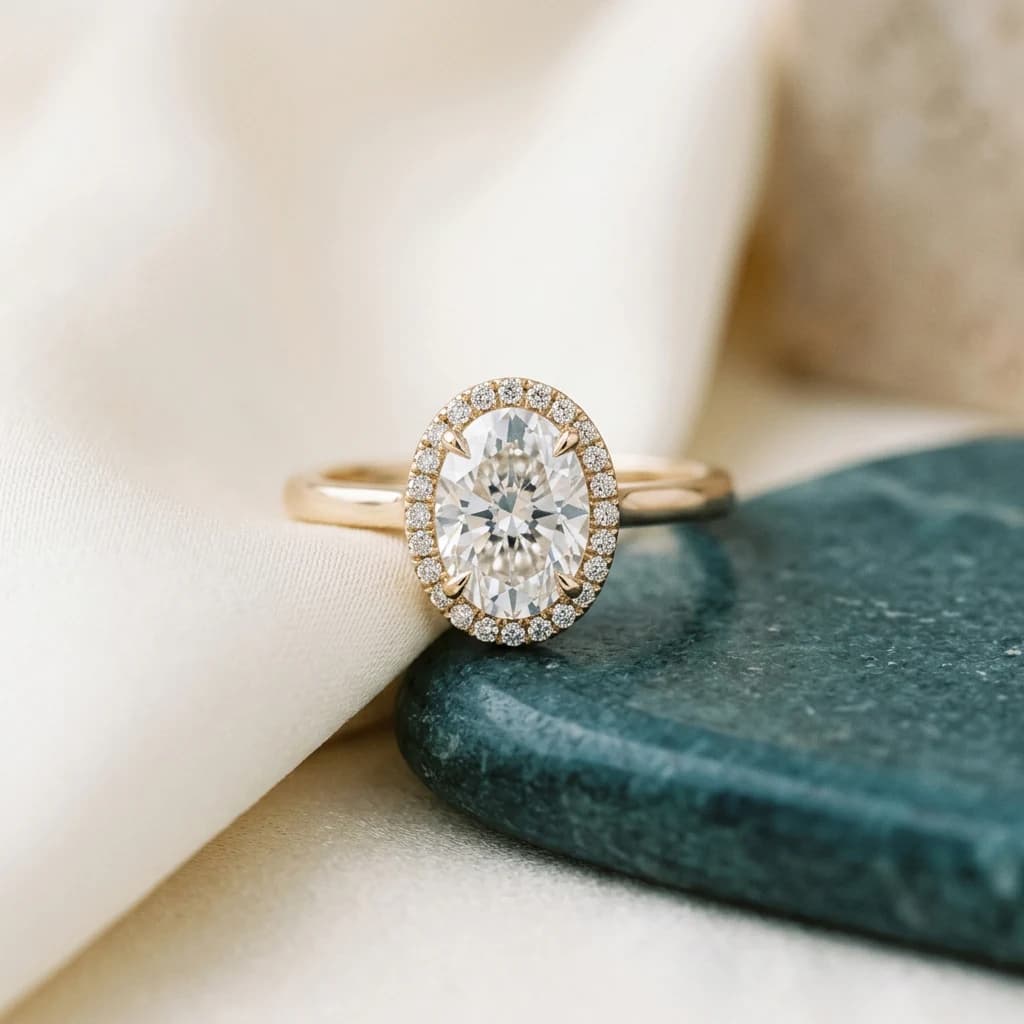
Carat is weight, not face-up size, and an oval usually faces up larger than a round brilliant of the same weight because its length spreads across the finger. That makes any 1 carat oval diamond price a matter of dimensions and quality rather than weight alone, and it is why millimeter measurements matter more than carat when judging presence. For settings, oval cut diamond engagement rings work beautifully in a solitaire, which lets the elongated shape stand alone; a halo, which adds sparkle and apparent size; a three-stone design, which pairs the oval with side stones; or an east-west orientation, which turns the stone sideways for a modern line. An oval cut diamond ring with slim prongs keeps the outline open, while a bezel protects the edges with metal — see our setting comparison guide guide for how the styles compare.
| Factor | What to look for | Practical guidance |
|---|---|---|
| Ratio | Length divided by width; 1.35 to 1.50 is the versatile range. | Choose around 1.40 for a classic oval, higher for a slender look. |
| Carat | Weight, not face-up size; the oval's length spreads across the finger. | Compare millimeter length and width between stones of equal carat. |
| Bow tie | A darker pattern across the middle, from subtle to dominant. | Judge face-up at arm's length and in motion, not under magnification. |
| Setting | Solitaire, halo, three-stone and east-west all suit the oval. | Match the setting to the ratio and the wearer's style. |
Ratios are a preference range, not a quality rule; the best ratio is the one that matches the silhouette you want.
Oval vs round brilliant
The oval and the round are both brilliant cuts at heart, sharing the same 58-facet pattern as the round brilliant cut and the same family of fire and sparkle. The difference is geometry. The round is perfectly symmetrical in every direction, while the oval stretches that symmetry into two axes, a long one and a short one, and that single change explains most of the practical differences between them. The round's symmetry keeps its light return even from every angle and made it the first shape with widely standardized cut grades. The oval trades a little of that uniformity for length, a softer outline and a larger-looking face-up profile.
Choosing between them usually comes down to what you want on the hand. A round brilliant is the safe classic: maximum standardization, even sparkle and timeless recognition. An oval delivers the same brilliant sparkle in a longer, more individual silhouette that makes fingers look longer and the stone look larger, at the cost of comparing ratios and bow ties yourself. Buyers who want visible presence without a higher carat weight often lean oval; buyers who want the most predictable comparison lean round. Belaroq carries both shapes as lab-grown stones, with lab-grown price points that sit below comparable natural diamonds, and the custom process can turn either into a one-of-a-kind design, typically in about 30 days from approval.
| Comparison | Oval cut diamond | Round brilliant |
|---|---|---|
| Facet pattern | 58-facet brilliant pattern, stretched lengthwise. | 58-facet brilliant pattern in perfect symmetry. |
| Face-up look | Elongated; often looks larger than its carat weight. | Compact circle; size reads close to carat weight. |
| Cut grading | No single standardized cut grade; compare ratio and bow tie. | Widely standardized cut grades from major laboratories. |
| On the finger | Makes fingers look longer; softer, more modern outline. | Classic, timeless presence with even sparkle. |
| Choosing | Prefer when you want length and a larger look. | Prefer when you want the most predictable comparison. |
Illustration éditoriale créée pour Belaroq avec Gemini 3.1 Flash Image via APIYi.
Oval cut diamond questions, answered
Concise answers to the questions buyers ask most about oval cut diamonds.
What is the bow tie effect in an oval cut diamond?
The bow tie effect is a darker, bow-shaped pattern across the middle of the stone. It comes from how the elongated brilliant gathers light: some facets are blocked by the viewer and some light passes through instead of reflecting back. Nearly every oval shows it to some degree. The goal is a subtle bow tie that adds depth, not a dominant one that darkens the center.
Are oval diamonds more expensive?
Not necessarily. Price follows the 4Cs and the individual stone rather than the shape alone, and oval cut diamonds often list below round brilliants of comparable weight and quality, partly because rounds carry the highest demand and the most standardized cut grading. On Belaroq, pricing is anchored to lab-grown stones, which list below comparable natural diamonds, and the same design in VVS clarity lists about 30% above its VS version.
Which of the 4Cs is most important for an oval cut diamond?
Cut deserves the most attention, because the oval brilliant has no single standardized cut grade, so ratio, symmetry and the bow tie have to be judged directly. Clarity is the most forgiving, since the many small facets hide inclusions well. Color deserves a look at the ends of the stone, where tint can concentrate slightly in elongated ovals. Balance all four against the budget, and compare specific stones rather than grade labels.
Are oval diamonds becoming more popular?
Yes. The oval has grown into one of the most requested shapes for oval cut diamond engagement rings, driven by its elongated silhouette and the way it makes fingers look longer. Its softer outline also reads as modern next to the classic round. Popularity changes nothing about grading, though, so the same comparisons for ratio and bow tie still apply.
What is the best ratio for an oval diamond?
Most buyers find the sweet spot between 1.35 and 1.50 length-to-width, with many preferring around 1.40. Below 1.35 the stone starts to read roundish, and above 1.50 it reads long and slender. There is no single correct answer, because ratio is a look preference, but that range keeps the oval balanced and the bow tie easier to manage.
Do oval diamonds look bigger than round?
For the same carat weight, an oval usually faces up larger than a round brilliant, because its length spreads across more of the finger while a round's weight sits in a compact circle. The difference comes from dimensions rather than weight, which is why millimeter length and width are the numbers to compare. A well-proportioned oval can deliver visible presence at a lower carat weight.
What settings work best with oval diamonds?
Oval cut diamond rings suit many settings. A solitaire lets the elongated shape stand alone; a halo adds sparkle and apparent size; a three-stone design pairs the oval with side stones; and an east-west orientation turns the stone sideways for a modern line. Slim prongs keep the outline open, while a bezel adds protection. The best setting matches the wearer's style and the stone's ratio.
How much is a 1 carat oval diamond?
There is no single 1 carat oval diamond price, because color, clarity, ratio, setting and metal all move the total. Belaroq anchors its catalog to lab-grown stones, which list below comparable natural diamonds, with some designs in the jewelry-under-500 collection and carat-plus pieces priced higher. The reliable approach is to compare specific stones with similar proportions rather than rely on averages.
The practical takeaway
The oval cut diamond is the round brilliant's longer, softer sibling: the same sparkle, stretched into a silhouette that flatters the hand and often faces up larger than its weight suggests. The decisions are few, but they matter. Choose a ratio in the 1.35 to 1.50 range that matches the look you want, judge the bow tie face-up and in motion rather than under magnification, and let the stone's brilliant facets forgive clarity while you check color at the ends. On Belaroq, every oval is lab-grown, pricing for our our ring designs is anchored to specific designs rather than invented averages, and a custom oval can be ready in about 30 days.