
Diamond Color Scale: D to Z Explained
Color is one of the four quality factors used to grade diamonds, and the D-to-Z scale is the language jewelers use to describe how colorless a stone is. This guide explains how the scale works, how grading laboratories evaluate color, and how the letter grade you choose affects appearance and price. It also clarifies how color relates to clarity, since shoppers often see the two terms side by side. All guidance applies equally to Belaroq's laboratory-grown diamonds, which are graded by independent laboratories.
Near-colorless G–J is the practical sweet spot for most engagement rings.
For most lab-grown engagement rings, a near-colorless stone in the G to J range offers the practical balance: little visible warmth in the setting and a meaningfully lower price than colorless D to F.
Diamond color at a glance
- The D-to-Z scale describes the absence of color, from colorless D to light yellow Z.
- The scale starts at D by convention, not because earlier letters were used.
- Color is graded face-down under standardized light against master stones.
- G through J, the near-colorless range, is the practical choice for most jewelry.
- Color and clarity are independent scales: color is hue, clarity is inclusions.
- IGI applies the same D-to-Z color grades to lab-grown diamonds.
- Since October 1, 2025, GIA uses Premium or Standard assessments for eligible D-to-Z lab-grown diamonds.
What is the diamond color scale?
Most gem-quality diamonds are colorless or nearly colorless, and color in a diamond almost always appears as a subtle yellow or brown tint. The diamond color scale runs from D through Z and describes how much of that tint is absent, much as the diamond clarity scale describes the presence of internal inclusions. D sits at the top, reserved for stones in which trained graders detect no color at all, and each later letter records a slightly stronger presence of color.
The scale begins at D rather than A for a historical reason: earlier systems had used A, B and C loosely, and the graders who standardized the scale wanted room for future grades better than anything they had seen. Color is also only one axis of quality; a stone can be flawless in color yet weak in cut or clarity, so the factors are assessed separately.
How diamond color grading works
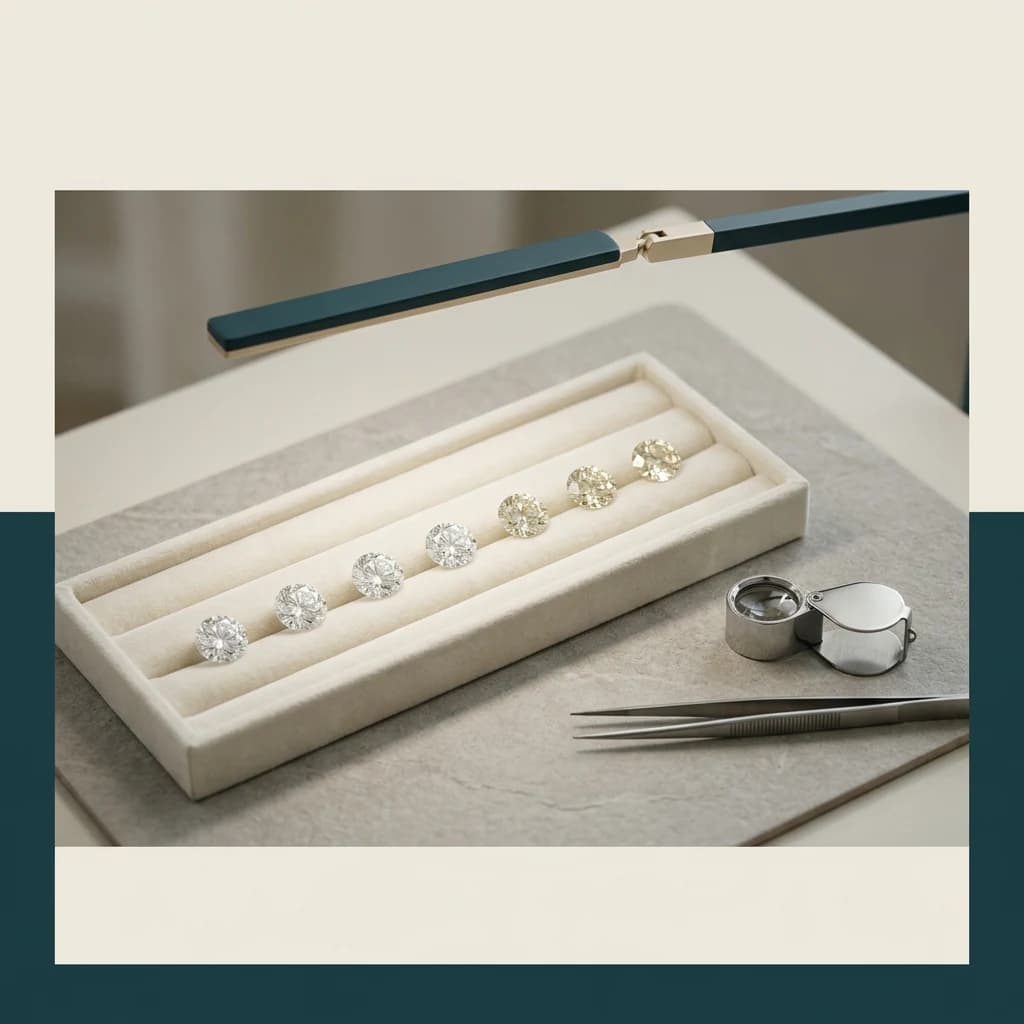
Professional color grading is done under controlled conditions. The diamond is placed table-down in a standardized viewing environment with fixed lighting, and the grader compares it against a set of master stones with known color positions. Viewing the stone table-down reduces the effect of brilliance and fire, which can disguise faint color. The final grade records how the stone sits between neighboring masters, a method designed to stay repeatable across laboratories.
Lab-grown diamonds are graded on the same D-to-Z scale as mined stones, though the two main laboratories use different grading report terminology. IGI reports record a color grade from the scale as part of the 4Cs, while GIA, since October 1, 2025, uses Premium and Standard overall assessments for eligible D-to-Z laboratory-grown diamonds. A color grade is a laboratory finding, not something a shopper can judge reliably from a phone photograph.


The diamond color chart
Jewelry retailers often present the D-to-Z scale as a chart that groups the grades into broader bands: colorless, near colorless, faint, very light and light. These bands are a convenience for comparison, not a substitute for the letter grade on a laboratory report, and different sources may draw the boundaries slightly differently. The table below summarizes the bands as they are commonly described.
Shoppers searching for a diamond color and clarity chart are usually comparing two separate scales at once. Color describes the absence of hue and is graded from D to Z, while clarity describes internal inclusions and surface blemishes and is graded from Flawless to Included. The two do not move together: a D-color diamond can carry visible inclusions, and an SI-clarity diamond can be colorless.
| Grade range | Common name | What it means |
|---|---|---|
| D–F | Colorless | The highest colorless range; no color detectable to a trained grader under standardized light. |
| G–J | Near Colorless | Little color detectable to the trained eye; the practical sweet spot for many engagement rings. |
| K–M | Faint | Faint color that becomes easier to detect, especially in larger stones. |
| N–R | Very Light | Very light color, clearly visible to the untrained eye in most settings. |
| S–Z | Light | Light color, visible at a glance in a face-up position. |
This terminology summarizes the GIA scale in plain language. Read the issuing laboratory's wording for exact grade language.
How color affects price and appearance
Price moves in steps along the color scale because colorlessness is rarer and more sought after, so the gap between adjacent letters is generally larger near the top of the scale than near the bottom. The same stepwise logic shapes lab-grown price tiers. Within a single grade, price still varies with carat, cut and clarity, which is why two stones of the same color letter can cost different amounts. Rather than chase a letter, compare finished pieces at the same size and grade.
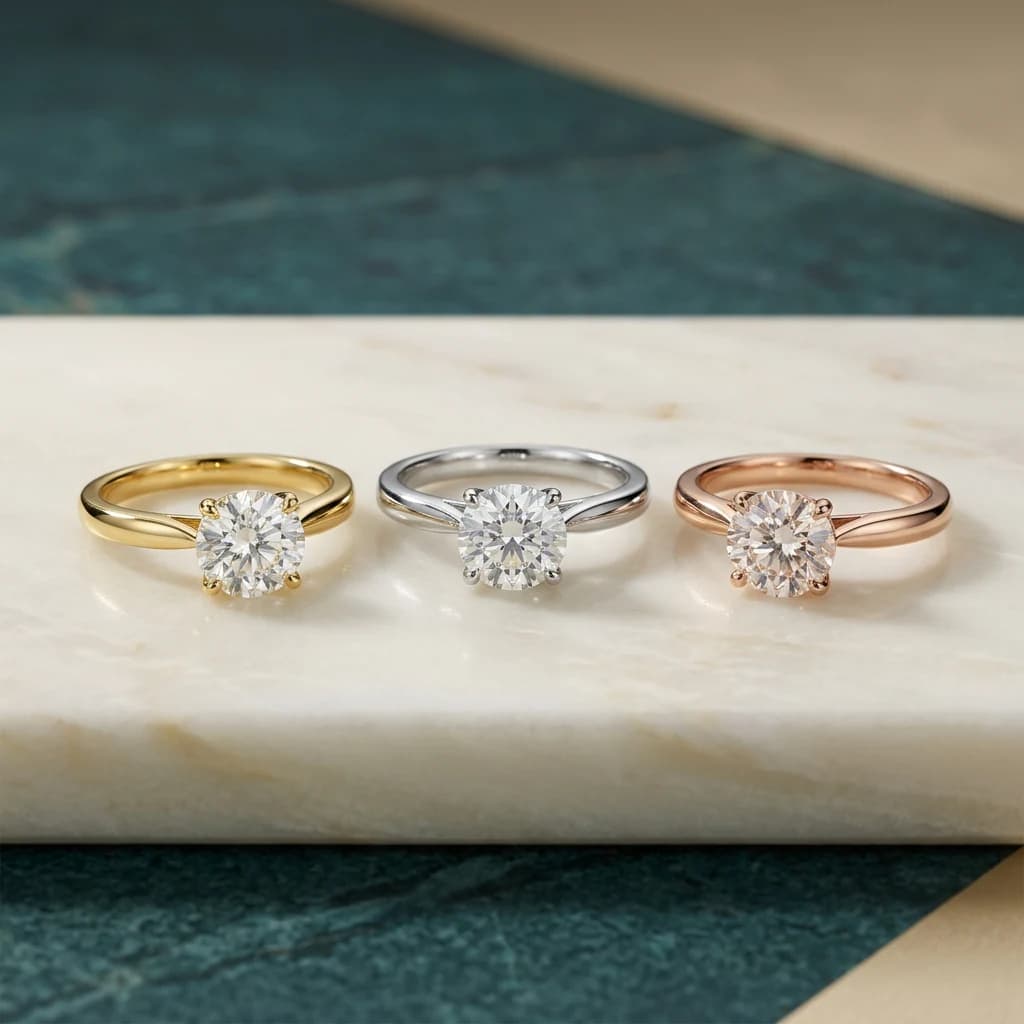
In a finished piece of jewelry, color grade is only one contributor to what the eye sees. Yellow gold masks faint warmth, while white gold and platinum emphasize it, so a near-colorless stone in a yellow-gold setting can look as white as a higher grade in white metal. Carat and shape matter too: larger stones and step cuts such as emerald reveal color earlier. The complete design should therefore guide the grade choice.
Best color grade for an engagement ring
For most lab-grown engagement rings, the near-colorless range from G to J is the balanced default. In a white-metal solitaire the stone carries the whole look, and buyers who want the whitest possible appearance may reasonably choose colorless D to F. In yellow-gold or rose-gold settings, and in designs where halo or pavé stones surround the center, faint warmth in a G-to-J stone is harder to notice, so the extra spend on a colorless grade may be unnecessary. The same reasoning applies to the VS vs VVS clarity decision: the higher grade is rarely visible in the finished piece.
Size changes the calculation modestly for your engagement ring. Because color becomes more visible as stones get larger, a two-carat center may show warmth slightly more readily than a half-carat stone of the same grade, though the setting and the lighting usually dominate what the eye sees. The final choice should weigh the complete piece, the metal color and the budget together, not the letter alone. Comparing one design across two or three grades settles it in practice.
Illustration éditoriale créée pour Belaroq avec Gemini 3.1 Flash Image via APIYi.
Diamond color questions, answered
Concise answers to the most common diamond color questions.
Why does the diamond color scale start at D?
The modern scale starts at D to leave clear distance from older systems that had used A, B and C loosely. Early graders wanted room for future grades without changing letters already in circulation. The convention stuck, and D has meant the top of the colorlessness scale ever since.
What is the best diamond color grade?
There is no single best grade. For most lab-grown engagement rings, near-colorless G to J offers the practical balance of a white appearance and a lower price, while D to F suits buyers who want the whitest stones.
What does near-colorless mean?
Near-colorless describes the G, H, I and J grades. A trained grader can detect faint warmth in these stones under standardized light, but the tint is difficult to see in finished jewelry, especially in yellow gold or in designs with small stones around the center.
Does diamond color affect sparkle?
Color grade and sparkle are related but separate. Sparkle comes mainly from cut quality and how well the stone returns light to the eye. Faint warmth does not stop a well-cut diamond from returning bright flashes, but a visible tint can change the character of the light. For brilliance, cut matters more than color.
Is G or H color good for an engagement ring?
Yes. G and H are near-colorless grades that look white in most settings and cost less than D to F. In a white-metal solitaire they remain an excellent choice for many buyers, and in yellow gold the faint warmth is even harder to notice.
What is the difference between diamond color and clarity?
Color grades the absence of yellow or brown tint on a D-to-Z scale, while clarity grades internal inclusions and surface blemishes on a separate scale from Flawless to Included. The two are independent: a colorless stone can carry visible inclusions, and a lower-color stone can be clean.
Do lab-grown diamonds use the same color scale?
Yes. Lab-grown diamonds are graded on the same D-to-Z scale as mined diamonds. IGI reports a color grade as part of the 4Cs, and GIA has used Premium and Standard overall assessments for eligible D-to-Z laboratory-grown diamonds since October 1, 2025.
Is a lower color grade visible to the naked eye?
It depends on the grade and the piece. Faint grades such as K or L can read as slightly warm in a large white-metal solitaire but can go unnoticed in yellow gold or in small stones. Seeing the finished piece is more reliable than the letter alone.
The practical takeaway
Treat the letter as one input among several. For most lab-grown jewelry, near-colorless G to J delivers the appearance most buyers want at a sensible price, with D to F reserved for maximum whiteness. Compare the complete design in the metal you will wear, and let the report confirm your eyes.