
Lab Diamond vs Moissanite: The Real Differences
Lab diamond vs moissanite is one of the most searched jewelry comparisons, and the two stones are easier to confuse than most buyers expect. Moissanite looks a lot like diamond, which is exactly the point, but it is a different material with a different story. This guide explains what each stone actually is, how they compare side by side, and what the price difference really means in practice. If you want diamond, choose a real lab-grown diamond. If you want moissanite, choose it knowingly.
A lab-grown diamond is diamond; moissanite is a different material that looks similar.
A lab-grown diamond is genuine diamond, made of carbon atoms arranged in the diamond crystal structure, while moissanite is silicon carbide, a separate mineral with its own optical properties that simply resembles diamond.
Lab diamond vs moissanite at a glance
- Moissanite is silicon carbide; a lab-grown diamond is crystallized carbon.
- Diamond is the hardest known mineral at 10 on the Mohs scale; moissanite sits near 9.25.
- Moissanite is doubly refractive and shows more colorful fire than diamond.
- Lab-grown diamonds are graded on the 4Cs and typically arrive with laboratory reports.
- Moissanite is not graded as a diamond; it uses its own color and quality descriptions.
- Moissanite and cubic zirconia are both simulants; neither is diamond.
- The FTC requires clear disclosure whenever a simulant such as moissanite is sold.
- Price positions differ widely: moissanite typically costs far less per carat than lab-grown diamond.
What is moissanite?
Moissanite is silicon carbide, a mineral that occurs naturally in only vanishingly small amounts. It was first identified in 1893 by the French chemist Henri Moissan, who found crystals in fragments from the Canyon Diablo meteorite and initially mistook them for diamond; the gem was later named in his honor. Natural material remained too scarce to cut, so moissanite stayed a curiosity until the late 1990s, when producers learned to grow it in jewelry-quality form. Every moissanite stone sold today is laboratory-grown, which is part of why buyers keep asking about it alongside lab diamonds.
The stone is prized for its hardness, its brilliance, and above all its fire: the rainbow flashes of colored light, which are stronger in moissanite than in diamond. It is not diamond, and it is not cubic zirconia; it is a distinct gemstone with its own identity, sitting between those two options in both price and optics. The FTC Jewelry Guides require sellers to disclose the stone's name clearly, never leaving a buyer to assume they bought diamond. Understanding what counts as a lab-grown diamond settles the distinction before it starts.
- Composition: silicon carbide, not carbon.
- Discovered in 1893 by Henri Moissan in meteorite fragments.
- Jewelry moissanite is always laboratory-grown.
- Its own gemstone: not diamond, and not cubic zirconia.
- Fire: stronger rainbow flashes than diamond, from higher dispersion.
- Placement: a recognized gemstone in its own right, sold under its own name.
Is moissanite a lab-grown diamond?
No. The two stones are different materials, and the difference is categorical. A lab-grown diamond is diamond: carbon atoms arranged in the diamond crystal structure, grown from a seed in laboratory equipment, with the same chemistry and hardness as a mined diamond. Moissanite is silicon carbide, a separate mineral with its own composition, its own optical behavior, and its own market. Moissanite that happens to be made in a lab is still moissanite, never diamond. The long-tail question is moissanite the same as a lab grown diamond has the same answer: no.
The terminology is worth getting right. Gemologists separate synthetic stones, which are the same material grown artificially, from simulants, which are different materials cut to imitate diamond's appearance. A lab-grown diamond is a synthetic diamond in this precise sense, while moissanite is a diamond simulant. Both are legitimate when sold honestly, and both are protected against confusion by documentation: a grading report states what the stone actually is. That is why how reports document identity matters, and why knowing the vocabulary keeps anyone from paying diamond prices for a different gemstone.
- Lab-grown diamond: diamond material grown from a seed.
- Moissanite: silicon carbide, a diamond simulant.
- Synthetic means the same material; simulant means a look-alike.
- The FTC expects the stone to be named accurately at sale.
- Same origin, different material: laboratory growth does not change chemistry.
- Check the report: documentation states the actual identity of the stone.
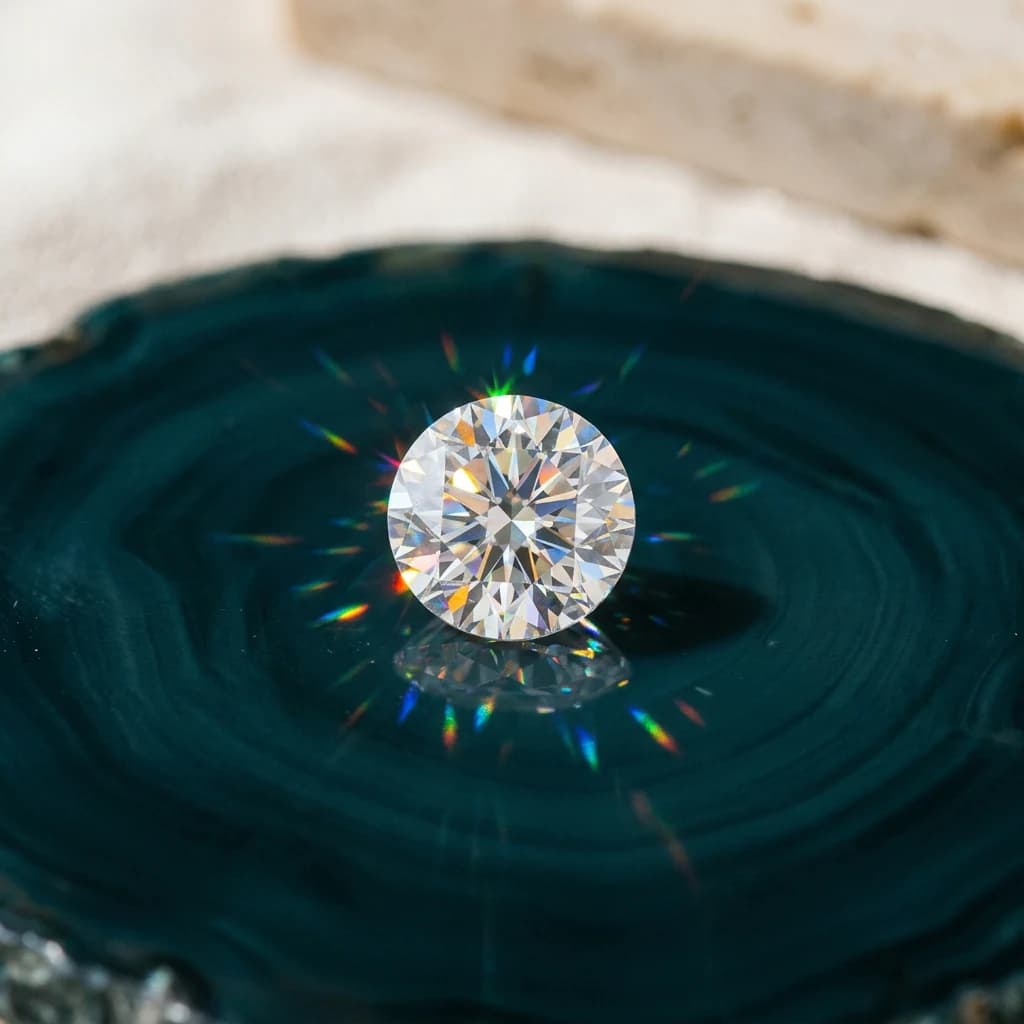
Lab diamond vs moissanite side by side
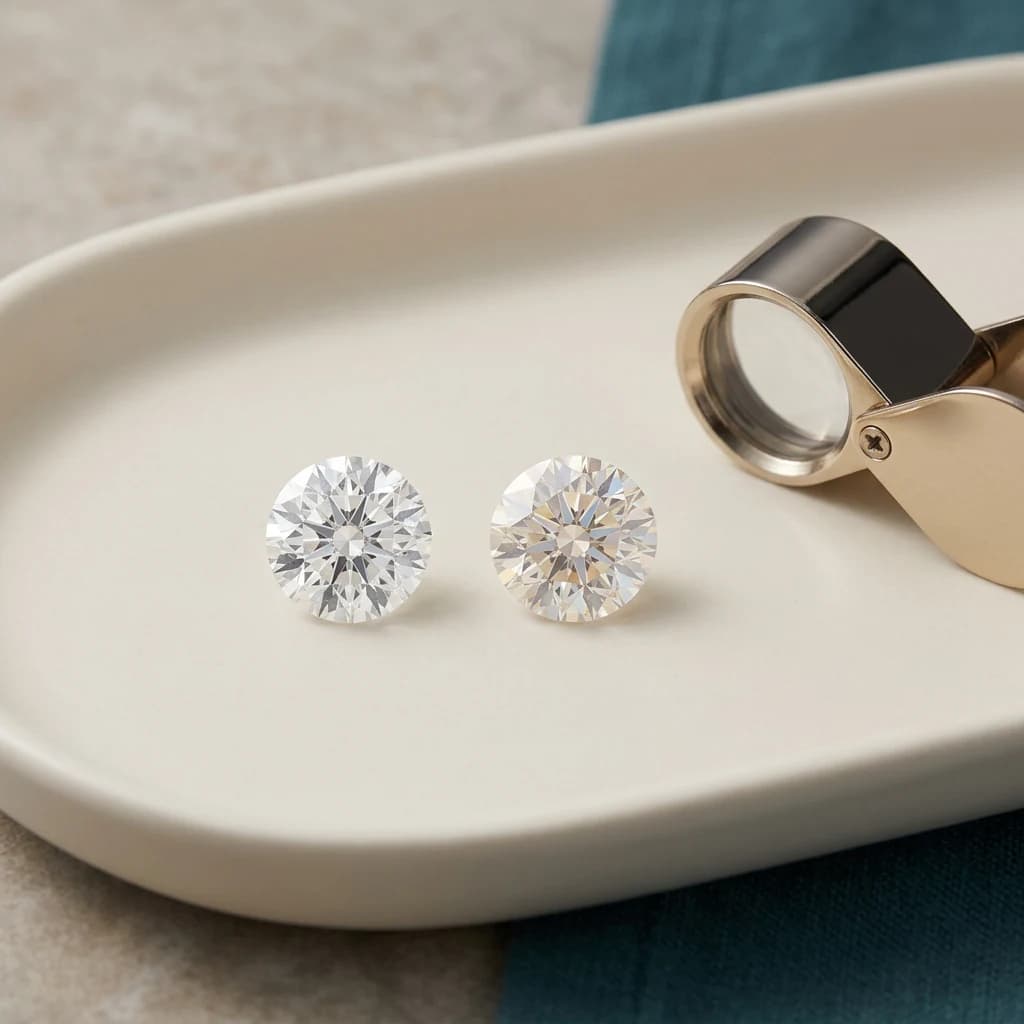
The moissanite vs lab diamond side by side comparison is clearest in table form, because the two stones differ across almost every row that matters. Read the table as a comparison of categories, not as a verdict on any individual stone, and remember what each column describes: genuine diamond on one side, a gemstone that imitates it on the other. Both have real strengths, but they are not the same strengths, and no table can capture how a specific stone performs in a specific setting, so treat the rows as starting points and let the eyes decide in person.
The sparkle rows deserve the most attention, because most lab diamond vs moissanite sparkle confusion lives there. Moissanite's higher dispersion throws stronger rainbow fire, while its double refraction can make facet edges look doubled under magnification. A well-cut lab-grown diamond, by contrast, is singly refractive, with a balance of white brilliance and fire that moissanite does not replicate. Neither effect is a flaw; they are simply different optics, and a jeweler can show both under a loupe in seconds. Cut quality matters in both materials: a superb cut beats a mediocre one every time.
- Diamond: carbon, Mohs 10, single refraction, 4C grading reports.
- Moissanite: silicon carbide, Mohs about 9.25, double refraction, its own color scale.
- Neither is better in the abstract; each stone wins different rows of the table.
| Comparison point | Lab-grown diamond | Moissanite |
|---|---|---|
| Material | Carbon atoms arranged in the diamond crystal structure | Silicon carbide, a different mineral that resembles diamond |
| Hardness | 10 on the Mohs hardness scale, the hardest known mineral | About 9.25 on the Mohs scale: very hard and fine for daily wear |
| Fire and sparkle | Singly refractive, with a balance of white brilliance and fire | Doubly refractive with higher dispersion, so stronger rainbow fire |
| Color | Graded from D to Z on the diamond color scale | Described on its own scale; near-colorless stones can show gray or green undertones |
| Grading | Graded on the 4Cs, typically with an independent laboratory report stating origin | Not graded as a diamond; most moissanite is sold without a 4C report |
| Price position | Well above moissanite and typically below comparable natural diamonds | Typically a small fraction of a lab-grown diamond's price per carat, with no fixed ratio |
| Maintenance | Cleaned with mild soap and water; resists scratching | Cleaned the same way; very durable, though oil film dulls any stone's sparkle |
This table compares the two materials as categories. Individual stones vary, and any grading claim should be checked against the stone's own documentation.
Moissanite vs cubic zirconia
The moissanite vs cubic zirconia comparison is a contest between two diamond simulants, and moissanite wins most of the measurable rows. Cubic zirconia, usually shortened to CZ, is zirconium dioxide, and it sits near 8 on the Mohs scale, noticeably softer than moissanite's 9.25. CZ also has a reputation for losing sparkle over time as scratches and oil film accumulate, while moissanite keeps its polish and fire far longer. In short, CZ is the entry-level simulant, moissanite the harder-wearing one, and the difference becomes visible on the hand within a couple of years of daily wear.
Neither stone is diamond, and neither should be presented as one. The practical ordering is simple: CZ is the least expensive and least durable of the three options, moissanite is harder, more fiery, and more expensive than CZ, and lab-grown diamond is harder still and graded like any diamond. For a piece worn daily, moissanite's durability usually justifies its premium over CZ; for a purely occasional fashion piece, CZ's price is hard to argue with. Neither is wrong; they are different budgets and different expectations.
- Hardness: moissanite near 9.25 on the Mohs scale, cubic zirconia near 8.
- Sparkle retention: moissanite keeps its polish longer; CZ clouds as scratches and oil accumulate.
- Price: CZ is the least expensive of the three options, moissanite the middle position.
- Both are simulants: different materials that resemble diamond and must be disclosed.
- Fire: moissanite's rainbow flashes are stronger than CZ's as well as diamond's.
- Origin: both are manufactured simulants; disclosure applies to each.
Price: lab diamond vs moissanite
The lab grown diamond vs moissanite price question has a clear direction but no fixed number. Moissanite typically costs far less per carat than a lab-grown diamond, because it is manufactured from silicon carbide at high volume, while growing gem-quality diamond from carbon is a slower, more expensive process. Quoting a fixed ratio would be dishonest: prices move with size, quality, market conditions, and retailer. What stays true is the structure behind each number, and how the lab-grown price is set explains the diamond side of it. What varies is the size of the gap, not its direction.
The comparison gets more interesting in the other direction. Lab-grown diamonds cost more than moissanite, but typically far less than natural diamonds of comparable documented quality, which is the comparison that drives most engagement budgets. Belaroq anchors its own range in real listings rather than invented statistics: lab-grown diamond jewelry starts under $500 in the catalog, and the configured price of a specific ring follows the stone, metal, and setting chosen at order time. When comparing, match documentation to documentation and total price to total price. If a listing seems to erase that gap, check the material first.
- Direction: moissanite typically costs far less per carat than lab-grown diamond.
- No fixed ratio: prices shift with size, quality, market conditions, and retailer.
- Order of price: moissanite, then lab-grown diamond, then natural diamond.
- Belaroq anchor: lab-grown diamond jewelry starts under $500 in the catalog.
- Compare like for like: same carat, same documentation, total configured price.
- Budget framing: moissanite buys size and fire; lab diamond buys diamond itself.
Which should you choose?
The choice between lab diamond and moissanite is a decision about meaning, budget, and optics, and all three are legitimate. Choose a lab-grown diamond when the stone needs to be diamond: an engagement or milestone piece where the material itself carries the meaning, and where grading reports, hardness of 10, and documented identity matter to the buyer. Choose moissanite when the goal is maximum size and fire for a modest spend, and when a clearly disclosed different gemstone is genuinely fine with the wearer; the answer is allowed to differ from one purchase to the next.
What matters most is honesty on both sides of the counter. The buyer should know exactly which stone is being offered, at what size and quality, for what total price, and the seller's disclosure should make that impossible to miss. For engagement rings, the same framework applies: set the budget, then decide whether diamond's meaning or moissanite's fire wins, and confirm your engagement ring choice is documented and clearly described before paying. Either stone can end in a ring worn happily for decades; a ring is a promise, and the stone inside should be exactly what was promised.
- Meaning: a lab-grown diamond is diamond; moissanite is a different gemstone.
- Budget: moissanite stretches a fixed budget to larger stones and more fire.
- Durability: both survive daily wear; diamond remains the hardest known mineral.
- Documentation: lab-grown diamonds carry 4C reports; moissanite is described on its own terms.
- Disclosure: either choice is legitimate when the seller names the stone accurately.
- Verify: check documentation and total configured price before paying.
- Try before deciding: view both stones in comparable light, side by side.
- Milestone pieces usually favor diamond; fashion pieces can go either way.
Ilustración editorial creada para Belaroq con Gemini 3.1 Flash Image mediante APIYi.
Lab diamond vs moissanite questions, answered
Direct answers to the comparison questions buyers actually search for.
Is moissanite a lab grown diamond?
No. Moissanite is silicon carbide, a different mineral, while a lab-grown diamond is genuine diamond: carbon atoms in the diamond crystal structure. Moissanite can be created in a laboratory, but growing it in a lab does not turn it into diamond. The two share an origin story, not an identity, so treat them as different purchases rather than interchangeable ones.
Is moissanite a diamond?
No. Diamond is carbon, and moissanite is silicon carbide, so the stones differ chemically, structurally, and optically. Moissanite is marketed because it looks like diamond, but appearance is not identity. When a stone is sold as diamond, it must actually be diamond; moissanite must be disclosed under its own name.
What is a simulated diamond?
A simulated diamond, or simulant, is any material that imitates diamond's appearance without sharing its chemistry. Common simulants include cubic zirconia, moissanite, and glass. A simulant is not the same thing as a synthetic diamond, which is genuine diamond grown in a laboratory. The distinction matters, because disclosure rules treat the two differently, so read the description, not just the picture.
Is moissanite the same as a lab grown diamond?
No, and the wording does not change the chemistry. Lab-grown diamond is diamond: crystallized carbon grown from a seed. Moissanite is silicon carbide, a distinct gemstone that resembles diamond. Sellers sometimes blur the terms, which is exactly why laboratory reports and clear disclosure exist. Same category of origin, completely different material.
What is the difference between moissanite and a lab grown diamond?
Material, hardness, sparkle, grading, and price. Diamond is carbon at 10 on the Mohs scale; moissanite is silicon carbide near 9.25 with stronger rainbow fire. Lab-grown diamonds receive 4C grading reports; moissanite is described on its own scale. And moissanite typically costs far less per carat than a comparable lab-grown diamond.
Does moissanite sparkle more than diamond?
It shows more fire, which is different from overall sparkle. Moissanite's higher dispersion produces stronger rainbow flashes, and its double refraction splits light differently than diamond's single refraction. Diamond returns a crisper balance of white brilliance and fire. Which looks better is taste, not measurement; ask to compare both under a loupe.
Is moissanite cheaper than lab diamond?
Typically, yes, and often by a wide margin per carat, because moissanite is manufactured from silicon carbide at high volume. There is no fixed percentage, so compare actual listings for the size and quality you want. The direction is consistent: moissanite occupies the lowest price position, then lab-grown diamond, then natural diamond, so compare per-carat listings of the same size before drawing conclusions.
Moissanite vs cubic zirconia: which is better?
Moissanite is harder, near 9.25 on the Mohs scale against CZ's 8, shows more fire, and keeps its polish longer, since CZ scratches and clouds with wear. Cubic zirconia wins only on price. For a daily-worn piece, moissanite is usually the better simulant; for occasional fashion jewelry, CZ's price is hard to beat.
Can you tell moissanite from diamond?
Yes, with the right tools. Moissanite's double refraction can make facet edges look doubled under magnification, and jewelers confirm identity with instruments such as electrical conductivity testers. To the unaided eye, a well-cut moissanite can pass as diamond, so identification belongs to professionals and laboratories, not to a glance at the showcase.
Is moissanite good for an engagement ring?
It can be, when chosen knowingly. Moissanite is hard enough for daily wear, dramatically less expensive than diamond, and loved for its strong fire. The honest caveat is that it is not diamond, so the ring's meaning should match the choice. With clear disclosure and a wearer who loves the look, a moissanite engagement ring is a perfectly reasonable purchase.
The practical takeaway
Lab diamond vs moissanite stops being confusing the moment the materials are named: one is diamond and the other is a different gemstone that resembles it. Choose a lab-grown diamond for the meaning, the grading report, and the hardest known mineral; choose moissanite for size, fire, and a gentler price; never confuse the two at the counter. Both stones deserve honest disclosure, and both can make a beautiful ring. For the next layer of the decision, how lab-grown compares with natural completes the picture. Either way, buy the stone you actually want, named honestly, documented properly, and priced like what it is.