
Princess Cut Diamond: The Complete Guide
The princess cut combines a crisp square outline with brilliant-style faceting, making it one of the most requested alternatives to the round brilliant. This guide explains how the shape is cut, where its strengths and weaknesses sit, which settings protect its sharp corners, and how carat, ratio and clarity affect value. Use it to compare a princess cut diamond ring against other shapes in our full shape comparison before you commit to a setting.
Princess cut diamonds at a glance
- Square modified brilliant: a square or near-square outline with brilliant-style faceting and pointed corners.
- Introduced and popularized in the 1960s and 1970s as a modern alternative to the round brilliant.
- Sharp corners are the most vulnerable area and need prong, bezel or halo protection.
- Good yield from rough: efficient cutting usually makes the shape good value for its carat.
- Faces up smaller than a round brilliant of the same carat weight.
- Available in both lab-grown and natural diamonds.
What is a princess cut diamond?
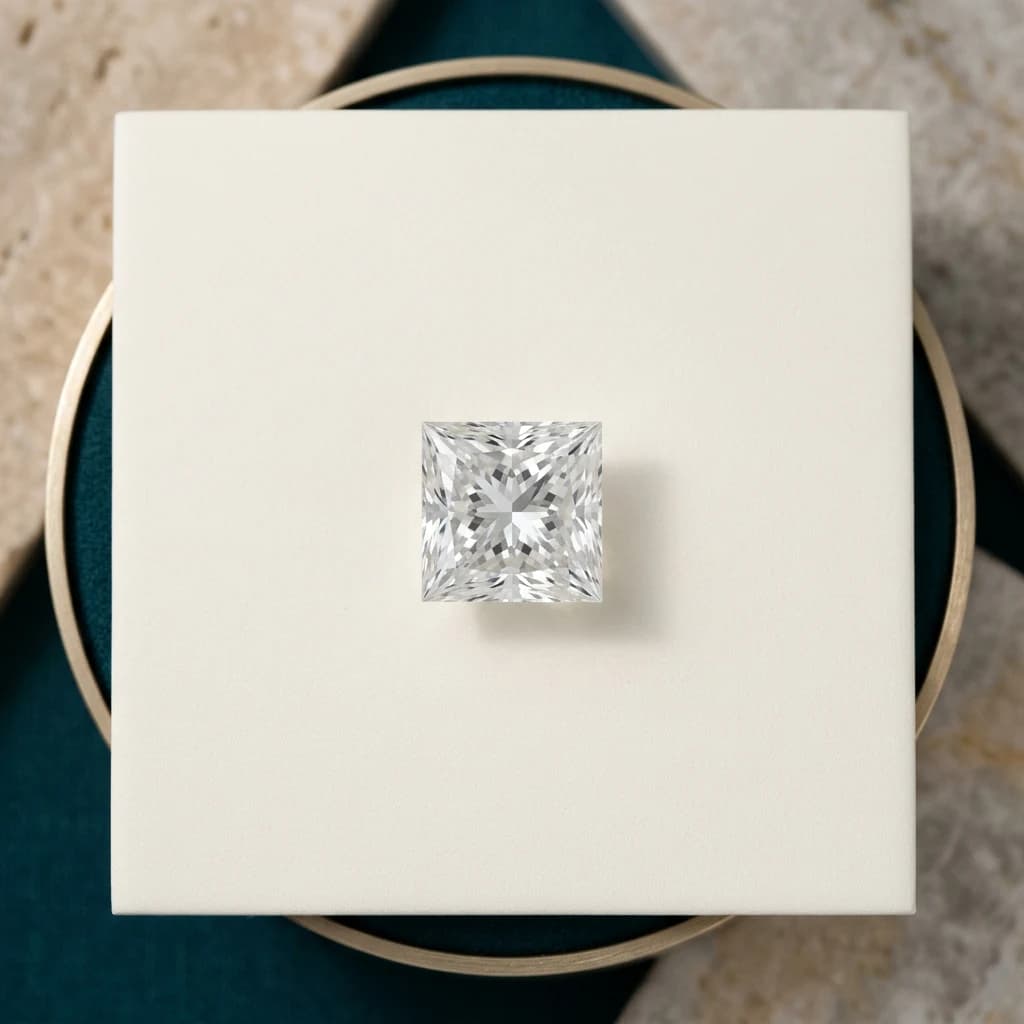
A princess cut diamond is a square or slightly rectangular diamond with brilliant-style faceting, usually described as a square modified brilliant. The outline has straight sides and four corners that are normally pointed, and a face-up ratio near 1:1 reads as a classic square. The cut first appeared in the 1960s and 1970s and grew popular as a modern, geometric alternative to the round brilliant, which remains the standard shape for comparison.
The facet pattern is built around a modified brilliant arrangement, so light breaks into many small, bright flashes rather than the broad, linear flashes of an emerald or Asscher-style step cut. Because princess cut proportions are less standardized than those of the round brilliant, two stones of the same carat can look noticeably different in brightness, contrast and apparent size. Compare the face-up outline, the light return and the millimeter measurements of each stone instead of relying on the shape name alone.
Princess cut pros and cons
The princess cut earns its popularity for practical reasons. Its brilliant-style faceting produces bright, active sparkle inside a clean square outline, which suits both contemporary and classic designs. The shape is also efficient to cut: a princess cut retains more of the rough crystal than many elongated fancy shapes, and that better yield usually makes the shape good value for its carat weight, and the same holds for laboratory-grown princess cuts. The square silhouette also pairs easily with other stones in bands and halos.
The trade-offs are structural and practical. Four sharp corners are the most exposed part of the stone, and a corner can chip if the setting does not protect it or the ring takes a hard impact. Cut grading for princess cuts is less standardized than for round brilliants, so judging light performance takes more care. Face-up size and apparent color also shift with depth, table size and facet arrangement, which means measurements matter more than the name.
- Pro: brilliant, high-energy sparkle inside a square or near-square outline.
- Pro: a clean, modern geometric look that works across engagement rings, pendants and studs.
- Pro: efficient cutting from the rough usually makes the shape good value.
- Pro: flexible in settings, from solitaire and halo to channel bands.
- Con: sharp corners are vulnerable to chipping and need deliberate protection.
- Con: cut quality is less standardized than for round brilliants, so comparisons need more care.
- Con: face-up size and apparent color shift with depth and proportions.
Best settings for princess cut diamonds
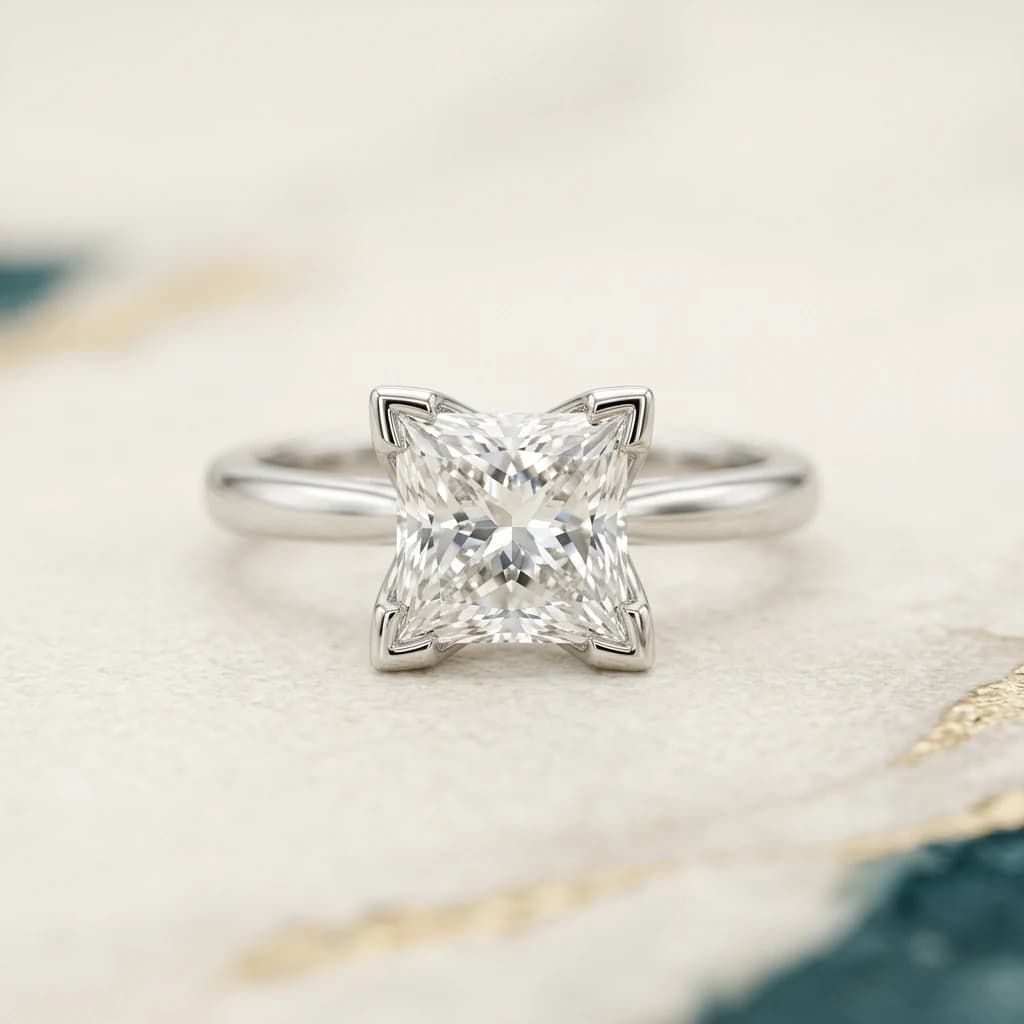
The right setting choice does double work for a princess cut: they present the square outline and protect the four corners. A four-prong corner setting places one prong over each corner, keeping the straight sides open to the eye. Solitaires often use V-prongs, which cup each corner in a V-shaped metal support, while a halo frames the stone with smaller diamonds and shields the corners as part of the design. A bezel or partial bezel offers the most complete edge coverage for a very active wearer.
The same logic applies beyond rings. Princess cut diamond earrings are most common as studs, where each stone sits in corner prongs or a light bezel and the two stones should match in outline, proportions and face-up size. In pendants and necklaces, a princess cut is usually set as a square or turned forty-five degrees into a kite orientation, so the bail and the lower corner should be checked together when the design is confirmed. Matched pairs matter more in earrings than in a single center stone.
- Four-prong corner setting: one prong over each corner, with the straight sides left open.
- V-prong solitaire: V-shaped prongs cup each corner for extra protection on a daily ring.
- Halo: a border of small diamonds frames the square and reduces corner exposure.
- Channel: princess cuts sit edge to edge, common in bands and three-stone designs.
- Bezel or partial bezel: a metal rim follows the outline for the most complete coverage.
Size, ratio and carat for princess cut rings
Carat is a measure of weight, not of visible area, and the distinction matters most in square stones. A princess cut carries a meaningful share of its weight below the girdle, so a 2 carat princess cut diamond ring will generally face up smaller than a round brilliant of the same carat weight. If visible spread is the priority, compare how carat translates to millimeters on the grading report instead of stopping at carat, and remember that a halo or a slimmer band can change perceived size without changing weight.
Ratio describes the relationship between length and width. A ratio near 1:1 reads as a classic square, while a ratio above roughly 1.05 reads as a gently rectangular shape that suits buyers who want a hint of elongation. Price is set by carat, clarity, color and the individual stone rather than by the shape name, so compare princess cuts with the same grading criteria you would apply to any diamond; the same applies to lab-grown pricing.
Princess cut vs cushion cut
Princess and cushion cuts belong to the same square family, which is why buyers compare them. The difference starts with the outline: a princess cut has straight sides and sharp corners, while a cushion cut has softly rounded corners and slightly curved sides. The princess reads as precise and architectural; the cushion reads as softer and more romantic. Both work in rings, earrings and pendants, so the outline usually decides the choice before light performance enters the conversation.
Light behavior follows the same split. The princess cut's modified-brilliant facets tend to produce crisp, geometric flashes, while cushion cuts return a softer, broader pattern with less hard edge. Neither character is objectively better: choose the princess cut for a clean, modern line and the cushion for a rounded, gentler look — both are widely used in finished engagement rings. If neither standard option resolves the choice, a custom design can fix the exact outline, ratio and setting; Belaroq custom pieces are typically completed about 30 days after the specification is confirmed.
Ilustración editorial creada para Belaroq con Gemini 3.1 Flash Image mediante APIYi.
Princess cut diamond questions, answered
Concise answers to the questions buyers ask most about princess cut diamonds.
What is a princess cut diamond?
A princess cut diamond is a square or slightly rectangular diamond with brilliant-style faceting, usually called a square modified brilliant. It has straight sides, four corners that are normally pointed, and a face-up ratio near 1:1. The cut was introduced in the 1960s and 1970s and became popular as a modern, geometric alternative to the round brilliant.
Are princess cut diamonds a good value?
Often, yes. The princess cut retains more of the rough crystal than many fancy shapes, and that efficient yield usually carries through to pricing. Value still depends on the individual stone, so compare clarity, color, proportions and millimeter measurements across the stones you are considering rather than judging the shape name alone.
Do princess cut diamonds sparkle like round diamonds?
Both use brilliant-style faceting, so a well-cut princess diamond shows bright, active sparkle. The pattern looks different: princess cuts produce a geometric, chevron-like mix of flashes instead of the round brilliant's highly standardized pattern. Because princess cut grading is less uniform, the individual stone's cut quality matters even more than with rounds.
How do you protect princess cut corners?
Choose a setting that covers all four corners: a four-prong corner setting, V-prongs, a halo, or a bezel or partial bezel. Corner coverage keeps the points from catching on surfaces and absorbing impacts. Check the prongs regularly, especially on a ring worn every day, and have the setting inspected after any hard knock.
Are princess cut diamonds good for engagement rings?
Yes. A princess cut diamond ring is a modern classic: the square outline suits solitaires, halos, channel bands and three-stone designs, and the brilliant-style faceting keeps the center bright. The important step is pairing the stone with a corner-protecting setting that matches how the ring will actually be worn.
What settings work best with a princess cut?
Four-prong corner settings and V-prong solitaires are the most common because they present the square while protecting its corners. Halos, channels and bezels also work well, each with a different visual character. Princess cut diamond earrings usually use corner prongs or light bezels, with the two stones matched in outline and face-up size.
What is the difference between princess and cushion cut?
Both belong to the square family, but a princess cut has straight sides and sharp corners, while a cushion cut has rounded corners and softer, slightly curved sides. The princess reads as precise and modern; the cushion reads as gentler, with a broader and softer light pattern. The outline is usually the deciding factor.
Do princess cut diamonds face up small?
A princess cut carries a meaningful share of its weight below the girdle, so it typically faces up smaller than a round brilliant of the same carat. Compare the stone's millimeter measurements and face-up outline, and remember that the setting, halo or band design also changes perceived size.
The practical takeaway
The princess cut is a bright, modern square that rewards careful setting choices. Pick a corner-protecting mount, compare millimeter measurements rather than carat alone, and treat proportion and cut quality as part of the value. For a princess cut diamond ring, the outline, the setting and the individual stone matter more together than the shape name does alone.