
Asscher Cut Diamond: The Complete Guide
An Asscher cut diamond is a square step cut with deeply cropped corners, giving the stone an octagonal-looking outline and a hall-of-mirrors interior. Created in 1902 by Joseph Asscher of the Amsterdam firm Royal Asscher, the cut faded after the Art Deco era before returning in the 2000s. This shape-by-shape guide explains how the Asscher cut works, why clarity matters more than usual, the best settings and earring styles, and what affects price.
Asscher cut diamonds at a glance
- A square step cut with deeply cropped corners that give the stone an octagonal-looking outline rather than a plain square.
- Created in 1902 by Joseph Asscher, the Amsterdam cutter who later cleaved the Cullinan, the largest gem diamond ever found.
- A vintage Art Deco character built on symmetry, clean lines and architectural depth rather than on brilliant sparkle.
- Open step facets and a wide table act as windows into the stone, so inclusions and body color are easier to see than in brilliant cuts.
- The classic ratio is near 1:1, although elongated Asscher cut diamonds between roughly 1.15 and 1.30 are also cut.
- Lab-grown and natural diamonds are cut into the same Asscher shape, with the same appearance and the same grading standards.
What is an Asscher cut diamond?
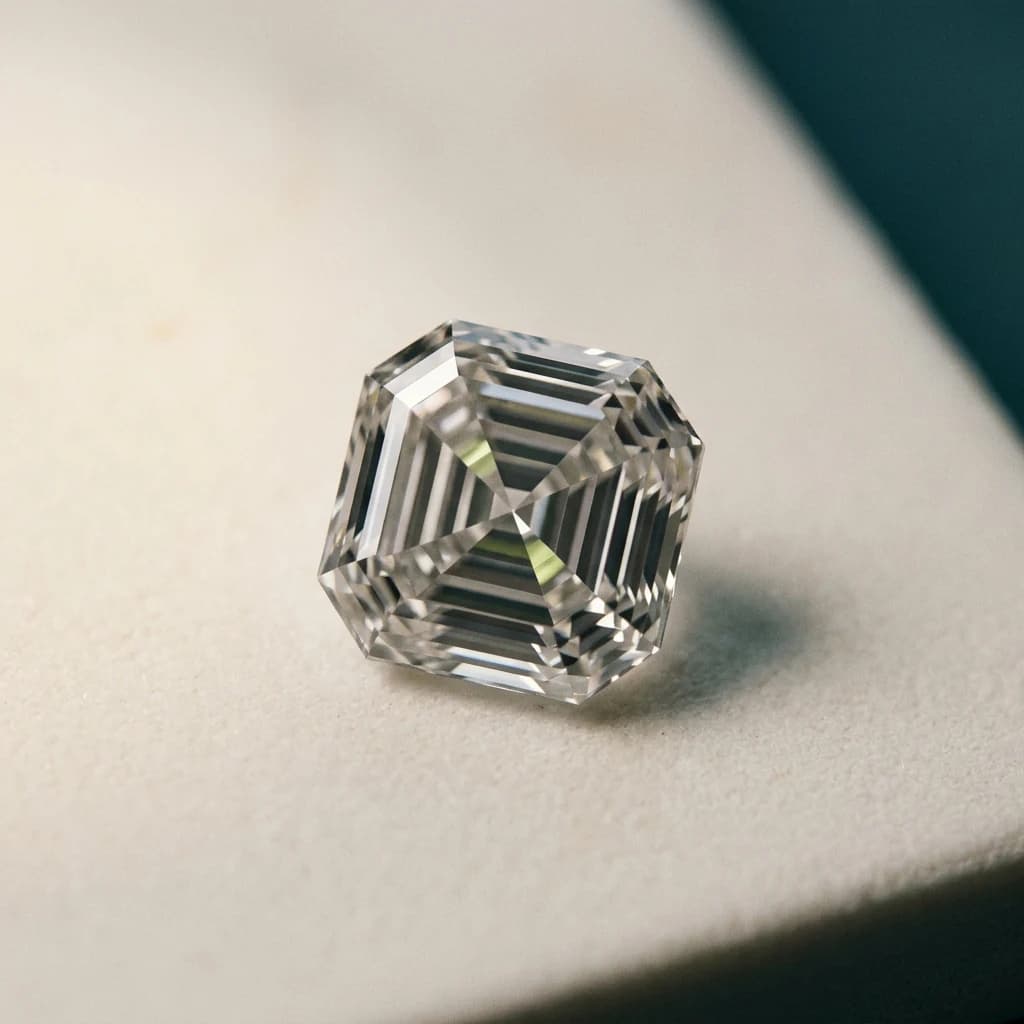
An Asscher cut diamond is a square step cut whose corners are cropped so deeply that the outline reads as octagonal. The stone is built around a large, flat table, with rows of long, parallel step facets descending from the girdle on both the crown and the pavilion. Those facets meet in straight lines, and the eye drops from level to level in a repeating pattern that collectors call the hall of mirrors. The effect is depth and architecture rather than scattered sparkle, which is why the shape has always been associated with tailored, geometric design and with the clean, symmetrical lines that Art Deco jewelry made famous. Unlike a brilliant cut, which breaks light into many small flashes, the Asscher reflects light in broad, orderly bands, and the character of the stone changes with the angle of view. It is the square relative of the emerald cut, which shares the same step facets in a more elongated outline.
The cut was created in 1902 by Joseph Asscher, whose Amsterdam firm still bears the family name; Asscher later won lasting fame for cleaving the Cullinan diamond in 1908. The original cut enjoyed a quiet following through the 1920s and 1930s before demand faded, and for decades the shape appeared mostly in vintage jewelry rather than new production. It returned in the 2000s, when Art Deco-inspired design regained popularity and the Royal Asscher company introduced a modernized version with updated facet proportions. Today both square and elongated Asscher cut diamonds are cut from natural and laboratory-grown rough alike, and the shape appears across engagement rings, earrings and pendants.
Asscher cut pros and cons
The Asscher cut appeals first through character. Its stepped interior and geometric outline evoke the architecture and jewelry of the Art Deco period, and its mirror-like depth returns broad, orderly flashes of light as the stone moves. The deeply cropped corners remove the vulnerable sharp points that some square cuts carry, which makes the stone easier to set securely and less likely to chip at a corner during wear. The overall look is sophisticated, deliberate and quieter than a brilliant cut, and that restraint is exactly what draws buyers who find round or princess stones too busy. It is a shape that reads as intentional rather than as a default, and it tends to suit buyers who already know they want a geometric, vintage-leaning stone rather than maximum light performance, a preference that carries over to laboratory-grown Asschers.
The trade-offs follow from the same design. The long, open step facets reveal inclusions and body color more readily than a brilliant facet pattern, so clarity and color choices carry more weight in an Asscher than in most other shapes. The cut returns flash rather than fire, which can disappoint buyers who specifically want rainbow sparkle, and the deep pavilion holds weight beneath the girdle, so an Asscher can look smaller face-up than another square cut of the same carat weight. Finally, fewer well-cut Asscher diamonds are produced than princess or cushion cuts, which makes good stones harder to find and worth comparing patiently before buying. Buyers who understand these limits usually choose an Asscher for the design itself rather than for maximum light return, which keeps expectations aligned with the shape's strengths.
- Pros: vintage Art Deco character built on symmetry, clean lines and architectural depth rather than sparkle.
- Pros: the hall-of-mirrors interior returns broad, orderly flashes of light as the stone moves through any angle.
- Pros: deeply cropped corners are less vulnerable to chipping than the sharp points of a princess cut.
- Pros: a distinctive, recognizable outline that stands apart from round, cushion and princess cuts.
- Cons: open step facets and a wide table reveal inclusions and body color more easily than brilliant cuts do.
- Cons: limited fire, so buyers who want rainbow sparkle may prefer a radiant, round or cushion stone instead.
- Cons: the deep pavilion can make the stone look smaller face-up than its carat weight would suggest.
- Cons: fewer well-cut Asscher diamonds are produced, so the available selection is smaller than for princess cuts.
Why clarity matters for Asscher cuts
Step cuts are more revealing than brilliant cuts, and the Asscher cut is the clearest example. The stone is built from long, flat facets that lie open like panes of glass, and a wide table looks straight down into the pavilion. Light passes through in broad, unhurried bands, so anything inside the stone, a crystal, a feather, a cloud, is easier to catch at normal viewing distance than it would be inside a round brilliant. The same principle applies to the emerald cut, which shares the same open facet design, and it explains why both shapes are traditionally bought at higher clarity grades than brilliant-cut stones. A stone that would pass unnoticed as a princess cut can reveal its characteristics when cut as an Asscher. As a rule of thumb, step cuts are often shopped a grade or two higher on the clarity ladder than brilliant cuts at the same budget.
Practical guidance is grade by grade. VVS and higher grades are virtually always clean to the unaided eye, while VS stones are typically eye-clean in Asscher cuts and represent the common balanced choice; Belaroq's catalog prices VVS variants at 30% above the same design's VS price as a July 2026 snapshot. SI stones can still look clean, but they should be inspected one by one, because the open facets make any visible characteristic more noticeable than it would be elsewhere. Color also shows more readily in step cuts, since there is less sparkle to mask body tint, so near-colorless grades are popular choices for Asscher stones, especially in white metal settings.
Best settings, earrings and ratios
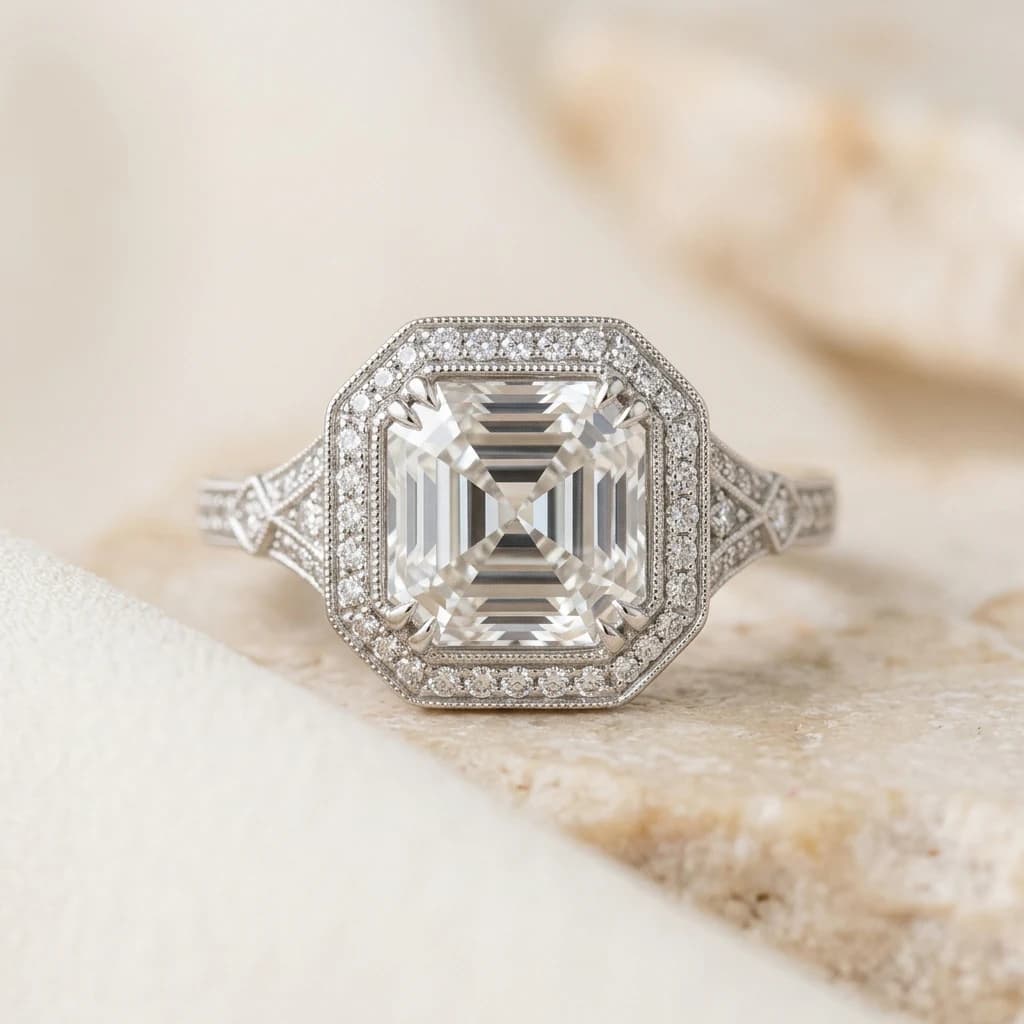
The Asscher cut carries setting designs that repeat its geometry. A four-prong solitaire lets the octagonal outline stand alone, while a three-stone ring pairs the center with trapezoid or baguette side stones whose step facets echo its own. A halo setting mirrors the square-with-cut-corners outline in smaller stones and adds face-up presence without changing the center, and an east-west setting turns the stone ninety degrees for a horizontal line across the finger. Each approach is widely available for an Asscher cut diamond ring, and prongs on the cropped corners protect the stone without interrupting its outline. Bezel and half-bezel settings offer still more protection for buyers who plan daily, hands-on wear. Yellow and rose gold soften the outline, while platinum and white gold reinforce its crisp, architectural feel.
For earrings, Asscher cut diamond earrings are usually offered as Asscher stud earrings, where the square outline and mirror depth read cleanly at ear height, or as drop and pendant styles that let the stone move and catch the light with each turn. Buyers choosing a loose stone should decide on ratio early. The classic Asscher cut is cut near 1:1, while an elongated Asscher cut diamond runs roughly 1.15 to 1.30 and stretches the finger or the ear line more. The elongated style blurs the boundary between Asscher and emerald cut, so comparing both shapes side by side is worthwhile before committing to a ratio. The ratio also changes how the hall-of-mirrors effect reads, since longer stones show longer mirror bands.
Price and value
Asscher cut diamond prices follow the same forces as other shapes: carat weight, color, clarity and the quality of the cutting itself, with market demand and the yield of finished stones from rough setting the level. Because fewer Asscher cuts are produced than princess cuts, and because the shape's deep pavilion uses more rough for each face-up millimeter, an Asscher can carry a higher price per carat than a princess of comparable grade. Rather than quote figures that change with the market, Belaroq publishes the current price on every product page, where the exact stone and setting are specified, and treats that listing as the only number that matters. Cut quality is the quiet variable: two stones with the same grades can differ in how crisply their corners are cut and how evenly their steps align. The same variables drive lab-grown prices, which sit lower but move for the same reasons.
The same shape is available in laboratory-grown diamond form, where the quality scale applies identically at a more accessible price, and complete Asscher pieces exist at entry budgets. Belaroq's jewelry-under-500 collection includes finished lab-grown diamond pieces at or below US$500, an anchor that can be verified against the catalog at any time. Buyers who cannot find the exact Asscher cut diamond ring they want can commission one instead, since the Belaroq custom jewelry process takes around 30 days from design approval to delivery. In this shape, value comes from clarity and cut quality rather than from chasing the largest carat number, because a poorly cut Asscher loses the depth that justifies the shape.
Ilustración editorial creada para Belaroq con Gemini 3.1 Flash Image mediante APIYi.
Asscher cut diamond questions, answered
Concise answers to the questions buyers ask most about Asscher cut diamonds.
What is an Asscher cut diamond?
A square step cut diamond with deeply cropped corners, created in 1902 by Joseph Asscher of Amsterdam. The outline reads as octagonal, and rows of long step facets below a wide table create the hall-of-mirrors depth the shape is known for. The deep corner cuts are a defining feature, since they turn a plain square into an eight-sided outline.
Are Asscher cut diamonds more expensive?
Per carat, an Asscher cut can cost more than a princess or cushion cut of comparable grade, because fewer Asscher cuts are produced and the deep pavilion uses more rough per face-up millimeter. Demand and cutting quality move prices as well, so check current product listings rather than relying on fixed comparisons.
Is clarity more important for Asscher cut diamonds?
Yes. The long, open step facets and wide table act as windows into the stone, so inclusions are easier to see than in brilliant cuts. VS and higher grades are the common choices, with VS typically eye-clean in an Asscher. SI stones can still work but should be inspected individually before buying.
Are Asscher cut diamonds popular?
Yes, as a distinctive alternative rather than a mainstream shape. Asscher cut diamond rings grew steadily after the shape's early-2000s revival, led by Art Deco-inspired designs and halo settings. The cut holds a steady niche among square shapes, smaller than princess or cushion demand but durable and loyal.
Why is it called an Asscher cut?
It is named for Joseph Asscher, the Dutch diamond cutter who designed the shape in 1902 at the Royal Asscher Diamond Company in Amsterdam. The same cutter later cleaved the Cullinan diamond in 1908, one of the most famous cutting feats in history. The family firm still produces modern versions of the cut.
What is the difference between Asscher and emerald cut?
Both are step cuts with trimmed corners, but the Asscher is square with deeply cropped corners and an octagonal-looking outline, while the emerald cut is usually rectangular with shallower corner cuts. The Asscher's near 1:1 ratio and high crown give it a more compact, architectural character than the elongated emerald. Longer Asschers cross into emerald territory, so ratio is the practical dividing line.
Do Asscher diamonds sparkle?
They flash rather than sparkle. The wide, flat step facets return broad, mirror-like bands of light instead of the many small flashes of a brilliant cut, so rainbow fire is limited. Buyers choose an Asscher for its calm, architectural light play and its depth, not for brilliant-style sparkle.
What settings work best with Asscher cuts?
Solitaire, halo, three-stone and east-west settings all work well, and prongs on the cropped corners protect the stone without hiding its outline. For earrings, Asscher studs are the classic choice, with drop styles for movement. A halo adds face-up presence and echoes the shape's geometry without changing the center.
The practical takeaway
An Asscher cut diamond rewards buyers who value architecture over sparkle. The square step cut with its deep cropped corners offers a distinctive Art Deco character that no brilliant cut can imitate, but its open facets demand more attention to clarity and color than most shapes. Decide on ratio early, choosing a near 1:1 stone for classic lines or an elongated stone for a more modern look, confirm the setting protects the cropped corners on the engagement designs you are considering, and judge the actual stone's depth in person before buying.